Many quake deaths may have been avoidable, report says, faulting Venezuela's response
Published in News & Features
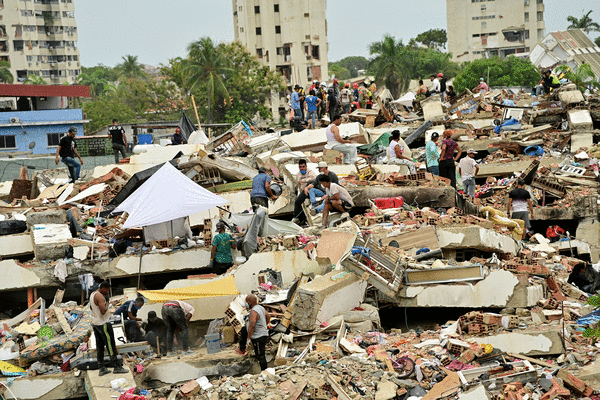
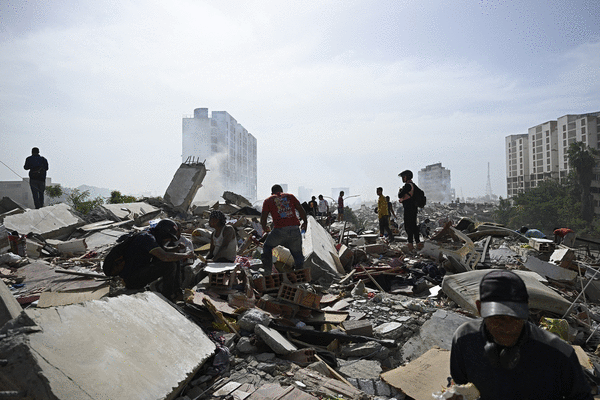
Many of the more than 5,000 people killed in Venezuela’s devastating twin earthquakes might have survived had authorities mounted a professional emergency response during the critical first 72 hours after the disaster, according to a new report that sharply criticizes the government’s handling of the crisis.
Released Thursday, exactly one month after the June 24 earthquakes struck Venezuela’s northern coast, the report argues that years of neglected emergency preparedness, the militarization of disaster response and the deterioration of the country’s civil protection system transformed a natural disaster into a far deadlier humanitarian catastrophe.
The report, prepared by the Washington-based advocacy group Miranda Center for Democracy, comes as authorities announced late Wednesday that the official death toll had climbed to 5,398, with 16,740 injured, 6,462 people rescued, 17,907 left homeless and 23,335 still living in 107 temporary camps. Officials also said the earthquakes destroyed 190 buildings and severely damaged 856 others.
Government officials have repeatedly rejected suggestions that the emergency response was delayed or poorly coordinated. During a July 3 news conference, interim President Delcy Rodríguez said authorities mobilized immediately after the earthquakes and dismissed claims that crucial time had been lost.
“It was a natural tragedy on a scale we never imagined,” Rodríguez said. “We did not wait one day, two days, or three days. We activated immediately.” She also defended the government’s casualty reporting, saying officials would not speculate about the number of victims and were releasing only “rigorously verified” figures.
The Miranda Center’s 17-page After Action Review concludes that emergency operations were placed under military leadership rather than disaster-management professionals, leaving the critical rescue effort largely in the hands of relatives, volunteers and international search-and-rescue teams. It also argues that authorities understated the scale of the disaster, pointing to independent estimates suggesting fatalities and structural damage may have been substantially higher than official figures.
The review says its findings are based on interviews with Venezuelan civil protection and disaster-management experts, including responders to the 1999 massive flooding in Vargas, testimony from volunteers who entered the disaster zone beginning June 25, and open-source verification using United Nations data, NASA and U.S. Geological Survey assessments, international media reports and studies by transparency organizations. It says factual claims were included only when corroborated by at least one independent secondary source.
The critical first 72 hours
At the center of the report is its conclusion that the government’s greatest failure came during the three days immediately following the earthquakes, when the chances of finding survivors trapped beneath collapsed buildings were highest.
According to the review, emergency authorities failed to activate standardized disaster protocols that should have classified the emergency, coordinated search-and-rescue operations and rapidly assessed damage in order to direct domestic and international resources where they were needed most. Instead, it says, emergency operations were directed by military officers without specialized disaster-management training, resulting in confusion, poor coordination and delays that reduced the chances of saving lives.
Rodríguez has disputed that characterization. While acknowledging in a July 2 statement that the first people to begin searching collapsed buildings were “survivors of the collapse itself, relatives and neighbors,” she described that as the natural sequence of events following any major disaster rather than evidence of a failed state response.
The report reaches a different conclusion, arguing that the critical 72-hour window passed “without a coordinated state-led operation,” forcing survivors to depend largely on relatives, neighbors and international rescue teams during the period when trapped victims were most likely to be found alive.
Emergency system stretched to its limits
The organization argues those shortcomings were not the product of a single failed response but the culmination of years of institutional deterioration.
According to the review, Venezuela’s civil protection agencies had been operating for years with severe personnel shortages, inadequate funding and outdated equipment after decades of politicization and militarization. It says trained professionals were increasingly replaced by political appointees or military officers, while emergency budgets were diverted away from equipment, maintenance and technical training.
The report cites previous assessments indicating some civil protection units had been functioning at 10% or less of their operational capacity before the earthquakes, with shortages ranging from ambulances and rescue equipment to basic protective gear such as boots and uniforms. It also says emergency workers who publicly demanded better conditions were, in some cases, detained by military intelligence and security agencies.
Those institutional weaknesses, the report argues, became evident almost immediately after the earthquakes struck.
Search-and-rescue efforts, it says, were carried out primarily by residents, volunteer firefighters and international teams rather than by the national government. Venezuelan rescuers often relied on sledgehammers, pickaxes and shovels because hydraulic rescue equipment and heavy machinery were unavailable.
“We don’t have the tools, we don’t have the technique, we don’t have the technology,” one civil protection rescuer quoted in the report said. “We’re stuck in the Stone Age.”
The review also claims that civil society assumed many functions normally performed by the government.
It says volunteers created the country’s first missing-persons registry after authorities failed to establish one during the first five days following the disaster. Grassroots organizations also coordinated humanitarian aid, identified people trapped beneath collapsed buildings and directed international rescue teams using information collected through WhatsApp groups and social media.
The report credits the international response with preventing an even greater catastrophe, saying more than 60 international urban search-and-rescue teams and over 2,400 first responders from 29 countries participated in rescue and relief efforts coordinated through the United Nations.
Conflicting accounts
Beyond criticizing the emergency response, the report challenges the government’s accounting of the disaster.
Although officials have reported 5,398 deaths, the review points to U.S. Geological Survey modeling that it says indicates a greater than 70% probability the final death toll exceeded 10,000. It also cites humanitarian estimates that roughly 50,000 people were missing during the early days of the crisis and NASA analyses estimating that nearly 59,000 buildings were damaged or destroyed, figures substantially above official assessments.
Rodríguez has rejected suggestions that authorities understated the disaster, saying the government releases only casualty figures that have been fully verified and would not speculate about the final toll.
The report also cites U.N. estimates placing reconstruction costs at $37 billion, making the earthquakes one of the costliest disasters in Venezuelan history.
Among its most serious allegations, the report says authorities obstructed rescue operations and humanitarian assistance during the first days after the disaster.
It claims that beginning June 26, access to the hardest-hit areas of La Guaira was restricted through a QR-code credential system that delayed volunteers, firefighters and humanitarian convoys. It also says that some international rescue teams were held at airports awaiting authorization to deploy, while journalists and non-governmental organizations faced restrictions on access to disaster areas.
The review claims that security personnel looted belongings from damaged buildings, morgue workers demanded payments from grieving families before releasing bodies and officials redirected privately collected humanitarian aid through ruling-party structures. It attributes those allegations to witness testimony and previously published investigations.
Long road to recovery
The organization also argues that the disaster exposed long-standing structural weaknesses dating back decades. It compares the government’s handling of the earthquakes with the response to the 1999 Vargas flooding tragedy, arguing that although Venezuela later established what experts once considered a modern disaster-risk management framework, years of political interference and declining investment eroded the country’s ability to respond effectively to a catastrophe of this magnitude.
The report is also critical of the government’s flagship “Gran Misión Vivienda Venezuela” housing program, arguing that thousands of units were built on geologically unstable terrain without adequate independent oversight of seismic safety. Rodríguez has disputed broader criticism of public construction standards, saying approximately 80% of the buildings that collapsed in the hardest-hit areas were privately developed.
The Miranda Center concludes that rebuilding Venezuela will require more than reconstructing damaged homes and infrastructure. Unless the institutional weaknesses exposed by the earthquakes are addressed, the report argues, the country will remain vulnerable when the next major disaster strikes. It says a more comprehensive after-action review, including recommendations for emergency preparedness and reconstruction, will be published in a future report.
©2026 Miami Herald. Visit at miamiherald.com. Distributed by Tribune Content Agency, LLC.





Comments