Trump says Saudi nuclear deal subject to forming Israel ties
Published in News & Features
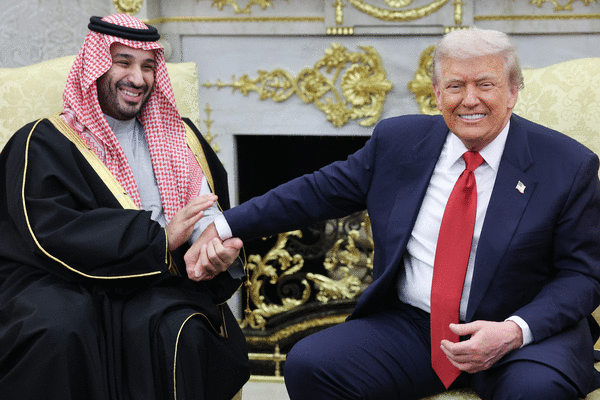
U.S. President Donald Trump said a new civil nuclear agreement with Saudi Arabia depends on the kingdom normalizing ties with Israel, throwing cold water on a landmark deal his administration finalized just a day earlier.
In a social media post Thursday, Trump also said there would be “no enrichment” of nuclear material. The pact would allow American companies to expand nuclear energy development in a long-coveted market, but it also raised concerns about a lack of guardrails that would prevent Riyadh from enriching uranium to weapons-grade.
Trump said that the agreement “will be approved, but is totally subject to Saudi Arabia joining the very respected and successful Abraham Accords,” referring to his initiative to get Arab countries to formally recognize Israel.
“The United States is not opposed to Civil (Non-Enriched) Nuclear Facilities,” the president added.
Trump’s surprising demand shortly after announcing the deal throws a wrench into the implementation of the agreement. Saudi Arabia has said it will not normalize ties until Israel accepts Palestinian statehood, something the Israeli government has ruled out.
The full text of the agreement between the Saudis and the U.S. has not been made public, and a U.S. Energy Department statement released Wednesday when the pact was finalized made no mention of Israel or the Abraham Accords.
Saudi Arabia hasn’t commented on Trump’s post.
Trump has increased pressure on the kingdom and other countries in the region to join the Abraham Accords. Saudi Arabia is the biggest Arab power in the Middle East and Trump has long desired its participation in order to strengthen the pact and bolster Israel’s long-term security in the region.
“Saudi Arabia’s joining of the Abraham Accords would be an historic leap forward for peace in the Middle East,” Israeli Prime Minister Benjamin Netanyahu’s office said in a statement Thursday.
The prospect of Israel agreeing to Palestinian statehood in the near future is remote, given renewed hostilities in the Middle East following Hamas’s attack on Israel and the subsequent war in Gaza.
The president’s new condition also mirrors the stance of his predecessor, former President Joe Biden, who also sought to link the provision of nuclear technology to the Saudis with normalizing relations with Israel and Israeli concessions to the Palestinians.
The Oct. 7, 2023 Hamas attack on Israel and Israel’s subsequent war against the Iran-backed group halted that peacemaking initiative, with Gulf Arab states frequently decrying the violence and death toll in Gaza.
Despite its past misgivings, Israel voiced cautious understanding of Trump’s nuclear accord. Eli Cohen, the Israeli energy minister, said Riyadh might otherwise have sought civilian nuclear capabilities from China, which would have made monitoring them harder. He said Israel’s focus is the potential for future uranium enrichment on Saudi soil.
“It’s our job to worry and to be in dialogue with the Americans,” he told Tel Aviv radio station 103 FM. “On the issue of enrichment: Will it happen? Under what conditions will it happen? Who will have oversight?”
A key part of the Saudi nuclear agreement, likely worth tens of billions of dollars, allows American companies to build a uranium enrichment facility in Saudi Arabia if a study — conducted jointly by the U.S. and the Saudis — determines the move is necessary, according to the Wall Street Journal, which earlier reported on the matter.
The agreement is set to be submitted to Congress, which would need to muster a veto-proof majority to block the measure.
The timing of the accord’s finalization was surprising, given the U.S. is engaged in an active military conflict with Iran designed to destroy Tehran’s nuclear program and prevent the Islamic Republic from acquiring an atomic weapon. Allowing the Saudis to proceed with its own civilian nuclear program alarmed nonproliferation experts worried that it could spark an arms race in the Middle East.
—With assistance from Ari Natter, Dan Williams and Iain Marlow.
©2026 Bloomberg L.P. Visit bloomberg.com. Distributed by Tribune Content Agency, LLC.






Comments