These 'insta-reefs' could be the future of hurricane protection for Miami's coast
Published in News & Features
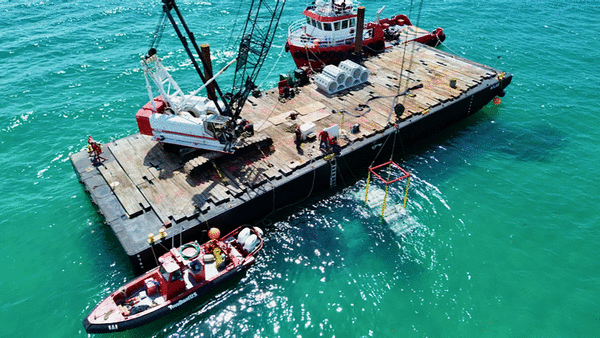
MIAMI — When hurricanes come ashore in Miami, their waves take big bites out of the coastline, chewing up sand and waterfront properties alike. A chunk of concrete sunk offshore in Miami Beach could change that.
The University of Miami recently installed the second phase of its hybrid reef project — an engineered piece of concrete seeded with hearty corals designed to withstand the steaming, shallow seas of South Florida — after years of research, some funded by the U.S. military.
The researchers say they already have promising results from phase one, placed in 2023 offshore of Miami Beach, and they have big hopes for what’s next.
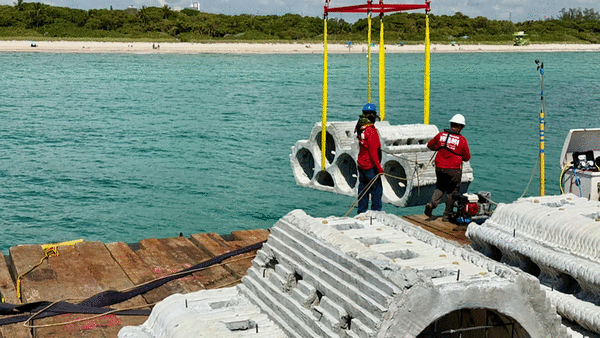
In the most recent phase, scientists dropped three “SEAHIVE” structures into the water near 81st Street in Miami Beach. Each structure looks like a bunch of rigatoni noodles stuck together with holes poked into them, and they're specially designed to help break down waves by allowing a calculated amount of water to flow in and out.
Lab results showed these structures could cut the energy from incoming waves dramatically — by up to 98%, said Landolf Rhode-Barbarigos, an associate professor at the University of Miami College of Engineering who spearheaded the invention of SEAHIVE in 2018. That’s key when it comes to protecting coastal South Florida from 20-foot waves from a future storm.
“We showed that this was feasible. To do this on a large scale, you need a large installation,” he said.
At 7 meters long each, the recently placed structures aren’t substantial enough to actually break a big wave to protect the coast. And they’re too far away, placed 750 meters from the sand. At that size and distance, they’re more like minor speed bumps.
That’s why the next phase will be much longer (a 100-meter-long deployment) and much, much closer — inside the swim zone in Miami Beach, around 200 meters from the shore. The project is already being permitted and planned, said Andrew Baker, a professor in the Department of Marine Biology and Ecology and director of the Coral Reef Futures Lab at the Rosenstiel School.
“We want these structures to be as close to shore as we can reasonably get them and close to the water’s surface as we can go because that’s what’s going to really break the waves,” he said.
Coral cover
South Florida’s nearshore area is no stranger to sunken things covered in marine life, like Neptune Memorial Reef, the Reefline or any number of scuttled boats or artificial reefs. What sets the UM project apart, besides the SEAHIVE structure, is the corals on top of it. Those other structures are covered in soft, bendy corals, sponges, marine plants and algae. They’re pretty for snorkelers and divers and form great habitats for fish and marine life, but they don’t exactly break down wave energy.
SEAHIVE uses hard corals, the kind that are proven to slow down waves. Lab testing shows the SEAHIVE structures are even more effective at breaking waves when corals are growing on the exterior, and as the corals grow, the structure will provide even more protection.
Baker and his team placed a bevy of hard corals on the structure, including corals implanted with a more heat-resistant algal symbiote (the tiny critters that live inside the coral animal and provide it shade and food). They also planted something unusual — a hybrid between the two most endangered species in the wild, Elkhorn and Staghorn corals. Both species are considered “functionally extinct” in the region due primarily to climate change-induced marine heat waves.
These hybrid corals, also called fused acropora, combine the best features of their parents. They grow fast like Staghorns and thick and robust like Elkhorns, Baker said. And, since they’re not technically either of their federally endangered parents, they fall through the crack when it comes to the extensive permitting needed to plant new ones on a reef. The state of Florida requires permits to plant corals if they’re endangered, part of the state’s responsibility to protect the heavily endangered species.
“Only two or three different individuals (fused acropora) in Florida have been found naturally on the reef,” Baker said. So his team grew a thousand of them using some of the military funding for this project.
For both phases of this project, Baker’s team wanted to ensure the baby corals they planted stay put, so they placed a net over the area and released the coral larvae inside, where they were forced to make a home on the structures. It worked.
“The rates of survival of these larvae were greater than what we see on a natural reef,” he said. “It matches what we see for lab grown that we plant.”
That’s good news, because South Florida needs reefs for protection — stat.
The region is at risk of stronger, wetter storms due to climate change, the same force that’s cranking the thermostat on the marine environment and cooking the weaker corals. “Insta-reefs” like these, Baker said, can help plug some of the holes in Miami’s coastal armor faster.
“While restoration tries to maintain those structures and make sure we don’t lose what we have, there are sections of the coast like Miami Beach where we don’t have reefs,” he said. “We can use active coral restoration to fill in those gaps.”
Better, faster, stronger
The latest iterations of the project were also 3D printed, a move that’s expected to both speed up development and drastically cut costs. The printers use a special type of marine concrete that allows corals to attach themselves more easily.
“With that, we started really pushing the limits of what can be done,” said Adam Friedman, co-founder of 3D printing company 1print, which made the structures. “The beauty of 3D printing is you can be a mobile factory.”
Friedman and his firm are locking in on grants that will allow them to install wave measuring sensors on the devices so they can find out exactly how much impact the structures have on the nearby surf.
With that kind of data, UM can persuade clients like the U.S. Army Corps of Engineers to install their product, instead of or in addition to the conventional sea walls and river gates the Corps uses.
But even without it, Rhode-Barbarigos said the team is fielding international interest in the SEAHIVE. So far they have one other version installed in North Florida, another upcoming in Jupiter and interest from the Florida Department of Transportation as well as a project in Italy.
“As we have success stories, people are going to copy us. I think this is a great case and a great way for us to show that Miami is going to lead on coastal resilience,” he said.
©2026 Miami Herald. Visit miamiherald.com. Distributed by Tribune Content Agency, LLC.






Comments