New Fort Lauderdale plant will turn yellow drinking water clear. But experts say old pipes may discolor it again
Published in News & Features
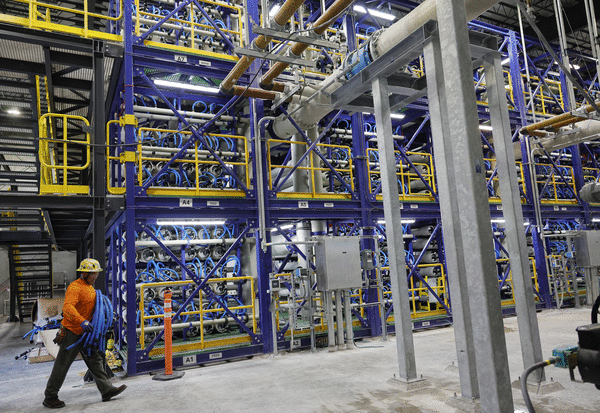
FORT LAUDERDALE, Fla. — Fort Lauderdale officials say all that yellow water flowing from the tap will disappear when the city’s pricey new water plant is fully operational later this year.
That claim is being met with deep-seated skepticism from experts who say the city’s network of old, unlined cast-iron pipes that snake underneath Fort Lauderdale streets might just discolor the water again.
Fort Lauderdale’s new $666 million treatment plant will indeed produce clear water when it fully takes over operations from Fiveash, the old water plant that’s unable to remove the yellow tint. But to reach customers, some of that clear water produced by Prospect Lake Clean Water Center will travel through old pipes that could bring back the yellow or even give it a brown hue, say experts interviewed by the South Florida Sun Sentinel.
Fort Lauderdale officials brushed off those claims.
The water might be a bit discolored at first, but will turn clear in a matter of weeks as naturally occurring mineral deposits inside the older water mains adjust to the new water chemistry, said city spokesman Kevin Pulido.
“The new treatment plant will produce high-quality drinking water that continues to meet all regulatory standards,” Pulido said. “During the transition, this temporary disturbance may cause brief discoloration in some areas. While the color may change, it does not affect the safety or quality of the drinking water, which will continue to meet all state and federal standards.”
The Prospect Lake plant will use advanced nanofiltration and ion-exchange technologies that can strip out the tannins that give the water from the current treatment facility its yellow tint. Tannins are natural organic compounds that are harmless to consume but can turn water an off-putting yellow.
Just like the old water plant, the new plant will deliver drinking water to customers in Fort Lauderdale, Wilton Manors, Oakland Park, Tamarac, Davie, Lauderdale-by-the-Sea, Sea Ranch Lakes and Port Everglades.
The new plant is expected to open in mid-September but will operate in conjunction with Fiveash as part of a 30-day phased transition. At the end of that transition, the water should turn clear when the new plant is operating on its own, Pulido said.
The Sun Sentinel spoke to five industry experts to get their take on the city’s assertion that the new plant will cure the yellow water problem that has plagued the city for decades.
One, retired city engineer Peter Partington, suggested the water chemistry could be tweaked to make up for the old pipes. The other four had serious doubts the water would stay crystal clear after traveling through aging unlined pipes.
“You’re going to take some of the cleanest water in the world and put it into pipes that are going to make it yellow again,” said Bob Bowcock, a California-based water quality expert. “You’re going to end up with red water or brown water. It will eventually equalize. But it’s going to be a couple years.”
When new, treated water travels through aging iron pipes, it can stir up built-up sediment and create rusty, brown or yellow tap water, said Bowcock, a former water utility manager who routinely provides expert witness testimony to both state and federal courts.
‘Nasty, stinky, brown water’
Three years ago, Bowcock warned city officials that water from the new treatment plant wouldn’t be so crystal clear once it goes through the city’s old pipes.
“Your consumers are going to expect pure water coming out of their tap,” he said at the time. “What you’re going to get is pure water running through old pipes and they’re going to get nasty, stinky, brown water after spending $666 million. They are not going to be happy.”
Bowcock came to Fort Lauderdale at the invitation of Boyd Corbin, a local water quality watchdog who has complained frequently about the city’s aging pipes and treatment methods.
During Bowcock’s visit, he urged Fort Lauderdale to replace its vintage water pipes instead of building a new treatment plant.
With consultants warning that Fiveash was on the verge of calamitous failure, city commissioners opted to move forward with the water plant.
As for the aging water pipes, Mayor Dean Trantalis noted those would take years to replace.
“We can’t replace those overnight,” he said at the time.
Unlined cast-iron pipes are not unique to Fort Lauderdale. Such pipes are common throughout the nation’s aging infrastructure.
Here’s one reason there’s a push to replace them: Rust-like deposits tend to form inside the walls of unlined steel and cast-iron pipes, an internal corrosion process known as tuberculation. The buildup narrows the pipe’s interior, restricts water flow, lowers water pressure and can sometimes change the color of the water coming out of the pipe.
Raj Verma, a civil engineer who served as Fort Lauderdale’s public works director six years ago, predicted the water may never turn clear until the old pipes are replaced.
“The water may eventually come out clear or it might not happen until they replace the pipes,” Verma told the Sun Sentinel. “Unless they have replaced the entire distribution system, the water is going to be going through some rusty pipes. Maybe the pipes have been replaced in neighborhoods 1, 2 and 3 and things will be fine. But if the pipes have not been replaced in neighborhoods 4, 5 and 6, there’s no guarantee the water will come out crystal clear.”
The potential problems were raised years ago as the city came under mounting pressure to replace its aging water plant and vintage pipes, Verma said.
“They are fixing one aspect of the system but not the other,” he said.
Even yellow water safe to drink
No matter the color, Fort Lauderdale water is safe to drink, city officials say. And they have the water quality tests to prove it.
An estimated 100,000 tests are performed every year on Fort Lauderdale drinking water in state-certified laboratories, city officials say. The tests include daily bacterial and chemical tests on finished water, weekly bacteriological tests of water in the distribution system, monthly and quarterly testing of water supply wells, and annual tests of all regulated drinking water contaminants.
The mayor was exasperated that anyone would question Fort Lauderdale’s “heroic effort” to improve the city’s water infrastructure.
“We’re damned if we do and we’re damned if we don’t,” Trantalis said.
He chalked up the concern over water color to skeptics hypothesizing about a worst-case scenario.
“Everyone is speculating,” Trantalis said. “We’ll have to see what happens when we turn on the tap. Nobody knows what’s in the older pipes. It’s mere speculation as to what we will encounter. At least we know that cleaner, clear water is being pushed through the pipes.”
But if the skeptics turn out to be right, the city will address it should any issues arise, the mayor told the Sun Sentinel.
One of the skeptics is Ralph Zeltman, a retired county engineer who lives in Fort Lauderdale and sits on the city’s Infrastructure Advisory Board.
“Once the new water is exposed to a rusty pipe, it can’t stay clear,” Zeltman said. “It’s just the nature of the beast. They still have a lot of old cast-iron pipes underground.”
But just how many remains a mystery, Zeltman said.
Fort Lauderdale’s massive underground network includes more than 770 miles of water mains ranging from 2 to 54 inches in diameter.
But to this day, no one can say how many old cast-iron pipes remain in Fort Lauderdale’s sprawling grid of underground water pipes.
In 2023, the Sun Sentinel asked the city how many old water pipes need replacing, but was told no one could say without doing extensive research.
Three years later, the city still can’t say.
But Fort Lauderdale is now under orders from the state to map all of its underground water pipes and control valves.
The consent order compelling Fort Lauderdale to upgrade its aging water infrastructure was issued by the state’s Department of Environmental Protection.
The state’s order followed a series of pipe breaks between 2023 and 2025 that required emergency repairs and resulted in a slew of boil-water orders. The state agency determined that parts of the system were not being maintained and required rehabilitation or replacement.
Work is expected to begin this fall.
Under the consent order, all corrective actions must be completed within three years.
Violations of the consent order and its timelines may result in penalties of up to $15,000 per day per violation along with criminal penalties.
High cost of new pipes
The city’s older pipes, made of iron, steel, concrete and clay, are more susceptible to corrosion than modern-day PVC pipes, experts say.
Replacing those old water pipes isn’t something that can be done quickly — or cheaply.
In 2017, experts predicted it would take 20 years to replace and repair the city’s old water and sewer pipes and cost an estimated $1.4 billion. The city is currently working on updating those numbers.
The city can count on one thing: That cost has likely gone way up.
“Probably doubled,” said Fred Bloetscher, a civil engineering professor at Florida Atlantic University. “Construction prices in South Florida have gone absolutely crazy. It’s $2.5 billion at least. As for the time it will take, the question is how much work they have done. If the answer is none, it would be another 20 years from now before it gets done.”
Between 2023 and 2028, Fort Lauderdale expects to spend $54 million replacing water pipes. So far, the city has spent $12.2 million, Pulido said.
Zeltman said old pipes can lead to a drop in water pressure and decreased water flow, making it harder to fight fires. And that, he added, is just one more reason to replace them.
“The diameter of these old rusting pipes narrows and increases the friction over time, which restricts water flows and pressures needed to effectively fight fires,” Zeltman said.
City officials were intent on making it abundantly clear that rust is not making its way into Fort Lauderdale’s drinking water.
Naturally occurring mineral deposits can develop on the interior of some older cast-iron water mains, but those deposits are not freely mixing with the drinking water, Pulido said.
To manage the buildup of mineral scale on the pipe wall, utilities use corrosion-control treatment and water chemistry to help maintain stable protective mineral layers inside the pipe.
During the transition to the new treatment process, the city will carefully manage the water chemistry to preserve that protective layer while minimizing temporary color changes, Pulido said.
“When the chemically treated water goes through those pipes, it can pick up some of those minerals,” Pulido said. “And that’s why there may be some discolored water. But we can adjust for that. We can adjust the water chemistry to help maintain those mineral layers inside the pipe. There’s corrosion-control treatments in the water as well.”
City officials avoid using the word “rust” to describe the mineral buildup in the old pipes. The experts interviewed by the Sun Sentinel, however, used it to describe the tuberculation process.
“A tuberculated pipe will look rusty,” Bloetscher said. “It will have little flakes of what looks like rust and probably is rust. It’s a corrosion issue. If you have any corrosion in the pipe, you may still have yellow water. You can tweak it. It’s not like it’s magically crystal clear. You have to tweak it.”
‘One step at a time’
Partington, vice chair of Fort Lauderdale’s Infrastructure Advisory Board, said he understands any discomfort with the word rust. But even water that travels through a rusty pipe can still be safe to drink, said Partington, who worked as an engineer for the city for 22 years before retiring in 2012.
“It is somewhat a matter of an ick factor,” Partington told the Sun Sentinel. “When you see a rusty pipe and know the water is coming from that pipe. But it does not mean the water is not safe to drink. Every day the city does water testing to make sure it’s safe.”
Partington said he would not hesitate to drink the water coming out of the faucet of his home in Coral Ridge Isles.
“I’m quite happy to go to my faucet and drink a big glass of water,” he said. “I can assure you the water is safe … because it’s tested over and over again. The main point is the water is safe to drink now and it will be safe to drink after the plant opens.”
The way the mayor sees it, Fort Lauderdale’s drinking water will only get better when the new plant is fully online.
“The new technology will provide clearer, cleaner water from the aquifer,” Trantalis said. “We’ll take this process one step at a time. We’re getting there. Now we are going to see water that this city has never seen before.”
©2026 South Florida Sun Sentinel. Visit at sun-sentinel.com. Distributed by Tribune Content Agency, LLC.






Comments