Trump threatens more attacks on Iran after Houthis join war
Published in News & Features
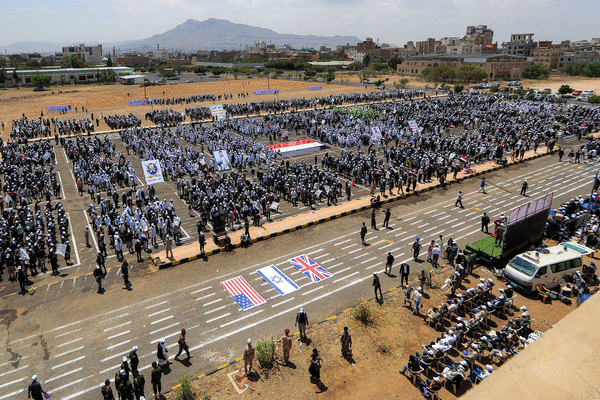
WASHINGTON — President Donald Trump threatened to step up strikes on Iran and said he’ll hold the country responsible for any further attacks by the Yemen-based Houthis on Red Sea ships, potentially widening U.S. involvement in the Middle East war.
The Iran-backed Houthis earlier claimed assaults on two Saudi Arabian oil tankers, the group’s first for several months, opening a new front in a conflict that’s disrupted global energy supplies and rattled bond markets. Brent crude climbed above $100 a barrel on Thursday for the first time in almost two months.
Trump told Axios in an interview that he’s considering a “massive attack” that would be “bigger than ever before” and is “close to making a decision” on it, the news agency reported. The president also posted on Truth Social that the U.S. will hold Iran responsible for further Houthi strikes and “major military punishment will be inflicted upon Iran and, of course, the Houthis, themselves.”
A day earlier, Trump threatened to escalate airstrikes against Iran — now into their second week — saying American forces will destroy one bridge or power plant each time Tehran shoots at vessels in the Strait of Hormuz. Iran has warned it will retaliate against infrastructure and bridges in the region, including energy facilities, if Trump follows through.
The U.S.-Iran conflict has flared up again in the past couple of weeks, and neither side is indicating it’s time for new negotiations. The attacks by the Houthis have intensified the conflict, even if hostilities remain less intense than during the height of the war in March and early April.
The Houthis said they targeted the Saudi tankers in the Red Sea with missiles and drones. The Saudi government confirmed an attack on one refined-products tanker, called the Encelia. The British navy separately said a tanker was struck near the Saudi town of Al Shuqaiq in the southern part of the sea.
The Houthis said the second vessel was named Layla, which is a crude-oil carrier.
While it’s unclear if the ships were damaged, the move could effectively close another maritime chokepoint vital to energy markets, following Iran’s shutdown of the Strait of Hormuz. Some vessels are already avoiding the Bab el-Mandeb strait at the mouth of the Red Sea, with oil prices rising further.
The U.S. carried out its 12th consecutive day of airstrikes on Iranian military sites overnight, including missile and air-defense facilities. Iranian state TV reported one attack on the passenger terminal at the Shalamcheh border crossing with Iraq, killing two people. Iran again fired upon U.S. bases and military sites in Kuwait and Jordan.
Trump said Wednesday that Iran is “getting hit so hard” but added he isn’t at the point of seriously considering fresh talks.
“They’re not ready to make a deal because every time they make a deal, they want to change it and everything,” he said at a rally in Georgia.
Iranian officials have been similarly dismissive of the prospect of returning to the negotiating table.
“There is no real problem with conveying messages — the issue lies in the U.S. approach, which is illogical, excessively demanding and hegemonic,” Iran Foreign Minister Abbas Araghchi told Iranian state TV. “That approach has been met with a firm response from us. As long as the United States fails to understand that the only way forward is to respect the Iranian people and Iran’s national interests, there is no prospect of progress on this front.”
The Red Sea has emerged as a vital workaround for crude exports, particularly from Saudi Arabia. The port of Yanbu became the main outlet for Saudi oil exports, allowing it to bypass the Strait of Hormuz, through which hardly any vessels are sailing.
The Houthis have sent emails to international vessel owners, warning them not to go to the kingdom’s ports. Incidents involving non-Saudi vessels would add an extra layer of risk for the industry and shipping crews.
The Houthis are part of Iran’s Axis of Resistance, a loose alliance of armed groups funded and trained by the Islamic Republic but operating with a degree of autonomy.
The Houthis, who control Yemen’s capital, Sanaa, and the Red Sea port of Hodeida, disrupted shipping with drone and missile attacks after Israel began its assault against Hamas in Gaza in 2023. However, they ended that campaign in May 2025 in a truce with the U.S., which had bombed them along with the U.K. and Israel.
The new Houthi strikes come days after the group said it would blockade Saudi ports in response to the kingdom attacking Sanaa, following rising tensions in the past few weeks. Riyadh carried out an air campaign for around seven years to oust the Islamist group, before the two sides agreed a ceasefire in 2022.
The U.S. resumed a naval blockade of Iran soon after the flare-up in fighting about two weeks ago. It also ended a waiver on Iranian oil sanctions.
The moves and the skirmishing mean an interim U.S.-Iran peace deal signed in mid-June — designed to lead to negotiations over Tehran’s nuclear program and a permanent peace deal in two months — has all but collapsed.
The U.S. says Iran must reopen Hormuz and stop attacking commercial ships for it to halt its bombing of the Islamic Republic.
The economic fallout from the war, particularly high fuel prices, is weighing heavily on Americans as the November midterm elections approach. Trump has received poor marks for his handling of the economy and the conflict, polls show, putting his fellow Republicans at risk of losing control of Congress.
U.S. gasoline pump prices are back above $4 a gallon.
—With assistance from Iain Marlow.
©2026 Bloomberg L.P. Visit bloomberg.com. Distributed by Tribune Content Agency, LLC.





Comments