US moves to strip citizenship from former ambassador who spied for Cuba
Published in News & Features
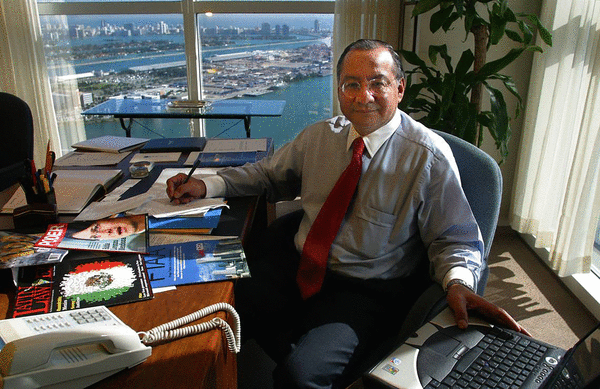
MIAMI — Federal prosecutors in Miami kicked off Friday the process to strip the American citizenship of a former U.S. ambassador who is currently serving 15 years in prison after admitting he had for been an agent for Cuban intelligence.
The Justice Department filed a lawsuit to take away Victor Manuel Rocha’s U.S. citizenship. The government claims that Victor Manuel Rocha — who was born in Colombia and became a U.S. ambassador to Bolivia under President George W. Bush — began serving as a secret agent for Cuba in 1973. He lied on his 1978 naturalization application because he said he had never knowingly committed a crime, that he had no communist affiliations, and that he affirmed he believed in the U.S. Constitution, the lawsuit said.
“Victor Manuel Rocha was not a low-level operative. He was a former United States Ambassador and senior government official who admitted he secretly served the Cuban regime for decades,” said U.S. Attorney Jason A. Reding Quiñones for the Southern District of Florida. “The complaint alleges that Rocha obtained American citizenship through lies, concealment and betrayal. A person who secretly serves communist Cuba should not keep the privilege of United States citizenship, even while in prison.”
Rocha is currently serving time at a low-security correctional facility in central Florida.
The move to revoke his citizenship comes as the Trump administration ramps up denaturalizations as part of its mass deportation agenda. Denaturalizations have historically been extremely rare. And while they continue to be highly unlikely for the average naturalized citizen, Rocha is at least the fifth person to face denaturalization in Miami this year.
Other recent denaturalization cases in South Florida include the former mayor of the city of North Miami, a Peruvian-born registered sex offender, and a Cuban woman convicted of healthcare fraud.
The denaturalization lawsuit against Rocha is based on his 2024 conviction for violating the Foreign Agents Registration Act, which requires people working for foreign governments to disclose it to the U.S. During Rocha’s sentencing in 2024, the federal judge overseeing the criminal case, Beth Bloom, questioned government prosecutors about why they were not pursuing denaturalization.
The U.S. government brought charges against Rocha after he met with an undercover FBI agent pretending to be a Cuban intelligence handler in Miami several times. Rocha confessed to being an agent for the Cuban Intelligence Directorate, and said that Havana had “accompanied him” in the process of getting State Department employment, according to the criminal complaint and plea deal.
Rocha told the undercover agent about training he had received on how to reach meetings undetected, creating a fake backstory as a “right-wing person” and how to use code words. He last visited Havana in 2017 on a Dominican Republic passport, according to the criminal complaint. Rocha told the undercover agent to send his “warmest regards” to Cuba’s intelligence agency.
“Throughout all three meetings with the (undercover agent,) the defendant behaved as a Cuban agent. The defendant consistently referred to the United States as ‘the enemy,’ and used the term ‘we’” to describe himself and Cuba,” according to court documents, which also described Rochas calling Fidel Castro “Comandante” and his contacts in Cuban intelligence as “comrades.”
Cuba recruited Rocha as a spy while he was a student in Chile in 1973, the same year that U.S. military-backed dictator Augusto Pinochet overthrew democratically elected socialist President Salvador Allende. Rocha had his petition for naturalization in 1978 heard by a judge at Mount Vernon, George Washington’s home.
After earning master’s degrees at Harvard University and Georgetown University, he began a decades-long career at the State Department. He rose through the ranks of foreign service, gaining top-secret clearance and serving diplomatic missions in Mexico, Honduras, Argentina Cuba, and the Dominican Republic. Bush appointed him ambassador to Bolivia in 2000.
Rocha struck a plea deal with prosecutors in April 2024 and was fined half-a-million dollars for violating the foreign agent laws. He was not formally accused of being a spy, which would have required sensitive evidence like catching him providing top-secret information to the Cuban governments. But it showed how deeply Havana was able to insert itself into the inner workings of the U.S. government to obtain sensitive intelligence.
Rocha said during sentencing that he had been radicalized during his time in university, and that his “deep commitment at that time to radical social change in the region led me to the eventual betrayal of my oath of loyalty to the United States during my two decades in the State Department.”
Right before meting out the sentence, the judge told him he had betrayed the United States for 51 years: “As an agent of the Cuban government, your actions were a direct attack on our democracy and the safety of our citizens.”
_____
©2026 Miami Herald. Visit miamiherald.com. Distributed by Tribune Content Agency, LLC.


Comments