'A cop's cop': Mourners gather to remember slain Chicago police Officer John Bartholomew
Published in News & Features
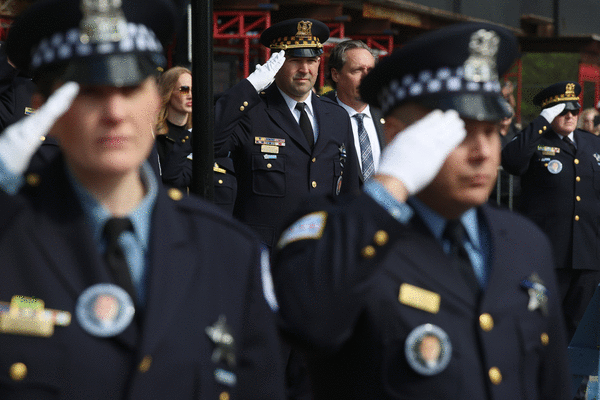
Chicago police Superintendent Larry Snelling called fallen Chicago police Officer John Bartholomew a “cop’s cop,” remembering the patrol officer by his image in a photograph wearing a helmet while working hard during the Democratic National Convention in Chicago in 2024.
“He walked like a seasoned veteran. He was proud, strong. He loved his job,” Snelling said during the funeral for the slain officer. “Most important, he was a family man who always helped his family, because he truly loved his family.”
Hundreds of mourners gathered Friday morning at an Edgewater church as loved ones prepared to lay to rest Officer Bartholomew, whose killing drew scrutiny to the county’s electronic monitoring system and raised questions about how a suspect in custody had a gun.
Bartholomew, 38, was slain in a shooting inside Endeavor Health Swedish Hospital on April 25 that also seriously injured a second officer, Nelson Crespo. Prosecutors have alleged that Alphanso Talley, 26, shot the officers while being treated at the hospital following an arrest for armed robbery.
Family, friends, fellow officers and public officials crowded into St. Andrews Greek Orthodox Church at 5649 N. Sheridan Road to remember Bartholomew, who loved ones have recalled as a public service-driven family man. Also in attendance were Mayor Brandon Johnson and former Chicago Mayor Richard M. Daley.
Traffic was closed to vehicles all around the church, and a Chicago Fire Department engine hoisted a giant American flag just outside the church.
By 9:15 a.m., hundreds of police officers had gathered on Sheridan Road in dress uniforms. Many sported buttons of Bartholomew’s face and milled quietly in front of a screen showing his picture in front of the church. Squad cars from other departments in nearby suburbs and Illinois State police sat in traffic crawling north on Sheridan as neighbors peered up the street from in front of their high-rises.
A few civilians stood on the edges of the crowd, holding smartphones and craning their necks as a procession of bagpipes stepped off down Sheridan.
Inside the church, Bartholomew’s casket lay covered with a city flag while white-robed clergy stood in an arc around it and chanted to begin the ceremony.
Snelling began his remarks by recounting the how he’d delivered the news of Bartholomew’s death to his family the day of the shooting and how Bartholomew’s mother had told him that he had always wanted to be a police officer. He then turned his address to Bartholomew’s three children.
“Your father is a hero,” Snelling said. “His legacy will live on. That is why we’re here today.”
Snelling thanked Renee Bartholomew, the officer’s widow, for her strength in the face of his death.
Also speaking at the funeral was Bartholomew’s brother, James Bartholomew, who listed the many roles his brother had played in the lives of the people gathered in the church and beyond its walls.
“If you are here today, you have lost a coworker, a friend, a fellow Christian, a neighbor. You may have lost a cousin, a nephew, an uncle, godfather, son, brother. If you are watching this across our nation you have lost a fellow American. If you are watching this around the world, you have lost a fellow human.”
He recalled his brother’s response to the news of the deaths of firefighter Michael Altman and Officer Ella French.
“Every time the same response,” he said. “That’s the job. Sometimes you don’t come back.”
Speaking at the front of the church, the officer’s brother paced back and forth as he spoke, wearing a pair of dark sunglasses with his suit.
“I am eternally grateful that God gave me 38 years on this earth with my brother,” he continued. “His love and his stewardship will be with us forever.”
He then walked off the altar to a brief round of applause.
The funeral followed a visitation at the same church on Thursday.
On his block in the Edison Park neighborhood, an enclave that houses many police officers and city workers, neighbors tied blue ribbons to trees.
“It’s so sudden he’s gone now,” a longtime friend, Richard Hudock, previously told the Tribune. “And now I’m just never gonna see him again.”
Bartholomew left behind his wife, Renee, a daughter and stepsons.
Snelling in a departmental message had called the shooting a “devastating loss for our department and our city.”
“This officer gave his life to protect his fellow Chicagoans, and we will never let our city forget his sacrifice,” he wrote.
Snelling spoke outside a visitation for Bartholomew late Thursday as well.
“We have a family in there that’s suffering,” he said, adding that the department was trying to provide loved ones whatever comfort they could. “You can feel the grief in the air.”
The shooting inside the Lincoln Square hospital on a Saturday morning sent a massive police response to the locked-down facility and set off sprawling investigations that also led to federal charges against an Indiana woman who is accused of buying the gun used in the shooting.
Around 9 a.m. that morning, the officers had brought Talley, who was in custody, to the hospital for treatment after he claimed to have swallowed drugs and said his legs were numb.
Talley allegedly kept his pants on at first while changing into a hospital gown, but later removed them. He had his left arm cuffed to the bed and kept his right arm underneath a blanket that was draped over him, prosecutors said.
While inside a treatment room, prosecutors said, Talley took a gun from under the blanket and shot Bartholomew in the head as the officer uncuffed him. He allegedly shot his partner moments later.
Officials are still probing how Talley had a gun inside the hospital.
Talley escaped the hospital as employees and patients hid and took cover before he was arrested hiding under a porch nearby.
Talley had been taken into custody earlier that morning and accused of taking about $110 at gunpoint from an Albany Park Family Dollar store.
Prior to that arrest, Talley had faced pending charges alleging armed robbery and carjacking and was released by Judge John Lyke on electronic monitoring.
On March 9, though, Talley’s device shut off and officials lost track of him. Lyke issued a warrant for his arrest, but the case went before the judge more than 48 hours after the violation occurred, contrary to a new policy set by Chief Judge Charles Beach that sought to more quickly address violations of electronic monitoring requirements.
The warrant was outstanding until Talley was arrested during the events on April 25.
_____
(Tribune reporter Tess Kenny contributed to this story.)
_____
©2026 Chicago Tribune. Visit chicagotribune.com. Distributed by Tribune Content Agency, LLC.




Comments