Former Baltimore Gun Trace Task Force leader says he aided feds as informant, wants early release
Published in News & Features
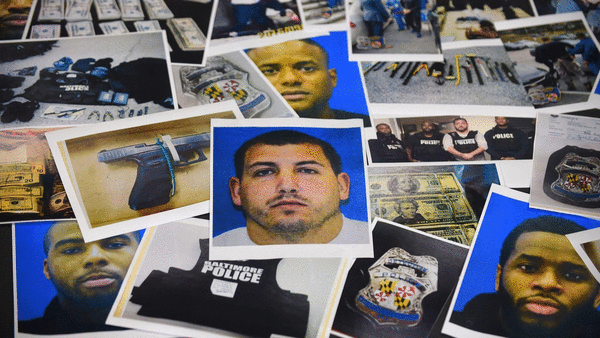
BALTIMORE — Convicted former Baltimore Police Sgt. Wayne Jenkins, who led the city’s Gun Trace Task Force, is seeking to cut short his 25-year federal prison sentence, claiming he secretly cooperated for years with federal investigators probing police corruption and was promised favorable treatment that never materialized.
Jenkins, 45, filed a series of motions in federal court this month asking a judge to reduce his sentence and compel what he called “specific performance” tied to his alleged cooperation with the U.S. Department of Justice. The filings, along with supplemental affidavits, remain sealed. When reached by The Baltimore Sun, officials with the U.S. Department of Justice declined comment.
In a separate public motion seeking to keep the records sealed, Jenkins alleged federal authorities began using him as an informant shortly after he pleaded guilty in 2018 to racketeering, robbery, falsifying records and civil rights violations tied to the Gun Trace Task Force scandal that rocked Baltimore.
“The implicit agreement was that Jenkins would garner some type of benefit from the U.S. for all the risk and work that he was undertaking for the benefit of the AUSA involved and the Department of Justice in particular,” Jenkins wrote. “No benefit ever came.”
Jenkins claimed his assistance involved information about other police officers, government officials and civilians, and said the cooperation exposed him to possible violence and retaliation.
Revisiting the Gun Trace Task Force
The filings reopen one of the darkest chapters in modern Baltimore policing. Jenkins, once hailed inside the Baltimore Police Department as a hard-charging anti-crime officer, admitted to leading a rogue squad of officers who robbed residents, stole drugs and cash, filed false reports, claimed fraudulent overtime and planted evidence. Federal prosecutors said Jenkins personally participated in at least seven robberies between 2011 and 2016.
The Gun Trace Task Force scandal triggered widespread fallout across Baltimore’s criminal justice system, including overturned convictions, lawsuits and renewed federal scrutiny of policing practices. Jenkins later became the central figure in HBO’s We Own This City, which dramatized the corruption scandal.
Federal prosecutors previously described Jenkins as the ringleader of one of the most corrupt police units in Baltimore history. In sentencing Jenkins to 25 years in prison in 2018, U.S. District Judge Catherine C. Blake said he had abused the public trust while “putting poison into our community when he should have been protecting” it.
‘Now he’s just looking for a benefit’
Abbe Smith, director of the Criminal Defense and Prisoner Advocacy Clinic at Georgetown University Law Center, criticized Jenkins’ effort to revisit his sentence years later.
“The arrogance is all I have to say,” Smith said. “If I was a prosecutor, I would say too little, too late. Why didn’t you offer this up earlier? Now he’s just looking for a benefit.”
Smith said Jenkins faces steep legal and political hurdles even if he did cooperate.
“This is a police officer who abused the public trust,” she said. “There’s only one group of people to whom we award a gun and a badge. When they abuse the privilege, it poses a danger to the rule of law itself.”
Smith also questioned whether Jenkins’ efforts to keep the filings sealed would ultimately hold up if the information were ever tied to prosecutions or court proceedings.
Jenkins previously attempted to reduce his prison sentence in 2020, when he sought compassionate release after claiming he performed life-saving measures on another inmate during a medical emergency.
More about Jenkins
A former Marine and Middle River native, Jenkins joined the Baltimore Police Department in 2003 and rose through the ranks before taking command of the Gun Trace Task Force in 2016. He pleaded guilty in January 2018 and was sentenced months later to 25 years in federal prison followed by three years of supervised release
In requesting that his most recent pleadings be sealed, Jenkins, who filed without the aid of an attorney, argued that he did not know whether there were other pending investigations or cases taking place that involved the facts from his filings and exhibits. Jenkins wrote that he was also unaware whether others prosecuted alongside him needed protection.
Jenkins is currently incarcerated at the Federal Medical Center, Lexington in Kentucky, according to the Federal Bureau of Prisons. His release date is listed as August 2037.
U.S. District Chief Judge George L. Russell III ordered federal prosecutors to respond to Jenkins’ filings by June 3.
_____
©2026 The Baltimore Sun. Visit at baltimoresun.com. Distributed by Tribune Content Agency, LLC.





Comments