White House ballroom security upgrades become Democratic target
Published in News & Features
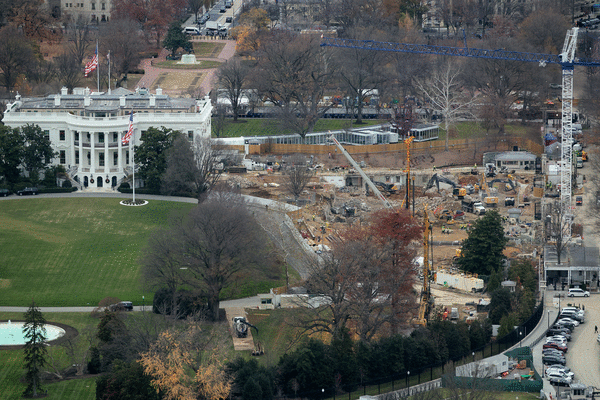
WASHINGTON — Senate Democrats are preparing to challenge on procedural grounds a $1 billion provision in a GOP reconciliation bill that is connected to plans for a White House ballroom.
Democrats say the provision is a “glaring” violation of the Senate’s Byrd rule, which restricts the type of material that can be considered in a reconciliation bill, according to sources familiar with their conversations.
The White House and Department of Homeland Security have come out in strong support of the provision in recent days, arguing, for example, that past attempts to assassinate President Donald Trump and a gunfight with an intruder at the White House Correspondents’ Dinner two weeks ago necessitate increased security measures.
The section of the reconciliation bill written by Senate Judiciary Committee Republicans would provide $1 billion to the Secret Service “for the purposes of security adjustments and upgrades, including within the perimeter fence of the White House Compound to support enhancements by the United States Secret Service relating to the East Wing Modernization Project, including above-ground and below-ground security features.”
The provision also includes a limitation that none of the $1 billion “may be used for non-security elements of the East Wing Modernization Project,” which presumably includes the planned 90,000-square-foot ballroom.
Democrats believe the funding and its purpose lie outside the jurisdiction of the Judiciary Committee, a violation of the Byrd rule if true, the sources said.
The Byrd rule, named after its principal sponsor, the late West Virginia Democratic Sen. Robert C. Byrd, prohibits matter that is “extraneous” to the budget.
The rule provides several definitions of what can be considered extraneous, including a title or provision in a reconciliation bill that was written by a committee that does not have jurisdiction over the matter.
The Secret Service falls under the jurisdiction of the Judiciary Committee. But Democrats contend the “ballroom project” falls under the jurisdiction of two other Senate committees. The Environment and Public Works Committee has jurisdiction over public buildings including the White House, while the Energy and Natural Resources Committee has jurisdiction over the National Park Service, and the White House is classified as a national park.
Within hours of the release of the text of a filibuster-proof bill designed mostly to provide immigration enforcement funding, Democrats took aim at the surprise provision connected to the “East Wing Modernization Project,” the centerpiece of which is the planned ballroom.
“Republicans looked at families drowning in bills and decided what they really needed was more (immigration) raids and a Trump ballroom,” Senate Minority Leader Charles E. Schumer, D-N.Y., wrote on the social platform X after the text was released earlier this week.
Immigration funds at core
The Judiciary-written text is part of a nearly $72 billion reconciliation bill that also was written by Homeland Security and Governmental Affairs Committee Republicans. It’s designed to provide more than three years of funding for immigration enforcement at the Department of Homeland Security, lasting beyond the remainder of Trump’s term.
The Senate-originated, fiscal 2026 budget resolution adopted by both chambers gave instructions to each committee to spend up to $70 billion for immigration enforcement, with the understanding that the final bill would be in the neighborhood of $70 billion.
Republicans agreed to seek funding for immigration enforcement through reconciliation after Senate Democrats refused to vote for such funding through the regular appropriations process without placing new restrictions on federal immigration agents in the wake of two fatal shootings of U.S. citizens in Minnesota earlier this year. The final fiscal 2026 Homeland Security appropriations bill funds most of the department through September with the exception of immigration agencies.
The Judiciary Committee portion of the reconciliation text totals nearly $39.2 billion, including $2.5 billion for the Justice Department and Secret Service. A separate title from the Homeland Security Committee would provide $32.5 billion, bringing the total to $71.7 billion in new spending.
The two biggest recipients of funding under the combined package would be Immigration and Customs Enforcement, receiving about $38.2 billion, and Customs and Border Protection, receiving a little more than $26 billion.
Both committees tentatively plan to mark up their portions of the bill May 19, after which they would be packaged together by the Senate Budget Committee and sent to the floor.
Democrats are reviewing the entire bill for potential Byrd rule violations ahead of both sides meeting with Senate Parliamentarian Elizabeth MacDonough to discuss the measure.
Former Senate aides and other budget experts, both Republican and Democrat, who have reviewed the legislation say it is largely tightly written to avoid Byrd rule challenges.
The authors of the text patterned much of the language after the reconciliation package that Republicans passed and Trump signed last year that provided billions of dollars in mandatory funding to the Department of Homeland Security.
That language made it through what is called the “Byrd bath,” a procedure where backers of the reconciliation bill and its opponents from the other party argue over potential violations.
When a provision in a reconciliation bill is judged to be noncompliant, it is often removed from the bill before it goes to the floor. Absent that, a senator can raise a point of order against the provision. If the chair agrees the objection is well-taken, it takes a three-fifths vote to waive the objection.
_____
©2026 CQ-Roll Call, Inc., All Rights Reserved. Visit cqrollcall.com. Distributed by Tribune Content Agency, LLC.






Comments