Virginia Supreme Court invalidates redrawn congressional map
Published in News & Features
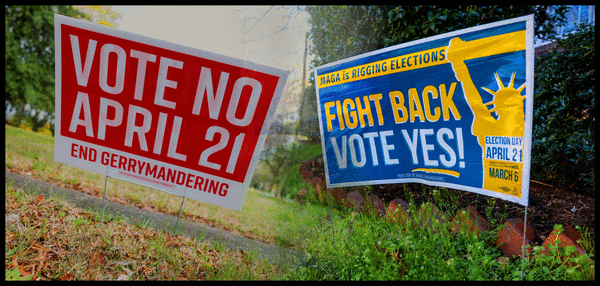
WASHINGTON — Virginia’s Supreme Court invalidated the state’s new congressional map Friday, overturning a ballot measure adopted by voters that would have targeted several Republican-held House seats.
The majority opinion, written by Justice D. Arthur Kelsey, found that the legislative process to advance the ballot measure violated Virginia’s constitution. “This constitutional violation incurably taints the resulting referendum vote and nullifies its legal efficacy,” the decision said.
The ruling means this fall’s midterm elections would be held under the current map, where Democrats hold six of the state’s 11 House seats. The ballot measure would have given Democrats a favorable chance of winning as many as 10 seats. Voters approved the new Democrat-drawn congressional map on April 21.
National Republican Congressional Committee Chair Richard Hudson of North Carolina praised the state court’s ruling in a statement Friday. The NRCC brought one of the cases against the state redistricting process.
“Virginia Democrats’ corrupt scheme to rig the map has been crushed in court, restoring fairness and protecting the future of the Commonwealth,” Hudson’s statement said.
In the ruling, Kelsey wrote that the legislature’s process had numerous flaws, including that representatives passed the first part of the ballot measure during the early voting period before the November 2025 elections.
That violated a provision that prohibits such measures — ballot measures to pass a constitutional amendment — from having an “intervening election” between their passage, the ruling states.
The legislature approved the ballot measure on Oct. 31, 2025, after more than 1 million voters had already voted early before the election, Kelsey wrote.
The point of the requirement was so that voters could have the opportunity to vote out politicians who support an unpopular constitutional amendment before the House of Delegates later votes to actually place it on the ballot, Kelsey wrote.
“The efficacy of the second popular vote depends in part upon the reliability of the first,” Kelsey wrote.
State officials had appealed multiple lower court rulings that found the legislative process for the ballot measure violated the constitution.
The Democrat-held Virginia legislature started the redistricting process in 2025, passing the first step of the referendum in the weeks before the general election. The legislature then reconvened in January to set up the referendum for the vote last month.
Virginia Chief Justice Cleo Powell, joined by Justices Thomas P. Mann and Junius P. Fulton III, dissented from the decision, arguing that the majority broadened the definition of “election” to get the result it wanted.
“Notwithstanding this bedrock principle, today the majority has broadened the meaning of the word ‘election,’ as used in the Virginia Constitution, to include the early voting period,” Powell wrote. “This is in direct conflict with how both Virginia and federal law define an election.”
Friday’s ruling reduces the number of potential seats up for grabs by Democrats in the fall midterms amid a flurry of mid-decade partisan redistricting nationwide. The current redistricting arms race started with a map passed by the Texas legislature last summer targeting five Democrat-held seats in the Lone Star State.
California soon followed with its own redistricting ballot measure targeting Republican seats. Florida, Missouri and others followed, targeting Democrat-held ones.
Since a Supreme Court decision last week invalidating a Louisiana congressional map with two Democrat-held seats, the redistricting effort has hit a new gear. Louisiana, Tennessee and Alabama have started redistricting targeting their states’ remaining Democrat-held seats.
_____
©2026 CQ-Roll Call, Inc., All Rights Reserved. Visit cqrollcall.com. Distributed by Tribune Content Agency, LLC.






Comments