Federal jury convicts four South Florida men in assassination of Haiti's president
Published in News & Features
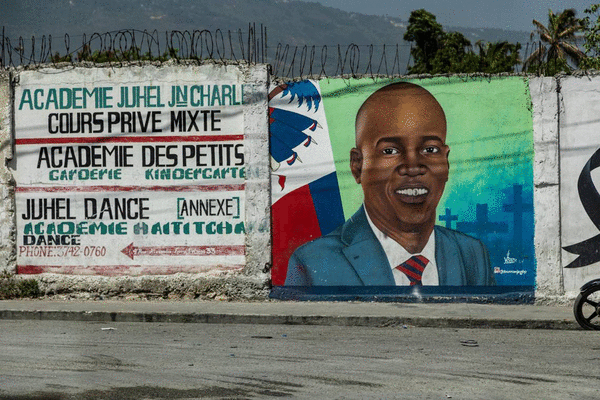
MIAMI — Four South Florida men were found guilty on Friday of conspiring to kidnap or kill Haiti’s president, Jovenel Moïse, who was assassinated in his home outside Port-au-Prince on July 7, 2021, plunging the Caribbean country deeper into political turmoil and gang-fueled chaos.
The verdict, delivered by a 12-member jury in federal court in Miami, came nearly five years after the assassination, following 39 days of testimony over almost nine weeks. The jury spent two days deliberating, after sending a question to the judge about one of the nine charges related to the shipment of bulletproof vests to mercenaries in Haiti, a country under a U.S. arms embargo.
Arcángel Pretel Ortiz and Antonio “Tony” Intriago, owners of Counter Terrorist Federal Academy and Counter Terrorist Unit Security in Doral — collectively known as CTU — were convicted along with James Solages, who worked for CTU, and Walter Veintemilla, a Broward area mortgage broker whom prosecutors said helped finance the plot.
All the men were accused of plotting in South Florida and hiring a squad of former Colombian soldiers to violently overthrow Haiti’s president in a coup scheme that turned from his ouster to his assassination a couple of weeks before his death. The defense teams challenged those allegations by asserting that Haitian police and presidential security details killed Moïse before the Colombian hit squad arrived at his hillside home in the middle of the night.
But prosecutors argued that the South Florida group, in collaboration with a few key Haitians starting in April 2021, wanted to replace Moïse with a new president willing to hire them for lucrative security and infrastructure contracts in Haiti.
“This case is very simple,” lead Assistant U.S. Attorney Sean McLaughlin told jurors during closing arguments. “This is a case about greed, arrogance and power.”
The verdict
The jury found the four defendants guilty of five counts, including a conspiracy to provide material support, a terrorism-related charge and conspiracy to lead a military expedition against a friendly nation, a violation of the U.S. Neutrality Act, which bans American citizens from waging war against any country at peace with the United States. Intriago, 63, also faced four additional counts related to shipping bulletproof vests to Haiti for about 20 former Colombian soldiers whom CTU recruited and sent to Port-au-Prince roughly a month before the killing.
Though the four defendants were tried at the same time, jurors were instructed they had to consider each one individually. A fifth defendant, Christian Emmanuel Sanon, a Haiti-born doctor and pastor who lived in South Florida, will be tried at a later date due to health issues. Initially, the South Florida plotters backed Sanon, 67, to succeed Moïse, 53, after his removal, but they abandoned him for another political candidate, a Haitian Superior Court justice, in the weeks before the president’s assassination.
All four defendants could be sentenced to as long as life in prison by U.S. District Judge Jacqueline Becerra.
Long before trial, six co-conspirators in the case had pleaded guilty to the conspiracy to kidnap or kill Moïse or to a lesser charge of smuggling the vests to the Colombians. Two additional individuals also took plea deals after being accused of money laundering charges related to the plot.
Federal prosecutors presented a sweeping case — one that ran parallel to and intersected with a still-unresolved sprawling investigation by Haitian authorities, who have charged more than 50 suspects, including the former first lady, Martine Moïse.
The U.S. case focused on more than 40 witnesses, photos of the crime scene borrowed from the Haiti National Police, as well as some of the weapons used by the Colombian commandos. There were 8,000 gigabytes of data gathered by FBI agents from more than 100 electronic devices in the United States, Colombia and Haiti. The evidence was part of a 900-page summary of text messages and voice notes showing the evolution of the plot, from plans to use gangs, to poisoning him, to detaining him at the airport after he returned from an overseas trip.
As they discussed their plans, the defendants referred to Moïse as “a rat” and “a thief,” and spoke in coded language about weapons and ammunition. They referred to them as “tools” and “screws” as they struggled to obtain them. They also adopted the names of angels and led others to believe they were acting on behalf of the United States government, including the military and the Drug Enforcement Administration, prosecutors said.
On the night the Colombian commandos raided Moïse’s neighborhood, Solages, 40, accompanied the squad and shouted that the operation was being carried out by the DEA and the U.S. Army.
One of the leaders of the commandos, a retired Colombian Army captain, testified for the government that the squad stormed the president’s residence at the direction of Solages, who had told an inner circle of plotters hours earlier that the goal was to kill everyone in the house.
A sweeping case
Moïse was fatally shot in the upstairs bedroom of his rented home outside Port-au-Prince. His wife, who was the government’s first witness when the trial began on March 9, was seriously wounded. The couple’s two college-age children who hid in a bathroom with one of their dogs were unharmed. Though the president had two semi-automatic rifles in his room, they were never fired.
During her testimony, Martine Moïse said she heard the assailants speaking Spanish during the attack and rummaging through the bedroom for a mysterious document. She also testified that a necklace and Kenneth Cole watch given to her husband by the Spanish ambassador were among the items stolen from the couple’s bedroom. She also commented on plastics bags of newly minted cash kept inside the couple’s bedroom and said her husband used the money to pay bribes and gather intelligence.
Defense lawyers for the South Florida men accused of hiring the Colombian commandos said they were accompanying Haitian authorities to provide security and execute a warrant for Moïse’s arrest – a story prosecutors insisted was created after the fact.
Prosecutor Jason Wu reminded jurors of the video testimony of Haiti investigative judge Jean Roger Noelcius, who signed the warrant and who said under oath he had no authority to issue one for Moïse’s arrest and fled after he saw it used in a coup attempt on Feb. 7, 2021.
“In a real arrest you also have a valid arrest warrant, not a bogus warrant that they pulled off of social media or the internet,” Wu said during the government’s closing arguments. “It was a fake from the day he signed it.”
As the trial wrapped up Tuesday, McLaughlin told jurors that the defense could argue for hours, but it would not change the evidence and “devastating and overwhelming” testimony against the four defendants.
“The United States has proved the guilt of each one of these defendants overwhelmingly as to every single count, as to every single defendant,” he said, pushing back on defense lawyers’ attempt to cast the killing as a Haitian-led operation that used their clients as scapegoats.
He also pushed back on the defense’s efforts to question the credibility of Martine Moïse’s testimony, which differ from what she initially told FBI investigators after she was airlifted to Jackson Memorial Hospital, and to cast Haiti as a corrupt country where even police evidence cannot be trusted.
“She is a woman who came in here with great strength and courage and told you what happened in her bedroom that night, and they cannot stand it because it blows a hole in the entire false theory,” McLaughlin said. “They cannot stand her, and they have done nothing but try to call her a liar, a con artist, a murderer, a terrible mother, a terrible person.”
The Haitian police investigation served as a blueprint for U.S. authorities, who did not get access to the weapons until two years after the killing.
Contrary to the defense’s theory and argument, that Moïse was already dead by the time the Colombians arrived, McLaughlin said the killing happened between 1:00 and 2:00 a.m., and “was conducted by Spanish speakers, and two of them were referred to as “El Jefe” and “Pipe.” He identified “Pipe” as former Colombian soldier Victor Albeiro Pineda Cardona and “Jefe” as Javier Romero, the captain of the so-called Delta team, tasked with entering the president’s bedroom first. The two are currently imprisoned in Haiti along with 15 other Colombians accused in the plot.
Also imprisoned in Haiti is Joseph Felix Badio, a former government anti-corruption chief who paid $110,000 to Moïse’s guards to stand down during the assault and purchased $20,000 worth of ammunition ahead of the killing. Badio, who has not been charged in the U.S. case, obtained most of that money from Haitian businessman Rodolphe Jaar, who pleaded to the main conspiracy charge.
The defendants in Miami, McLaughlin and fellow prosecutors argued, were not at odds, but rather worked together “day after day, week after week for months to violently overthrow the government of Haiti and to kill or kidnap” Moïse.
After the president’s assassination, the country collapsed further into unprecedented gang-fueled chaos, which has driven nearly 1.5 million Haitians from their homes and worsened a humanitarian crisis in which 1 in 2 Haitians currently do not have enough to eat.
The defense cast the killing as the work of Haitian insiders who wanted Moïse gone because of his use of armed gangs to target opponents. At the time of his death, the 53-year-old president was enmeshed in a constitutional crisis over his tenure, and his ruling by decree following his dismissal of the Parliament.
While the U.S. said Moise still had a year left in office, Haitian constitutional scholars and opponents argued that he had overstayed his time, which had expired on Feb. 7, 2021, the day he was targeted in an earlier coup.
Defense attorney Emmanuel Perez said Haiti is not going to remember Moïse as a “martyred son.” Moïse’s own actions, he added, provoked prominent Haitians, including two of the government’s own witnesses – former Haiti senator Joseph Joel John and Jaar – “to plot against him.” Like Jaar, John pleaded guilty to the conspiracy charge before trial and testified for the government.
The total budget for the coup, according to an FBI forensics expert, was about $343,000 and was raised through a variety of sources, including about $30,000 in federal pandemic relief loans. About half of that budget was financed by Veintemilla’s lending company in a loan to CTU to pay for Sanon’s security in Haiti, according to the government’s case. He was the plotters’ initial choice to succeed Moïse.
“The witnesses testified that Walter was giving money for security detail, and that’s not enough to convict him of a conspiracy to provide material support to kidnap and kill president Moïse,” Veintemilla’s lawyer, Marissel Descalzo, told jurors. “The people that gave the money to kill President Moise were in Haiti. That was Badio and Jaar. It wasn’t Walter.”
The government’s case, each of the defense lawyers argued, was based on flimsy evidence, including “cherry-picked” text messages and inconsistent witness testimonies. The forensics consisted of a broken chain of custody, including weapons provided to federal investigators by the Haitian police, and a lack of DNA and fingerprints.
“You cannot rely upon what you have been presented because it is unreliable,” David Howard, one of Pretel’s lawyers, told jurors. Pretel, 53, was an FBI informant at the time of the plot, and despite one of his handlers attending a meeting with him and his co-defendants, prosecutors have insisted the assassination was not endorsed by the U.S. government and that the federal agency was in the dark.
Moïse was shot 12 times with a bullet to his heart delivering the fatal blow, according to Jean Armel Demorcy, Haiti’s only forensic pathologist, who testified on behalf of prosecutors. But Demorcy’s extraction of only two bullets, one from the forearm and the other from the president’s back, came under scrutiny.
A defense team pathologist questioned how the two bullets lodged under the skin did not cause more damage if they were fired from a high-velocity rifle, as prosecutors claimed.
“Those two bullets that were extracted from the president’s body, it’s the defense’s position that those were planted,” said Jonathan Friedman, a lawyer for Solages.
Added Intriago’s lawyer, Perez: “The only ones that could have planted it are the ones who actually murdered the president because they wanted to make it seem,” like the Colombians killed him.
There was no DNA or fingerprints, he added, connecting the Colombians to the murder weapon, a Palmetto Armory assault rifle, that prosecutors presented in court during their closing.
But McLaughlin, the prosecutor, pushed back during closing arguments.
“This is not a place for gossip, rumor, innuendo, misrepresentation, conjecture, fiction,” he told jurors. “Facts, evidence and testimony matter.”
_____
©2026 Miami Herald. Visit at miamiherald.com. Distributed by Tribune Content Agency, LLC.




Comments