Trump says tariffs on cars, trucks to hit 50% amid Canada trade spat
Published in Business News
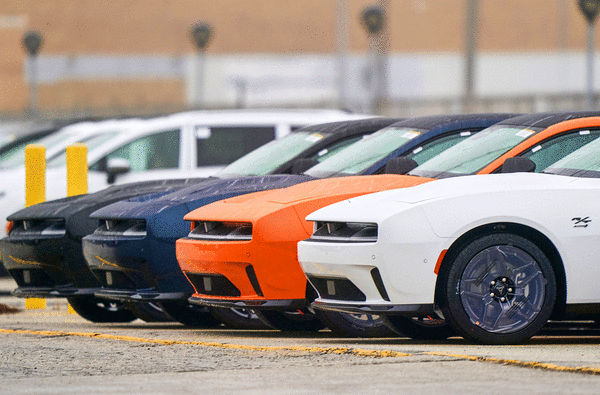
WASHINGTON — U.S. tariffs on all cars and trucks, automotive parts and steel will be increased to 50% starting January 1, 2027, President Donald Trump said in a social media post on Aug. 24 after trade talks with Canada collapsed.
"Build in the U.S. and there are ZERO TARIFFS. Canada will be treated like a State no longer!" Trump wrote.
"On Trade, and in other ways, also, they are among the worst Nations in the World to deal with. They feel entitled, and yet, WE DON’T NEED CANADA, THEY NEED US!"
Representatives for the White House did not immediately respond to a request for comment.
The two countries failed to reach a trade deal late on Aug. 21, with each side blaming the other as Canada readied tariffs on some U.S. goods in retaliation for 50% levies ordered by Trump on a series of other Canadian goods. Notable products on the list included cement, wine, dairy and hockey sticks.
Canadian Prime Minister Mark Carney said that the United States proposed last-minute changes in talks to avert Trump's ordered tariffs, saying the adjustments were "unfair, uneconomic and called into question the reliability of any deal."
Now Trump is escalating the trade tensions further, with a threat that could have significant implications for states like Michigan with automotive-heavy economies and major automakers like Ford Motor Co., General Motors Co. and Stellantis NV, which all have manufacturing operations in Canada.
All three companies immediately declined to comment on Trump's latest announcement, which cited agricultural issues as one reason for his newest threat on autos.
"Canada has been ripping off the United States of America for years. Their ridiculously high tariffs on our Farmers and farm products has made life impossible for these great American Patriots, and has long created a 60 Billion Dollar Deficit between our two Countries. Not sustainable, and NOT ANYMORE!" Trump wrote.
Currently, the United States' headline tariff rate for automotive goods coming from Canada is 25%, though the actual assessment rate is more complicated thanks to partial exemptions built around the United States-Mexico-Canada free trade agreement Trump signed during his first term.
Under the current arrangement, businesses have paid about $5.7 billion in import taxes on $61 billion worth of vehicles and car parts entering the United States from Canada since April 2025, according to a Detroit News analysis of federal trade data. That is an effective rate of about 9.4%.
The tariffs, according to analysts and free trade advocates, are already straining a North American auto industry that has relied for decades on linking supply chains between the United States, Canada and Mexico.
“We really need to look at this as a North American integrated industry," said Steve Verheul, formerly Canada’s chief USMCA negotiator and now a co-chair of the Coalition for North American Trade, in an Aug. 20 call with reporters.
He added: "The auto sector in North America does not work unless all three countries are operating as an integrated economy, and that's what we need to strive for at this point.”
Mexico, like Canada, faces the same current 25% U.S. tariff on autos. Trump and his allies have taken a friendlier tone with that country, but ongoing U.S.-Mexico talks over a wide range of trade issues have not produced a breakthrough.
The two countries have engaged in three rounds of formal talks on revising the USMCA, which Trump praised upon signing but has since condemned and defected from.
“I would tell you that there hasn't been much progress … between the second and third,” said Kenneth Smith Ramos, Mexico’s former chief USMCA negotiator and also a co-chair of CNAT.
He said that U.S. negotiators have been adding new issues to the discussion, especially around agriculture, rather than resolving existing ones related to regional content rules, labor and competition with China.
“That could complicate the discussions. It's already complicated enough.”
Auto industry skeptical of threat
As the auto industry took in Trump's latest threat, some warned of how dire the consequences would be while others expressed doubt that such a dramatic escalation would actually come to fruition.
Flavio Volpe, the president of Canada's Automotive Parts Manufacturers' Association, said on social media, "A threatened U.S. tariff on Canadian auto parts will be paid by (the) U.S. auto assembly. Without those specific parts, auto assembly throughout the U.S. would halt."
Auto executives, speaking to Reuters on the condition of anonymity, also raised skepticism about Trump's threat, noting that the president has previously announced large tariffs that never materialized and that any tariff of that size would likely spark a massive Canadian retaliation.
They also noted that January was months after November's midterm elections and said Trump's threat could be aimed at restarting talks.
The Alliance for Automotive Innovation, the top auto industry lobbying group in Washington, declined to comment.
Unifor, the Canadian union that represents autoworkers and employees in several other sectors, bashed Trump's announcement in a statement.
"Another Monday, another threat. Same message. President Trump’s latest intimidation tactic, threatening to impose 50% tariffs on Canadian cars, trucks, auto parts & steel is another attempt to force Canada into surrendering our auto industry & the good jobs that it supports," the union said.
The statement continued: "The U.S. administration fails to recognize that our highly integrated auto industry means ongoing instability hurts workers on both sides of the border & makes it increasingly difficult to build cars in North America. That’s the opposite of what auto workers need right now.
"Canadian and American auto workers have suffered the same fate, with plant closures and job losses because of significant non-North American imports. We need to resolve this, together."
The United Auto Workers union, Unifor's Detroit-based U.S. counterpart, did not immediately respond to a request for comment. The group has generally been supportive of Trump's past use of tariffs, though it has also criticized the administration for reaching trade deals with overseas partners like Japan.
Economist Patrick Anderson, CEO of the Lansing, Michigan-based Anderson Economic Group, said Trump's previous threats on items like feathers, honey, cotton sweaters and hockey sticks were "more of an annoyance than a real threat to trade with Canada," but Anderson characterized potential 50% tariffs on autos differently.
"(T)he promised 'dollar for dollar' Canadian retaliatory tariffs, and the just-threated tariffs on 'all Cars, Trucks, both large and small, Automotive Parts, and Steel' would be an absolute body blow to the auto industry on both sides of the border," Anderson said in an email, referencing comments from Carney and Trump.
He added: "It would mean plants closing, and many job losses in Michigan, Ontario, Ohio, Indiana, and Wisconsin."
"Both these countries have time to walk back from a real trade war before it happens. Let's hope they do, because nobody in North America will benefit from it."
Carney says autos, lack of US unity key in breakdown
Two automotive-related disagreements contributed to talks between the United States and Canada breaking down ahead of a Trump-imposed Aug. 21 tariff deadline, Carney told reporters over the weekend.
One was whether the Canadian parts inside vehicles would get exemptions from tariffs as American-made components already do under the current 25% vehicle import levies.
The other was how medium- and heavy-duty pickups made in Canada would be tariffed, Carney said. The two sides had been moving toward a deal that would have cut the tariff rate on vehicles to 15% with other carveouts included, multiple news reports stated.
But Carney said the American negotiators ultimately didn’t want to offer the same level of tariff relief for the larger and more powerful heavy-duty pickups, such as the Chevrolet’s Silverado HD and Ford’s Super Duty line. That would’ve meant GM trucks built at a plant in Oshawa and Ford pickups slated to soon start production in Oakville would not have received the same tariff relief as other vehicles.
“No rationale,” Carney said of why the American side had pushed for the heavy-duty exclusion. He added the terms would have “made the production (of these trucks) more uneconomic over time.”
Beyond the breakdown over autos, Carney also mentioned that U.S. officials had sought language to limit other outside trade deals that Canada could strike with other nations, language that he labeled as “unacceptable.” And the prime minister indicated that a lack of policy alignment on the U.S. side had hampered talks in the final days.
Carney, asked by a reporter if U.S. Commerce Secretary Howard Lutnick's involvement in negotiations impeded getting a deal done, said that was a question for the Trump administration.
"But I will say this, which is that the Canadian team: unified," the Canadian prime minister said. "... You cannot say that about the United States' administration."
©2026 www.detroitnews.com. Visit at detroitnews.com. Distributed by Tribune Content Agency, LLC.









Comments