WNBA players want teams to nip hateful online rhetoric in the bud -- and fans to focus on the basketball
Published in Basketball
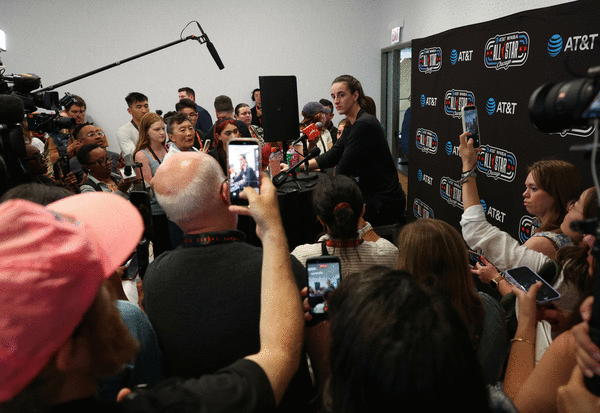
CHICAGO — When former President Barack Obama visited the WNBA All-Stars before practices Friday morning at the Obama Presidential Center, he made the rounds shaking hands with players. When he reached Indiana Fever star Caitlin Clark, he told her she was fantastic and then had some advice to offer.
“Don’t let all this nonsense get you down,” Obama told Clark. “I always say one of the things that was luckiest for me was I didn’t get famous until I was like 45. So I was an old-ass man. You’re my daughter’s age. … So don’t lose that joy.”
The nonsense is the hurricane of social media commentary that follows Clark’s every move. Debates ensue among critics, supporters and agitators every time she takes a hard foul or argues with an official, and anyone involved becomes sucked into the commentary, which many times centers on race.
The WNBA as a whole is grappling with how to deal with the microscope that comes with increased attention — and the hateful online rhetoric that sometimes accompanies it. Clark appreciated Obama’s words and his understanding of what it means to handle the scrutiny.
“I think sometimes people don’t always realize I’m 24 years old and I’m trying to navigate a lot of different things while trying to play basketball at the same time,” Clark said. “It was cool to hear that from him, and honestly it was probably a good reminder for all of us about treating people with respect, treating people with grace.”
Obama went on to compliment Clark on continuing to “hoop” in the face of a lot of off-court noise. Clark said she hasn’t lost the joy of playing the game and tries to maintain perspective about what happens on social media.
“We think (social media) is based in reality,” Clark said. “Don’t get me wrong, some of it is, but some of it’s not at the same time. I try to remind myself the best way I can, when you show up to the arena those are the people that truly care about the game and truly want to support the game. … (There are) people on the internet that write horrible things about people or whatever it is. There’s also a lot of really good people out there and there’s also a lot of people that love the WNBA and a lot of people that love and support me.”
Clark is far from the only player dealing with online controversies and hate.
Last week, the Las Vegas Aces released a statement condemning violent language used against players after star guard Chelsea Gray received an abusive message, including a racial slur in a social media direct message. The man who sent the message ultimately was fired by his employer, Hilton Grand Vacations, which offered a moment of vindication for players who face an increasing volume of similar messages.
“I think the Aces did a great job of speaking out on it, kind of nipping it in the bud instantly,” Aces star A’ja Wilson said. “That’s what you’ve got to do. I don’t like when things linger. It kind of sucks when it lingers because it allows a lot of things to seep in. So the biggest tangible thing is to really say things for what they are and just show us that you hear us, that you’re there for us and then we go from there. It starts with a conversation.”
The harassment of Gray focused on her inability to fulfill the specific statistics of a prop bet, which is a type of bet that hinges on the individual points, rebounds, assists or other aspects of performance for a player in one game.
These bets are often a driving force of individualized harassment for athletes across all sports. While that harassment might be rooted in the outcome of a gamble, it can quickly spiral into racial, homophobic and sexist language.
This isn’t a new problem in sports — but it is a relatively new issue for the WNBA. Even five years ago, most Vegas books did not offer lines or prop bets on WNBA games or players. The league’s popularity has opened it up to a wave of coverage and sponsorship but also to new sources of conflict through the culture of gambling.
“I think that a lot of this is coming from sports betting,” New York Liberty star Breanna Stewart said. “I guess because the sport’s getting bigger, that’s also why there’s sports betting, right? It’s a double-edged sword. Honestly I’m not super well-versed in all the different betting situations. I just think that with more eyes, with more viewers comes more good things and then more bad things. We’re trying to read between the lines and figure out how we can navigate this and go forward as we continue to grow.”
Player protection became a crucial cornerstone this season of all conversations surrounding the future of WNBA Commissioner Cathy Engelbert, whose contract is set to expire after this season.
Engelbert became the league’s commissioner in 2019. In the ensuing seven years, the WNBA has experienced unprecedented growth that includes a groundbreaking media-rights deal and expansion to six new markets. But league leadership often has chafed against players throughout Engelbert’s tenure, particularly during a contentious renegotiation of the collective bargaining agreement last offseason.
Players previously criticized Engelbert’s ability to build relationships as a key sticking point in her leadership. This concern spread to her approach toward enforcement of league suspensions and player protection from online attacks. Phoenix Mercury star Alyssa Thomas criticized Engelbert’s leadership after the forward said she received death threats and racial slurs following the league’s decision to suspend her for a game for a foul on Clark during a July game against the Indiana Fever.
Despite these issues, players were wary to dig in against the current commissioner during this weekend’s All-Star festivities.
“It’s not on me to decide,” WNBPA President Nneka Ogwumike said. “As players, when leadership is here, we rock with leadership. That’s my perspective. Cathy is here. I know there’s a lot of different conversations around the future of our leadership, but I told her that on Monday. This is who we got. This is what we all envisioned that we wanted us to be, and we’re going to rock with what we got.”
Dallas Wings guard Paige Bueckers didn’t directly address a question about WNBA leadership beyond saying the players were happy to get the CBA done. But she did talk about what she wishes the media got right about the WNBA.
To start, she stressed that physicality — and hard or flagrant fouls — are normal and have been a part of the league since its inception.
“You have the best women in the world competing against each other and trying to win, and stuff happens,” Bueckers said. “I just wish the discourse was a little bit more about basketball and less about all the other stuff and more people talked about how great the players are, how much skill is in the game, how much the game has grown, just the electricity of it right now. I just wish basketball was talked about a little more.”
©2026 Chicago Tribune. Visit chicagotribune.com. Distributed by Tribune Content Agency, LLC.




Comments