Commentary: Reject the Sand God. Call AI by its true name
Published in Political News
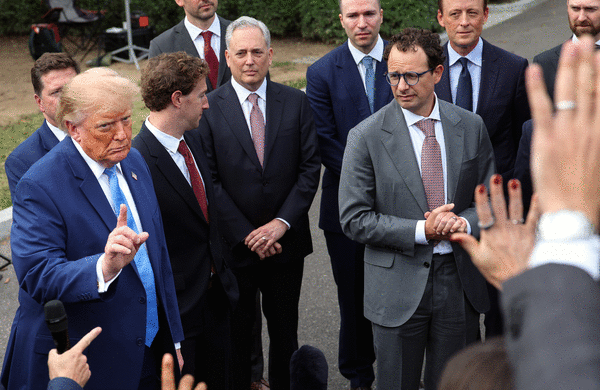
President Donald Trump recently signed an executive order telling federal agencies to replace the term "artificial intelligence" with "Super Intelligence." He said the word "artificial" makes the technology sound fake.
Many Americans already treat AI as a “super intelligence” that knows better and that they should confide in. Many already assign it the role of spiritual counsel, close confidante, or even romantic partner. In a Common Sense Media survey, one-third of teenagers claimed they had discussed serious personal matters with an AI instead of a person, and 31 percent said talking with an AI companion was as satisfying as talking with friends, or even more so. Bible Chat, an app that offers scripture-based advice and prayers, has been downloaded more than 30 million times.
The federally mandated rebrand encourages all of us to adopt the mental framework of viewing AI as so much more than a tool. Calling a chatbot "super" confers it a degree of esoteric knowledge, and almost, a degree of omniscience that supersedes that of a human. It confers a religious, near holy, status to an emerging technology.
I have been tracking AI’s effects on spiritual communities for the past 18 months. In June, we launched Faith Leaders for Secure AI, and more than 60 faith leaders from different denominations and faith traditions joined the launch. When I talk with faith leaders, their main concern isn't a robot uprising; it is an inversion of people’s spiritual lives, turning to tech where they should be seeking that fulfillment from a faith leader. It is the idea of congregants taking their problems to a chatbot instead of a person, and, ultimately changing their view of the human person and his or her place in the cosmos.
"Artificial" was an accurate word for describing the mechanics of machine learning. It reminded people that a company made up of flawed human beings built the product they’re using. Roboticists use the term "uncanny valley" for the discomfort people feel when a machine seems almost, but not entirely, human. That discomfort, that air of artificiality, was important in encouraging discernment in turning too much of our inner lives over to chatbots that to many sit in the gray area between man and machine.
Trump’s latest executive order directs agencies to "no longer acknowledge" the old terms. Reporters and executives, including Elon Musk, keep dead-naming the technology anyway, often catching themselves mid-sentence before reverting to doublespeak.
Joe Allen, a writer who has covered transhumanism for years, argues that the movement to merge humans with machines works like a religion. It is an effort to create "Sand Gods." These are digital deities driven by computer chips made from silicon, which comes from sand. Many transhumanist writers, he notes, describe the AI they hope to build in godlike terms.
Close readers of Genesis will notice something interesting about men creating Gods from sand. God formed man from the dust of the ground and breathed life into him. Now, tech bros are hoping to shape sand into silicon to build Super Computer Gods, transcend the mortal coil, and become God-like.
Chatbots are designed to keep users engaged. Heidi Campbell, a Texas A&M professor who studies religion and digital culture, has warned that they tell users what they want to hear. A pastor or a parent will sometimes tell you what you don't want to hear, and people need that in their lives.
What users type is also stored by the company that runs the app. A priest is bound to keep a confession. An app company is not; in fact, it is incentivized to harvest your data, your fears, your insecurities, and leverage them to keep you on the app.
Pastor Michael Grayston of LifeFamily Church in Austin, Texas, says people increasingly bring to AI the loneliness they once brought to friends or pastors. His view is simple: "AI cannot pray over your children."
Teenagers report the downside themselves. Drexel University researchers who studied teens' accounts of AI companions found that their use often began as emotional support and turned into dependency resembling addiction.
AI is useful for drafting emails and summarizing documents. It also often makes mistakes. A Florida woman spent 13 days in jail this year after investigators relied on a license plate camera hit; prosecutors later dropped the charges. Even our institutions and first responders are granting a degree of omniscience, of better knowledge than humans, in police work.
Here is what would help: Parents should know which AI apps their children use and talk with them about it. Pastors should address AI from the pulpit and be open about their own use. A Barna survey found that 24 percent of pastors use AI to help write or edit sermons. A guide for pastors by the Rev. Chris West, published by The Alliance for Secure AI, asks whether you would want a love letter from your spouse written by AI. Congregants deserve the same honesty.
Everyone else should keep calling it artificial intelligence. Use it for routine work, and bring personal problems to people.
Calling AI "super" doesn't make it omniscient or omnipresent. Reject the sand god. Call it AI.
_____
Nico Zviovich is an External Affairs and Coalitions Manager for The Alliance for Secure AI, and helped launch its Faith Leaders for Secure AI coalition.
_____
©2026 The Fulcrum. Visit at thefulcrum.us. Distributed by Tribune Content Agency, LLC.
































Comments