At Trump rallies, data centers take back seat to butts
Published in Political News
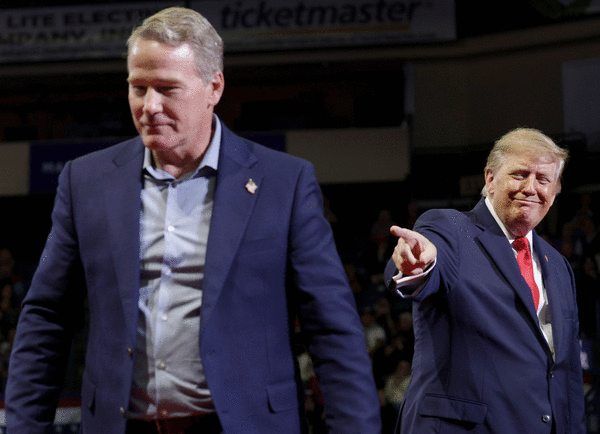
WASHINGTON — The backsides of Ohio GOP Sen. Jon Husted, rapper Nicki Minaj, even former Rep. Mike Rogers. As the midterm campaign enters its home stretch, President Donald Trump has talked up what he claims are the benefits of increasingly unpopular data centers, at the same time that he has made headlines taking about the physiques of Husted and others.
After being an outspoken proponent of the technology facilities for months, Trump has shifted to putting the onus on local jurisdictions to extract economic value. At a Saturday night rally in Perry, Ga., he said: “Tell them to pay you $10,000, $15,000, $20,000 for everybody that lives in the community — they’ll do it. You just got to ask.”
At the same time, he continues to discuss the literal bodies politic: During a Friday rally in Florida, he credited 72-year-old Health and Human Services Secretary Robert F. Kennedy, Jr., for having, “the body of a 30 year old.” At the Georgia weekend rally, the president focused on Democratic Sen. Jon Ossoff, calling him “a guy that looked very much to me like Pee-Wee Herman.”
There was plenty of time Tuesday night in Greenville, N.C., to make his pitch for data centers, which have become a big issue this election cycle. Trump set a new record for his second term, speaking for 1 hour and 51 minutes, besting his Feb. 24 State of the Union Address by 3 minutes and 14 seconds, according to Roll Call’s Factba.se. But Trump, a self-described data center true believer, didn’t bring up the sprawling, power-needy facilities.
Instead, Trump waited a few hours after returning to the White House to make another plug for the power-hungry facilities that have angered voters. He walked back into the executive mansion around 11 p.m. Tuesday night. About two-and-a-half hours later, at 1:37 a.m. Wednesday, he told his supporters to “make deals” around them.
“As the President of the United States, I have been watching Data Centers very closely, and have come to a very strong conclusion. New and large, in some cases gigantic, Data Centers are mandated by me to make their own electricity, and give or sell any excess back to the local community, or grid, and therefore there is electric price increase,” he wrote on his social media platform, Truth Social.
“If companies want to make their Data Centers popular, pay the community, and/or individuals within the community, a ‘dividend,’” he wrote before giving technology companies some guidance. “MAKE DEALS, and get them built!!! GREAT FOR THE U.S.A.”
Trump did make a passing mention of the facilities Wednesday night at a rally inside a livestock expo center in Clemson, S.C. — and the crowd reacted with silence. He said if the companies that own data centers begin paying local school systems, governments or residents, “all of a sudden you’re going to see data centers are going to be so popular.” But such comments get overshadowed by his other favored topics, according to transcripts compiled by Factba.se.
Husted, for instance, was very much on his mind in eastern North Carolina Tuesday as he stumped for his hand-picked GOP Senate candidate, Michael Whatley.
“I’m studying his body. I’ve never studied the body of a man before — it’s not my thing. Nothing wrong with it of course, nothing. I always precede by saying nothing wrong, but it’s never been my thing, to be honest with you, but I looked at his ass. And then I looked at his legs and … I said, ‘His ass is, it’s like it’s like a pile of muscle,’” the president said to laughter.
“Then I looked at his legs, and I said, ‘Man, his feet are big.’ Then I looked at his shoulders. And I tapped him on the shoulder, and it actually hurt my hand — it was like a piece of steel. And I said, ‘This guy’s a monster.’ And Jon Gruden told me that he was a violent tackler,” he said, referring to the former NFL head coach who played with Husted in college.
Trump spent nearly 10 minutes at a Sunday rally in Port Huron, Mich., saying the news media did not understand that he was joking about evaluating Husted. “I’ve been living with this whole thing about the ass,” he said. “And, believe me, it’s of no interest to me — except to say that Jon Husten is one hell of an athlete.” He told former Rep. Rogers, the GOP Senate nominee in Michigan, that he would say nice things about his rear end, too, if it would guarantee a GOP seat pick-up.
As voters fret about the cost of everyday life, he also on Sunday brought up the derrière of entertainer Minaj, who was at the Michigan rally: “By the way, I looked at one hell of a beautiful ass before: Nicki Minaj. That’s hard to miss. Stand up. That’s hard to miss.” But he did not plug data centers.
Vice President JD Vance, on the other hand, focused on Husted’s Senate voting record during a Wednesday rally in Cincinnati. “Don’t worry, I’m not gonna talk about Jon Husted’s ass. I’m not gonna do it,” the former Ohio senator quipped of his appointed successor.
Trump has seemed fixated on Husted’s build since Gruden told him about the senator’s days as a defensive back before an Oct. 3 rally in Vandalia, Ohio.
He did make a pitch for data centers at the Vandalia rally and one on Oct. 12 in Youngstown. But that was to boost Husted, who pushed for a vote on the “Ratepayer Protection Act” before the Senate broke for its campaign recess. That measure, which was not advanced by the Senate, would require state regulators to consider adopting standards to ensure large data centers pay for needed grid upgrades.
The White House responded to an email asking for comment about Trump’s rally mentions of the centers by providing a link to the Wednesday social media post, and provided a list of such projects and their economic benefits.
Natalie Baldassarre, national press secretary for the Republican National Committee, said in a Thursday statement that “Republicans put up legislation to protect Americans from increased costs associated with data centers and Democrats voted against it, forcing working families to foot the bill,” referring to the Husted-pushed measure. “Republicans are working alongside President Trump to build the AI infrastructure America needs while ensuring companies are paying their own way, shielding families from higher utility bills, and safeguarding local water and natural resources.”
“We’re also taking historic action to ensure that big tech data centers benefit local communities. We want them, look, there’s so much money to be made for Ohio, you can’t just turn them off. They’ll go to China,” Trump said in Vandalia.
“Jon Husted introduced the Ratepayer Protection Act to stop data centers from raising electricity costs and require them to pay their [fair share]. Good,” he added as the crowd began chanting the senator’s name.
Trump then moved onto other topics.
Husted’s opponent, former Democratic Sen. Sherrod Brown, has tried making his opponent’s name synonymous with data centers. Inside Elections with Nathan L. Gonzales lists the race as a toss up.
‘Surprising backlash’
Connecticut Rep. Jim Himes, poised to take the House Intelligence Committee gavel if Democrats win the House, said Wednesday “there is no doubt that there’s a surprising backlash against data centers out there — everywhere.”
“Even in rural communities, where power is cheaper, there’s a backlash,” Himes added during an event at the Brookings Institution.
That has created a political problem for Trump, who has focused much of his midterms campaign travel on rural locations.
Himes predicted the current “backlash is imminently solvable” once tech firms “figure out how to make a more attractive offer to communities.”
But negotiating such agreements, which typically take months or years, won’t happen until well after the Nov. 3 elections.
“The experts keep telling me the underlying demand for compute still looks infinite,” Himes said. “As long as that is a true fact, the build will happen. The question is how.”
The issue has crept into a number of House races.
Former NFL punter Jay Feely, the GOP nominee for Arizona’s open 1st District seat, on Sunday criticized his Democratic opponent, Amish Shah, over the matter. (Inside Elections on Oct. 15 shifted that race from a toss up to tilting toward Shah.)
“When he was in the [state] House, he voted for the tax credits to bring the data centers here. And now because they’re not politically popular, he’s against them,” Feely told “The Sunday Briefing” on Fox News Channel on Oct. 18, before delivering a very Trump-like description of the facilities’ potential economic impact.
“But we need to make sure that they’re not increasing the cost of energy for the local consumer, that they are using the recirculated water that uses less than the average golf course or bakery, and that they’re not being built in people’s backyards,” he said. “When you have those parameters, then they’re a win for the local economy. … We want those businesses here.”
The president on Friday again stopped short of predicting a big night for Republicans on Nov. 3, saying his party could retain control of the chambers “if I can get my voters out.”
“If we can’t get the voters out, I guess not. Typically, the president of, you know, Republican, Democrat, whatever, doesn’t do well,” he said of incumbent chiefs executives and midterm elections as he headed to a campaign rally in Florida. “So when I run 50% more people come in. I guess that’s good for me. I’d like to see if I can get a lot of them out now. If we do that, we’ll win easily in a landslide.”
©2026 CQ-Roll Call, Inc., All Rights Reserved. Visit cqrollcall.com. Distributed by Tribune Content Agency, LLC.





































Comments