Editorial: Big money can distort campaign reality
Published in Political News
If you’ve watched TV lately, you’ve probably seen this ad. Put out by Byron Donalds’ campaign, it features footage of a restaurant server, a utility worker and a senior-citizen couple, followed by a contemptuous voiceover accusing the Democratic gubernatorial candidate of wanting to raise taxes on tips, overtime, and Social Security.
The phrase “David Jolly wants to tax you more,” is repeated three times, in increasingly sneering tones. It’s a memorable spot, and good luck to anyone trying to forget it: It’s been aired so many times, people are making fun of it on social media.
It’s also a blatant lie. Florida has no income tax, and even as a member of Congress, Jolly never voted for measures that would target those categories of income for increased taxation. But by Election Day, it’s possible that a TV-watching Floridian will have seen the ad dozens of times. How many of those people will take the time to learn the facts?
That’s just one campaign ad, among the many littering local broadcasts. Ten billion dollars and counting is the latest estimate for what has already been spent on political ads that you can’t avoid unless you unplug your TV.
It’s projected to reach $11.6 billion by Nov. 3, and that would be the most spent in any election (the 2024 presidential cycle topped out at $11.2 billion).
Such a colossal waste
Imagine the good all that money could accomplish if it were spent instead on housing, healthcare or education. But there are more urgent questions:
— Where’s all that money coming from?
— What do donors expect for their money?
— What about real issues like the future of Social Security?
Central Florida voters are seeing some expensive contests play out — such as the race for U.S. House District 9, which was re-shaped to reach south. Incumbent Darren Soto has more money than most Democrats do, but his challenger Dan Green also has a healthy amount of money to pour into ads.
It’s the fight for control of Congress, in 30-second blasts. The commercials fly by so fast, with tiny disclaimers flashed at the very end, that it’s impossible to see who’s paying for what.
Most of the spending is negative not only because it works, but because loopholes in the election law encourage it. Ads paid by big-money political committees are not allowed to say “vote for” or “vote against,” so their best bang for the buck is to sling mud.
Billionaires buying elections
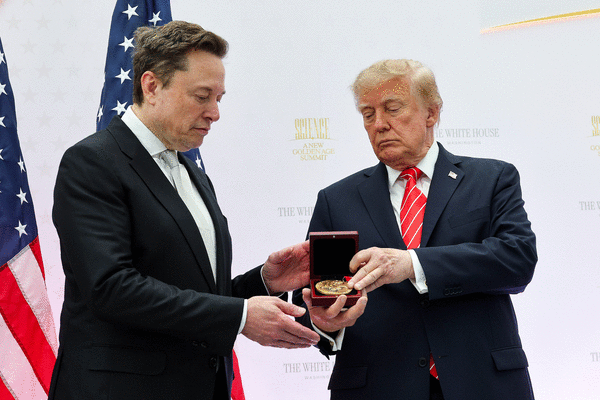
As to what donors expect, Elon Musk is the prime and most shocking example.
The largest known spender so far, he has given more than $276 million since July to Republican groups to save President Trump from facing a Democratic Congress and to protect the lucrative federal contracts of his Texas-based SpaceX company. Of the total, $158 million has gone to a super PAC supporting Texas’ corrupt attorney general, Ken Paxton, in his Senate race against Democrat James Talarico. We can’t find any going directly to Donalds, but Musk did send cash to a PAC that distributes its funds to GOP gubernatorial candidates.
Republicans have let their imagination and propaganda run wild about illegal voting by immigrants. But they have nothing to say about the corrupting influence of the money behind a legal immigrant named Musk. That’s a dangerous reality. Musk can cast only a single vote. Why should he be allowed to influence millions of others’ votes so lavishly?
“The American people believe in democracy — one person, one vote, not billionaires buying elections,” Sen. Bernie Sanders told a fired-up crowd of Democrats at a rally Sunday for Senate candidate Angie Nixon at the University of Florida in Gainesville.
Sanders has filed a constitutional amendment to overturn the Supreme Court’s disastrous 2010 Citizens United ruling that unleashed PACs on American democracy. It would also supersede a line of decisions dating to 1976 that made the sky the limit in campaign spending.
As hard as it is to pass a constitutional amendment, the need for this one has become dire. Florida is an obvious example why.
Bankrolled by for-profit prisons
In Florida, Byron Donalds topped $131 million in spending last week between his official campaign for governor and his much larger PAC, with a total of $38.1 million remaining.
A notable large new contribution to Friends of Byron Donalds is from the GEO Group, the massive private prison company headquartered in Boca Raton that has flourished under Trump and Gov. Ron DeSantis.
It gave another $1 million on Oct. 8 for a new total of $3.5 million. That’s the definition of pay-to-play politics.
As of earlier this week, Jolly has taken in some $21 million from all sources and has $4.8 million left.
His major notable new contributions: $3 million from a fundraiser featuring former President Bill Clinton, and $1 million from Henry Laufer of Manalapan, a retired Fort Lauderdale hedge fund billionaire and a major donor to other Democratic candidates, including former President Joe Biden. Jolly’s contributors are mostly individuals, although his PAC received $250,000 last week from the NEA Fund for Children and Public Education.
With fundraising this lopsided, Donalds clearly has an advantage, including a much larger opportunity to put out false information that Jolly literally cannot afford to rebut.
In colonial days, candidates wooed voters with whiskey at the polls and paid for it themselves. We won’t ever go back to those simple days, but today’s stupendously costly electioneering is truly an existential danger to our democracy.
_____
©2026 Orlando Sentinel. Visit at orlandosentinel.com. Distributed by Tribune Content Agency, LLC.








Comments