Editorial: The safety of your ballot is in your hands
Published in Political News
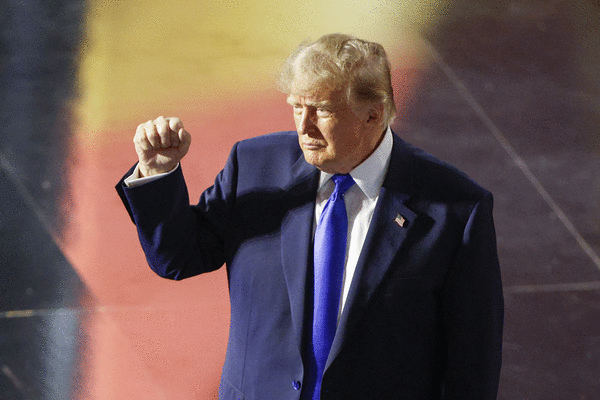
President Donald Trump reads the polls, too.
Terrified of a “Blue wave,” he’s working furiously to keep Democrats at bay and democracy on the ropes. First, he promised $5,000 checks to all Americans — a flat-out bribe, payable if Republicans remain in power. Then Trump told cheering supporters to “cheat like hell!”
There’s no limit to the lengths he’ll go to ensure a Republican victory on Nov. 3.
For the flimsiest technical reason, the Postal Service rejected a mail-in ballot envelope design to voters in (surprise!) deep-blue Tallahassee, in Leon County. The reason: the return address, in the upper left, fell 0.014 inches short of required white space above the words “Return Service Requested.”
Never mind that Leon County used the same design in the 2024 and 2026 primaries without objection.
But the Postal Service relented, and this week the Supreme Court blocked USPS rules that would have required states to upload voting information using an untried federal portal to a dubious database with barcodes that had not yet been created to determine who got a mail ballot.
It’s indiscriminate
Postal workers could make the call. If one ballot in a batch of 10,000 was suspect, all 10,000 ballots could be tossed. Voters would be left in the dark.
The technology was wrong. The procedures were wrong. But even if they were right, there is not enough staff, equipment or time to make it work nationwide, wrote Mark Earley, the diligent and detail-oriented Leon County Supervisor of Elections who submitted his ballot design for USPS review.
Earley and election experts nationwide signed onto legal briefs challenging the new rules. Local and state voting officials already screen for noncitizen voters, he wrote for a District of Columbia case. Empowering USPS, an agency with no experience in elections, would create more chaos and put ballots at risk. “It is tantamount to sabotage of the 2026 elections,” Earley wrote.
Some in state government are fine with that.
As state election officials reassured county supervisors in late August that their work would not be impacted by USPS changes, Attorney General James Uthmeier rushed into federal court to argue that the Supreme Court must side with the USPS and Trump. Justices Clarence Thomas and Samuel Alito Jr. voted to do just that, and Alito made it clear that concerns about possible chaos were outweighed by the right of USPS to create new rules.
Can courts stop him?
There’s no guarantee the 7-2 Supreme Court decision will stop or even slow other White House schemes to upend the November election.
A whistleblower at Homeland Security said hundreds of federal workers are scrubbing databases for suspected non-citizen voters. With almost no training, the whistleblower said, they are likely breaking laws by misrepresenting themselves in database searches, with “reckless” quotas leaving only about 12 minutes to determine on a case-by-case basis who’s an unlawful voter.
The Department of Justice has threatened top election officials in at least 30 states by notifying them they are “currently under investigation.” It is not clear why. In July, the DOJ announced any election supervisor who allows an undocumented citizen to vote or even remain on the voter rolls could go to prison, giving local supervisors every motivation to let fewer people vote.
One goal of this high-profile harassment is to create enough obstacles and discourage enough voters that they will simply sit out the election.
A legacy of voter suppression
For too long in America, voting has been too hard. If you were female, Black or brown, Native American, foreign-looking, poor or young, you risked being turned away at the ballot box. But people kept showing up.
Our elections remain secure. Voting early and in person can be done by appointment, and it eliminates the post office middleman.
So does personally dropping off a mail ballot at an elections drop box site. In some cases, a relative or friend can drop off the ballot. Mailed ballots also can be tracked, in real time, on a supervisor’s web page.
No one should sit this one out. Nov. 3 is still weeks away. That gives ample time to make a plan to vote, and plenty of time to push back against those who don’t want you to do so.
_____
©2026 South Florida Sun Sentinel. Visit at sun-sentinel.com. Distributed by Tribune Content Agency, LLC.







































Comments