Commentary: Uncontested elections are undermining American democracy
Published in Political News
The prevalence of uncontested elections in America—70% of all races in 2024—receives little attention. That’s partly because these races are often for local offices in small districts, but it’s also because many people don’t see these silent elections as a big problem. Some argue the absence of a challenger signals satisfaction with government or that the winner is a foregone conclusion and so it doesn’t matter if there is no challenger. This is misguided.
Unchecked silent elections stifle democratic dialogue and depress turnout. No challenger also means no campaign and no candidate debate, which limits opportunities for citizens to engage with multiple viewpoints and develop a habit of political engagement. When citizens are robbed of this, democratic culture erodes.
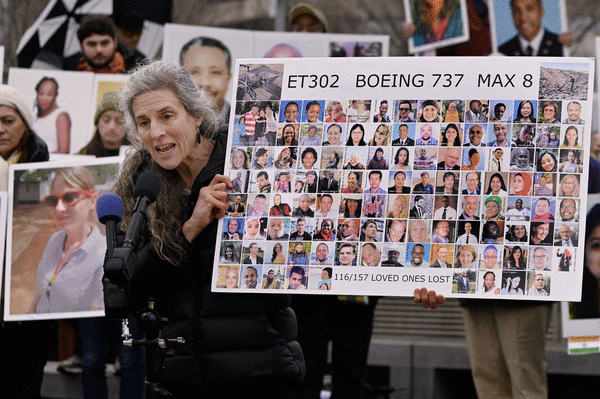
Nadia Milleron, an independent running for Congress in Massachusetts’ 1st district, agrees. “What kind of democracy is that if you don't have anyone running against someone who at the time had been in 36 years, earlier than the Berlin Wall falling,” she told me in reference to her 2024 and 2026 opponent, Congressman Richard Neal, first elected in 1988.
Milleron’s decision to challenge Neal was partially motivated by the knowledge that he would otherwise face no opponent. However, Milleron was also motivated by her experience dealing with Neal’s office. In 2019, Milleron’s daughter, Samya Stumo, was aboard a Boeing 737-MAX that crashed killing all on board. Milleron soon discovered that Boeing had hidden the plane’s deadly flaws and that the Federal Aviation Administration had allowed it to happen. Milleron felt she had to act. Her advocacy eventually helped pass the 2020 Aircraft Certification, Safety, and Accountability Act (ACSAA) overhauling aircraft certification.
While advocating for ACSAA, Milleron became exasperated by Neal’s refusal to meet with her despite her being a member of his district. Evidence suggests Milleron’s experience is common. Officials elected without competition skip more votes and sponsor less legislation than their peers who have won competitive elections. The more often a legislator goes unchallenged, the truer this becomes. These politicians also tend to be less responsive to constituent inquiries and requests. I experienced that too, as Neal’s office repeatedly ignored my requests for comment.
In addition to his lack of accessibility, Milleron grew to resent Neal’s extensive use of PAC funding, which she believes makes him beholden to corporate donors, not his constituents. PACs funded 75% of Neal’s 2024 campaign, the most of anyone in Congress.
To Milleron the solution is simple, “No corporate money should be in any election process. No corporate money at all.” Many share a form of this view, including Presidents Obama, Trump, and Biden. However, corporate money does have its defenders. Some political scientists argue that money has little impact on election outcomes because money flows to candidates already likely to win. They argue that well-funded candidates win because they are good candidates, not because they have more money.
Even if money in politics doesn’t change who wins, it changes who runs. Studies have shown that potential candidates without access to fundraising sources, like tradesmen, are less likely to run than candidates with access to fundraising sources, like lawyers. That means that money, not political debate, is filtering potential candidates. Sometimes this filtering process leaves just one candidate as would-be candidates abandon their campaigns in the face of massive funding disadvantages.
Something is lost when passionate candidates don’t run, even if they are unlikely to win. To run for Congress, Milleron collected the required signatures herself by talking to people outside a local grocery store. Milleron says of the experience, “You're able to talk with and show your sign to every single person. So I thought that was really good.” An aspiring politician speaking face-to-face with would-be constituents represents the best of American elections, an institution Alexis De Tocqueville praised for bringing “a multitude of citizens permanently together.” In silent elections, that is lost.
Milleron never considered challenging Neal in the democratic primary instead of the general election because she believes the two-party system obstructs action. When I ask Milleron how she sees herself ideologically, she rejects the question. “I really disagree with those categories. Moderate, liberal, left, right,” she says. “You're just in a club and you're not dealing with actual problems.” She knew she was unlikely to win a personally draining independent campaign. Friends told her not to run, but something urged her on. “I don't think it was a very carefully assessed decision,” she recalls. “It was more of an instinctive decision.”
Through friends, community outreach, and her personal funds, Milleron ended up raising a total of 350k for her campaign. Those funds let her buy political ads that raised her name recognition. “I know my district; I know what the people are like,” she recalls. “I just knew that I had to do that.” Congressman Neal ultimately outspent her 8-1.
Politics can be unforgiving to longshot candidates, but optimists can find reasons for hope. In 2024, Milleron won 37.5% of the vote in Massachusetts’ 1st district. Describing the outcome, Milleron’s tone mixes pride with resignation. “One hundred and thirty-three thousand, five hundred votes,” she recalls. “I got enough that I could win the midterm election.”
This fall Milleron will face Neal again. Of the 20+ candidates to have challenged Neal in the primary or general election over the course of his 38-year congressional career, she is the first to do so twice. Unfortunately, candidates like Milleron—competent individuals with passion, time, and resources—are rare.
The inherent challenges of running for office mean that candidates need to be competent, determined, and committed. Unfortunately, the barriers to running for office mean candidates must also be well-off and have abundant free time. Most people don’t meet those criteria, but they are governed primarily by those that do. This disconnect is bad for democracy. To address this gap we need more people to run for office, especially from unconventional backgrounds, and especially in districts with histories of uncontested elections.
Some people resist efforts to encourage more candidates to run, fearing that more candidate quantity means less candidate quality. When electoral fields become overly crowded, as was arguably the case with the 2016 Republican and the 2020 Democratic Presidential Primaries, discussion of individual attributes crowds out policy discourse. This concern is legitimate, but currently far more races suffer from a dearth of candidates than suffer from an onslaught of them.
Silent elections in America are a symptom of a political culture which makes it very difficult for people from less privileged backgrounds to enter politics. They are also inherently harmful to a democracy because of how they bypass the community-building and public debate aspects of an election.
____
Rafael Gonzalez is an MPP student at the Yale Jackson School of Global Affairs. Before graduate school, he worked for Boston Consulting Group, the World Food Programme, and the International Atomic Energy Agency. He has previously been published by Public Seminar for an article on industrial agriculture.
_____
©2026 The Fulcrum. Visit at thefulcrum.us. Distributed by Tribune Content Agency, LLC.










Comments