Trump cites unproven autism risk in attack on childhood vaccines
Published in Political News
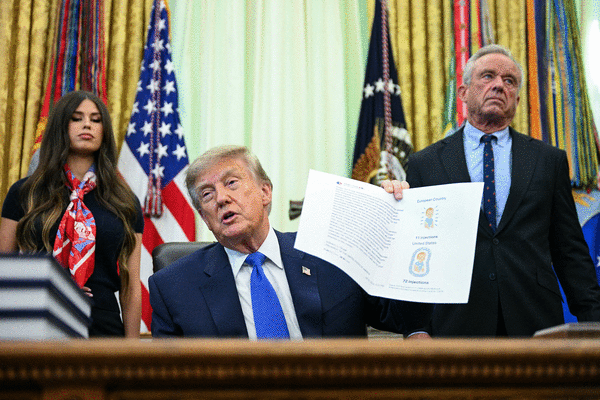
WASHINGTON — President Donald Trump renewed his administration’s efforts to dismantle the childhood vaccination schedule with a direct attack on the measles shot, returning to a politically unpopular issue and making unproven scientific claims just months ahead of the midterm elections.
Trump issued an executive order that recommends breaking up the combined measles, mumps and rubella vaccine into individual shots on Monday. Once-standard immunizations to prevent hepatitis B, Covid and the flu would no longer be universally endorsed. And immunizations would be divided into three categories — and given during separate medical visits — adding time and complexity to newborn medical care.
If implemented, the changes would mean parents would have to make more trips to the doctor to get the same protection against diseases for their young children.
That raises the risk that some would miss immunizations at a time when U.S. vaccination coverage is already eroding, putting more children in danger of becoming infected with a disease that could be prevented by the shots.
Trump connected the issue of vaccinations to rising rates of autism among U.S. children during the White House signing ceremony, despite the fact that scientific evidence has shown no link between the condition and immunizations. Months after Health Secretary Robert F. Kennedy Jr. stepped back from discussing his long-held anti-vaccine beliefs on the advice of political advisers, Trump reinvigorated the topic from the Oval Office.
“There’s a reason for such epidemic rates of autism, and we’re going to bring it back to much closer to where it was,” the president said. “While we do not know exactly what the cause is with respect to autism, it is essential to our research efforts that we have the very best vaccine recommendations in the entire world.”
He was more forceful about how the vaccine should be given, saying each component of the measles, mumps and rubella vaccine should be administered alone.
“We want three separate vaccinations, given at separate times,” Trump said. “Together, there could be a possibility they’re quite lethal,” he said, despite the fact that there is no evidence to back up such a claim. Two unvaccinated children died during a measles outbreak in Texas last year.
Officials from the American Academy of Pediatrics said the executive order would add to confusion and uncertainty among parents and likely result in at-risk kids missing or delaying useful vaccinations.
“The most tangible thing that will come out of the announcement today is confusion for parents,” said Aaron Milstone, member of the AAP’s Committee on Infectious Diseases, in a call with reporters. “I’m concerned about an unintended consequence of people under-vaccinating because of fear that giving a single dose of the MMR is going to put their child at risk when there’s no evidence to suggest that’s the case.”
The chances of the order going into effect are less clear. A federal court previously blocked proposed changes to the childhood immunization schedule because there’s no functioning federal committee to recommend changes.
The Health secretary must follow a legal process, including seeking advice from the panel, before overturning existing vaccine recommendations, said Lawrence Gostin, faculty director of the Institute for National and Global Health Law at Georgetown University.
“The President’s Executive Order is unscientific, dangerous, and unlawful,” Gostin said. “It will result in children skipping life saving vaccines and spreading preventable diseases.”
Vaccination spotlight
The order amounts to one of Trump’s most sweeping efforts yet to pare down vaccines recommended for children. The president turned his attention to the issue as he struggles to bring an end to the war in Iran and grapples with a shaky economy, all of which have put his fellow Republicans in danger of losing control of Congress in the November midterm elections.
It also puts a spotlight on a topic officials had previously sought to downplay ahead of the midterms.
An internal memo earlier this year advised health officials to focus on less divisive subjects like food guidelines and healthcare costs, as polling showed broad support for routine childhood vaccines in competitive election districts. A White House official said on Monday that the order was based on science and the president’s desire to communicate that to Americans.
The move drew the ire of Republican Senator Bill Cassidy of Louisiana, a medical doctor and frequent antagonist of Trump and Kennedy on public health policy, who called the executive order “wrong.”
“Breaking up vaccines will mean children have to get more shots to get the same protection, not fewer shots. It will increase hesitancy and make children less safe,” Cassidy said in a post on the social media platform X.
Despite the scientific consensus, some anti-vaccine activists believe that the MMR shot causes autism in kids, and by separating the shots, researchers would know which vaccine purportedly leads to development of the neurological disorder.
Under the order, the measles vaccine and inoculations for diphtheria, whooping cough, polio, chicken pox and HPV would still be recommended for all children. Shots for RSV, hepatitis A and B and meningitis would be reserved for high risk groups, while protections against flu and Covid would be determined by shared decision making between doctors and parents.
Federal and state officials are directed to implement the order, including adjustments about which shots would be required for school attendance. It directs the U.S. attorney general to take legal action against states that “violate” religious and medical exemptions, Trump said at the press conference.
Aluminum elements
The executive order directs an HHS task force to to present Trump with plans on separating the MMR vaccine within three months. The group also is being asked to develop alternatives to the aluminum that’s added to vaccines to boost the immune system response to them.
Trump previously expressed concerns about aluminum adjuvants in childhood vaccines during a press conference in September, where health officials suggested that using the over-the-counter painkiller Tylenol during pregnancy was linked to autism. Kennedy has a history of blaming aluminum in vaccines for various ailments.
The CDC website said that aluminum salts, used to strengthen the body’s immune system, “have been used safely in vaccines for decades,” though they can lead to more redness and pain at the injection site and more side effects like fever and chills. The CDC also cited an observational study from 2022 that showed a possible relationship between aluminum exposure and asthma, and said further investigation is needed.
A larger 2023 study conducted by Denmark’s public health agency found no association between aluminum adjuvants and asthma. Kennedy demanded that the Annals of Internal Medicine medical journal retract the Danish study, but the editors of the journal refused.
Earlier attempts
A May executive order sought to align U.S. shot schedules with countries that recommend fewer immunizations. A court has blocked other attempts by officials including Kennedy to alter official vaccine schedules and remake the advisory committee that oversees them.
Under the new order, children are recommended to receive protection for 11 diseases — down from 18. It also directs states that use school requirements to consider updating its laws based on the new recommendations.
Bloomberg News previously reported the Trump administration was considering an executive order on vaccines and autism, despite no scientific evidence suggesting a link.
The MMR is a two-dose combination shot that helps reduce the number of immunizations given to children. No vaccine is entirely perfect, but the MMR is one of the most effective shots on the market. It’s 97% effective in preventing a measles infection after two doses, according to the U.S. Centers for Disease Control and Prevention.
Splitting the shot could be expensive and complicated for MMR manufacturers Merck & Co. and GSK Plc. There is no evidence that there is any benefit to separating the combination shot, according to the Infectious Disease Society of America.
A Merck spokesperson said there has been no published scientific evidence that shows any benefit in separating the combination MMR vaccine into three individual shots and said evidence suggests that use of combination vaccines improves childhood vaccination outcomes.
Last year, Trump called for breaking up the shot into three separate vaccines. Then-acting director of the CDC Jim O’Neill called on drugmakers to “develop safe monovalent vaccines to replace the combined MMR,” in a social media post.
Japan stopped using the combination shot in 1993, leading to a huge spike in measles cases and more than 500 pediatric deaths about a decade later. The country only recently approved a triple combination MMR shot manufactured by Daiichi Sankyo, the first approval in 30 years.
Last year, a key U.S. vaccine advisory committee voted against Merck’s combination MMR and chickenpox shot in the youngest children due to an elevated risk of febrile seizures. About 15% of children under 4 take the shot.
_____
(With assistance from Madison Muller and Robert Langreth.)
_____
©2026 Bloomberg L.P. Visit bloomberg.com. Distributed by Tribune Content Agency, LLC.








































Comments