Commentary: Donald Trump's design depravity and disregard for expertise
Published in Political News
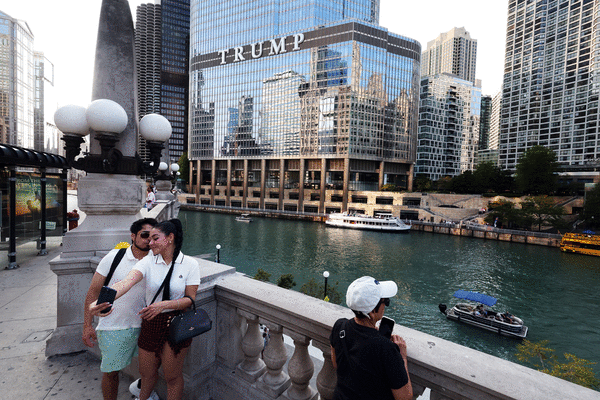
In June 2014, it seemed the entire city was upset when a certain New York real estate developer added five 20-foot-tall serifed letters spelling his name to the 16th floor of his eponymous tower facing the Chicago River.
That moment and the ensuing kerfuffle seem quite quaint now.
That unexpected design move — which defaced what is arguably the most architecturally distinguished building that bears Donald Trump’s name — was just a preface to what he’s doing at a far larger scale across Washington, D.C., and beyond.
There’s a weekly, sometimes daily, announcement of new design projects by the real estate president, and one never knows the full extent or budget for each project. But there’s seldom any necessity for them, and each reflects Trump’s never-ceasing capacity for self-regard.
The one constant is the absolute disregard for expertise that’s apparent in virtually every single example. There are many checks and balances that normally provide oversight of any architectural project that affects our public spaces. But Trump is now living the real estate developer’s fantasy — with seemingly no laws, no permits, no reviews, no budget and no outside expertise required. He’s genuinely making it up as he goes along.
And the cost can’t just be measured in dollars and cents. It’s part of a fundamental dismantling of process to satisfy one individual’s whims. And when there have been cursory reviews of some projects, they’ve been by panels that he’s stacked with grossly unqualified people, including members of the U.S. Commission of Fine Arts and the National Capital Planning Commission.
Trump’s “expertise” in building and design is highly overrated, as might be expected when you realize how few of the buildings that bear his name have any enduring architectural quality. In fact, his Chicago tower is of such quality in spite of the developer, who chose the local office of Skidmore, Owings & Merrill only when told that he needed a well-regarded Chicago architect to more easily gain city approvals. Even so, the city needed to strong-arm him when he tried to eliminate the spire from its top to cut his costs.
While the now-under-construction ballroom on the site of the demolished East Wing has garnered the most attention, Trump’s been remaking much of the White House’s extensive 82-acre grounds over the past year. This started with kitsch signage and a grotesquely curated “Gallery of Presidents” along the White House colonnade between the house and the West Wing.
Then the paving of the White House Rose Garden made a mockery of a garden. Similarly, the transformation of the center of the White House’s South Lawn into a helipad forfeits historic landscape for hardscape. This latest element was reportedly demolished because Trump didn’t like how the relatively flat platform was appearing within the sloped landscape. This is the sort of thing that could be avoided through careful planning and reviews by multiple interested parties. Since none of these appear to have been done, the costly changes are a direct result of Trump’s hubris and lack of respect for process and expertise.
The design of a new White House visitors screening center just south of the Treasury Department extends the range of new, poorly conceived classical elements in proximity of the White House. And the planned construction of permanent fencing around Lafayette Park, just north of the White House, will allow the quick and easy closure of this public space that has often been the site of public demonstrations that can capture the attention of the president.
The triumphal arch has been a stock figure in urban landscapes for millenniums. Washington’s lack of such a structure is a lesson in constitutional discretion — these United States have not needed to celebrate our triumphs in such a form. But Trump somehow feels that reaching 250 years is a grand triumph on his watch — even as he dismantles so many democratic features of our governance. And it needs to be big — because size seems to be the only true measure he understands, other than gilding (which will be prominently displayed on the multiple statues adorning said arch).
The 250-foot-tall structure will “adversely affect” 37 historic sites in the nation’s capital according to a recent Section 106 review by the National Park Service. This reasonable determination by the park service is based on the fact that the proposed arch is far too tall, based on both historical precedents and its location in the low-lying portions of Washington that have traditionally deferred — by law and custom — to the Capitol and Washington Monument.
And the very review of the arch that identified its adverse effects is in the crosshairs of the administration. New rules for Section 106 of the National Historic Preservation Act would limit or eliminate public comment and consultation with state and tribal officials regarding historic properties, allowing political actors to replace professional input as well as broader engagement with their own unfettered actions. This would affect more than just Trump’s pet projects; it would make historic preservation that much more difficult throughout the country.
“You are America. Unconstrained by habit and convention,” reads the text along the top of the new Obama Presidential Center in Jackson Park. But I don’t think President Barack Obama meant that a future president should be loosed as Trump has been to inflict his poorly conceived designs on America. The remainder of the Obama text invokes “we” as the essential ingredient in our shared public experience and future.
And there is no “we” in Trump’s design plans. “We” means that design must reflect and protect the public health, safety and welfare of us all — a stricture that binds every licensed architect practice to the public’s benefit. Trump’s current schemes are the ill-conceived designs of a man who has spent his career erecting mostly garish and architecturally undistinguished buildings around the world. The designs that he’s unleashing on Washington show that his lack of design savvy can’t be hidden by taking on classical garb.
And those five letters across the facade of Trump Tower Chicago that have mocked this fine city for more than a decade are but a footnote to the aesthetic carnage that Trump continues to deploy throughout the nation’s capital.
____
Edward Keegan writes, broadcasts and teaches on architectural subjects. Keegan’s architecture column is supported by a grant from former Tribune critic Blair Kamin, as administered by the not-for-profit Journalism Funding Partners. The Tribune maintains editorial control over assignments and content.
___
©2026 Chicago Tribune. Visit at chicagotribune.com. Distributed by Tribune Content Agency, LLC.










































Comments