Lawmakers want better data on AI's workforce impacts
Published in Political News
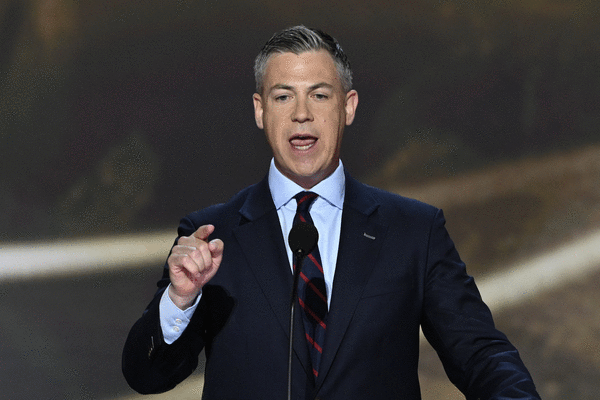
WASHINGTON — A bipartisan pair of senators is pushing for more and better data to understand the impact of artificial intelligence on the workforce.
That data could help back up what experts told a Senate subcommittee on Wednesday — that the biggest AI-fueled change may be different tasks at work rather than mass unemployment.
Sens. Jim Banks, R-Ind., and John Hickenlooper, D-Colo., urged support for their bill that would add questions to federal surveys about how AI is used in the workplace and which occupations are most impacted.
Banks introduced the bill, known as the AI Workforce Projections, Research and Evaluations to Promote AI Readiness and Employment, or AI Workforce PREPARE Act, in December.
At a hearing of the Senate Health, Education, Labor and Pensions Committee’s panel on Employment and Workforce Safety, which Banks chairs, he said that better data is a first step toward helping workers master skills needed “in the AI economy.”
“Existing labor statistics too often fail to tell us how occupations’ tasks are changing, what skills are needed, which jobs will grow and shrink and how workers move through the labor force because of AI,” Banks said.
The bill would allow the Labor Department to hire experts in AI and require the department to set up an AI Workforce Research Hub, monitor how employees move between jobs impacted by AI and develop benchmarks to measure which tasks may be automated, requiring employees to be retrained.
The bill would also encourage companies to voluntarily share data on their adoption of AI. It would require employers to disclose if AI was a factor in a mass layoff.
Sens. Maggie Hassan, D-N.H., Jon Husted, R-Ohio, and Roger Marshall, R-Kan., are also co-sponsors of the legislation.
Hickenlooper, who serves as ranking member of the panel, said in support of the bill that “informed policy starts with good data.”
He also said he’s working on another bill that he said would bring together “regional partnerships of educators, industry and intermediaries to provide credentials, apprenticeships, other … jobs and training that use AI,” to take advantage of expertise in a region’s workforce needs.
Hickenlooper said the bill would increase communication about forecasts for workforce needs in the age of AI, as well as strategies to respond.
Experts weigh in
The subcommittee heard from a panel of experts who underlined the need for better data and explained possible changes beyond the bill.
Carol Rogers, director of the Indiana Business Research Center, offered her support for Banks’ bill and urged the committee to “create standards for the definitions so that we compare apples to apples” in measuring AI’s impact on the workforce.
Liya Palagashvili, director of the Labor Policy Project at the Mercatus think tank at George Mason University, said that measurement systems should be “resilient across several possible futures.”
She said that data on AI in the labor market could be improved by “linking business surveys’ answers to actual hiring and wage outcomes” to allow comparisons based on whether a firm uses AI.
She also encouraged lawmakers to add occupational data to wage records reported by employers “so we can see which specific jobs are growing or shrinking.” She also requested a “timely measure of new solo independent business activity” to measure whether AI is increasing that type of work.
The panel experts largely downplayed concerns about mass unemployment, instead focusing on how AI could change the skills workers need and how they acquire them.
Palagashvili said that “early evidence does not yet show broad AI-driven employment loss.”
She said that current data on jobs for young workers in fields most exposed to AI is “more consistent with slower hiring than with layoffs” and that some of the slowdown may have begun before the release of major generative AI models, indicating that the hiring changes could be caused by other economic factors.
Ken Clark, president and CEO of workforce investment group EmployIndy, said that “AI is reshaping far more jobs than it’s replacing.”
“The greatest long-term workforce risk is not widespread unemployment,” Clark said. “It’s the disruption of career pathways that workers rely on to gain experience and continually develop new skills throughout their careers.”
Justin Heck, senior director of research and data production for skills-based hiring advocacy group Opportunity@Work, said that AI could also “hollow out” midlevel positions by removing friction points where employees learn necessary skills to move up in the workforce.
“A company that automates the demanding parts of jobs may see short-term efficiency gains while inadvertently dismantling the pipeline that produces its own future supervisors and managers,” Heck said.
©2026 CQ-Roll Call, Inc., All Rights Reserved. Visit cqrollcall.com. Distributed by Tribune Content Agency, LLC.


















































Comments