US Supreme Court declines to hear challenge to Illinois' law barring concealed carry of guns on public transit
Published in Political News
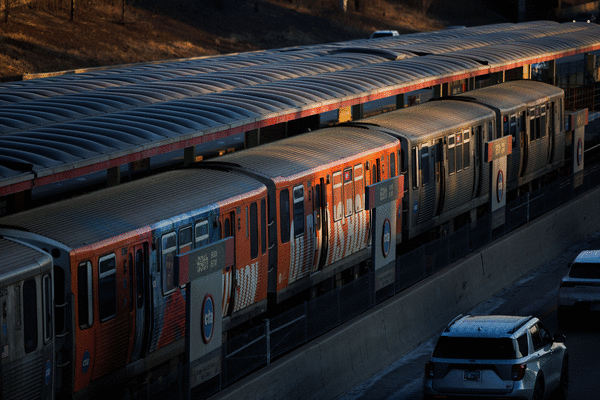
SPRINGFIELD — The U.S. Supreme Court on Monday declined to hear a legal challenge to an Illinois law barring concealed carry permit holders from carrying loaded guns on public transportation, leaving intact the state’s 2013 prohibition on firearms aboard buses and trains.
In September, a three-judge 7th U.S. Circuit Court of Appeals panel in Chicago overturned a 2024 ruling from U.S. District Judge Iain Johnston in Rockford, who found the public transportation provision of Illinois’ concealed carry law unconstitutional.
David Sigale, a lawyer for the Illinois State Rifle Association representing the plaintiffs, said in a prepared statement that he and his clients are “very disappointed” with the Supreme Court’s decision, “especially since law-abiding public transportation riders in Illinois are less safe as a result of the law.”
“We know that groups like the ISRA will continue to fight this prohibition in the legislative and political arenas, as well as the courts, so that Illinoisans’ Second Amendment rights will be respected,” Sigale said.
The office of Illinois Attorney General Kwame Raoul, a defendant in the case, could not be reached for comment immediately. But another defendant, Cook County State’s Attorney Eileen O’Neill Burke’s office, applauded the high court’s decision not to take up the case.
“Everyone deserves to feel safe on public transit. Minimizing the risk from dangerous weapons is crucial to protect members of the public who use this vital public resource,” Burke’s office said in a prepared statement. “We are pleased the Supreme Court agreed with our arguments, which will allow Illinois’ commonsense law banning firearms on public transportation to stand.”
Central to Johnston’s ruling was a constitutional standard requiring gun laws to be “historically” consistent with laws on the books in the 18th century, when the Second Amendment’s right to bear arms was ratified. That standard emerged from the U.S. Supreme Court’s landmark 2022 decision in New York State Rifle & Pistol Association v. Bruen, in which the court’s conservative 6-3 majority held that modern gun laws must be rooted in the nation’s historical tradition of firearm regulation.
Johnston, who Republican President Donald Trump nominated to the bench during his first term in 2020, ruled that historical laws cited by Illinois officials and other defendants “do not serve as an appropriate historical analogue” to the plaintiffs’ argument about their right to self-defense.
But the 7th Circuit reversed Johnston’s ruling, finding that Bruen does not prevent governments from restricting firearms in certain public places.
“The Second Amendment protects an individual’s right to self-defense. It does not bar the people’s representatives from enacting laws — consistent with our nation’s historical tradition of regulation — that ensure public transportation systems remain free from accessible firearms,” the 7th Circuit panel wrote. “We are asked whether the state may temporarily disarm its citizens as they travel in crowded and confined metal tubes unlike anything the Founders envisioned. We draw from the lessons of our nation’s historical regulatory traditions and find no Second Amendment violation in such a regulation.”
The three judges on the panel were Amy St. Eve, nominated by Trump in 2018; Kenneth Ripple, nominated by Republican President Ronald Reagan in 1985; and Joshua Kolar, nominated by Democratic President Joe Biden in 2024.
Beyond public transportation, Illinois’ 2013 concealed carry law prohibits permit holders from carrying firearms in government buildings, hospitals and stadiums during sporting events, among other locations.
The challenge to the law was brought by three suburban Chicago residents and one from DeKalb County, all concealed carry license holders who said they didn’t use public transportation as much as they would like because of the statute’s threat of criminal prosecution for carrying a concealed firearm on public transportation, according to court papers.
Johnston’s ruling came amid heightened concern about crime on Chicago’s transit system. The 7th Circuit’s ruling last September arrived a little more than a week before U.S. Transportation Secretary Sean Duffy sent a letter to the Chicago Transit Authority demanding a plan to reduce crime and fare evasion or risk losing federal funding. That letter also came after 23-year-old Iryna Zarutska was stabbed to death in August aboard a train in Charlotte, N.C. In November, a 26-year-old woman was set on fire in an apparently random attack on the CTA Blue Line.
The concealed carry case is among several recent legal challenges to Illinois gun laws. Challenges to the state’s assault weapons ban — signed by Gov. JB Pritzker in January 2023 following the Highland Park Fourth of July parade shooting that killed seven people — have largely failed. The 7th Circuit heard arguments on the ban’s constitutionality in September but has not yet issued a ruling.
____
©2026 Chicago Tribune. Visit at chicagotribune.com. Distributed by Tribune Content Agency, LLC.









































Comments