California dodges a bullet on Colorado River cuts
Published in Science & Technology News
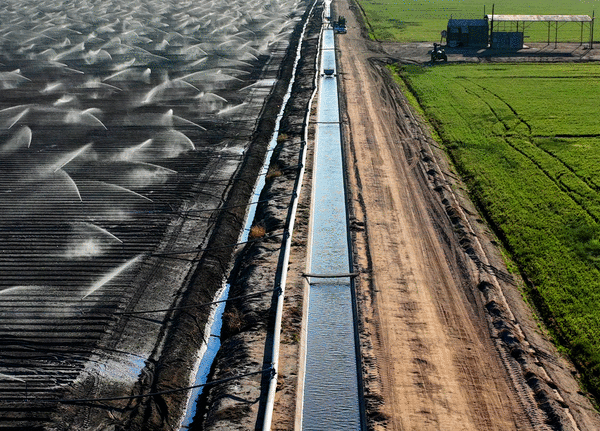
California and two other states have avoided the harshest water cutbacks the Trump administration could have imposed over the next two years to deal with the deepening crisis on the Colorado River.
The Los Angeles Times has learned that federal officials have agreed with an offer made earlier this year by California, Arizona and Nevada to reduce what they take from the river by at least 3.2 million acre-feet between now and the end of 2028.
Under the plan, California will cut its use of Colorado River water by about 12% through 2028, Arizona will take about 31% less and Nevada 28% less, according to two officials at state and local agencies who spoke anonymously since details of an announcement are still being finalized.
In May, the three states proposed these cuts for the next two and a half years, and now the federal government is set to sign off on much of their proposal. The Trump administration could have required cuts nearly twice as large.
The Colorado River provides water for about 35 million people and 5 million acres of farmland, from the Rocky Mountains to Southern California and northern Mexico. It has shrunk dramatically in the last 27 years, and research shows climate change is intensifying the extremely dry conditions.
The Trump administration’s two-year blueprint aims to strike a compromise between two quarreling groups: the three downstream states of California, Arizona and Nevada, and the upstream states of Colorado, Wyoming, Utah and New Mexico.
They’ve been at an impasse in negotiations while the river’s reservoirs continue to decline. Last week, the major reservoirs Lake Mead and Lake Powell fell to their lowest combined levels on record.
Near Las Vegas, Lake Mead is now 27% full. Lake Powell, on the Utah-Arizona border, is at just 23% of capacity. If it drops an additional 33 feet, water won’t reach its intakes to generate hydroelectric power.
While the lower states are avoiding even larger cuts for the time being, the Trump administration is rejecting other parts of their proposal. For example, the lower states pushed unsuccessfully for a federal promise to release more water each year from upstream reservoirs into Lake Mead, which holds water for California and other downstream states.
Federal officials have been in talks with state negotiators while preparing new rules for dealing with shortages over the next 10 years. The federal government must adopt a new framework this year because the old rules, set in 2007, are expiring.
U.S. Interior Secretary Doug Burgum met virtually with the governors of the seven states on Tuesday and said next week his agency will release a document — formally called a final environmental impact statement — detailing a new “operating framework.”
One state representative said this framework will essentially “define the corners of the football field” by outlining how large cuts should be based on reservoir levels. The official said the specific cutbacks in 2027 and 2028 will soon be detailed in a separate plan, which could later be revised if larger cuts are needed to prevent reservoirs from reaching dangerously low levels.
What happens after 2028 remains to be negotiated among the states.
The 10-year federal framework will enable much larger cutbacks if deemed necessary in future years — as much as 40% of the combined allotments of California, Arizona and Nevada.
The Bureau of Reclamation is not requiring water cuts for the four upper states over the next two years, the state and local officials said.
The Trump administration is, however, providing funds for water-saving efforts, including $350 million for the lower states and $100 million for the upper states. The money comes from the Biden-era Inflation Reduction Act, and will go to pay urban agencies that leave water in Lake Mead, and farmers and ranchers who agree to leave fields dry.
Some agreements have already been signed, while others are being drawn up.
For the Trump administration, accepting the three states’ proposal “is taking the path of least resistance,” said Felicia Marcus, a water researcher at Stanford University.
“It’s bigger than a Band-Aid, but smaller than the tourniquet we really need,” she said.
This year, the upper portion of the river’s watershed in the Rocky Mountains had the least snow on record.
Although the federal plan aims to slow the decline of Lake Powell, it may not be enough to prevent the loss of hydropower at Glen Canyon Dam as water levels continue dropping.
And there are no guarantees the states won’t be forced to take more dramatic action within the next two years, Marcus said.
Peter Soeth, a spokesperson for the U.S. Bureau of Reclamation, said the agency is working with state officials in developing the framework to “provide stability while allowing flexibility” to incorporate any future agreement among the states.
After Gov. Gavin Newsom’s meeting with Burgum and other governors, spokesperson Anthony Martinez said: “We look forward to the federal government finalizing durable operating rules, so the entire basin has clarity and certainty heading into the new water year.
“That said, we still have real concerns, and we’ll keep pressing for a plan that shares the responsibility fairly across all seven states.”
California uses more water from the Colorado River than any other state, mostly for agriculture, though the state has taken less in recent years.
Farms in the Imperial Valley, which produce crops from hay to vegetables, depend entirely on the river.
Cities across Southern California have been getting nearly one-fourth of their water from the river in recent years. It’s not yet clear how much they will need to cut back. Agencies are still working that out.
In the last three years, California and other states have turned to voluntary water cutbacks and federal payments to farmers who agree to leave fields dry part of the year.
Representatives of California, Arizona and Nevada agencies are meeting with federal officials in Las Vegas this week to finish a series of water-saving agreements for the next two years.
“This is a step in a long process,” said Bill Hasencamp, manager of Colorado River resources for the Metropolitan Water District. “We have a lot of work to do to get this plan in place.”
Hasencamp said many who are involved in the talks hope the two-year plan will keep them out of court. But he said the fact that there is now a plan doesn’t eliminate the possibility of a legal fight among states.
Clearly, it would be better to have a seven-state consensus, he said, and the 10-year federal framework leaves space to keep trying to reach one.
©2026 Los Angeles Times. Visit at latimes.com. Distributed by Tribune Content Agency, LLC.






Comments