Formerly endangered ospreys bounce back in record numbers in Pennsylvania
Published in Science & Technology News
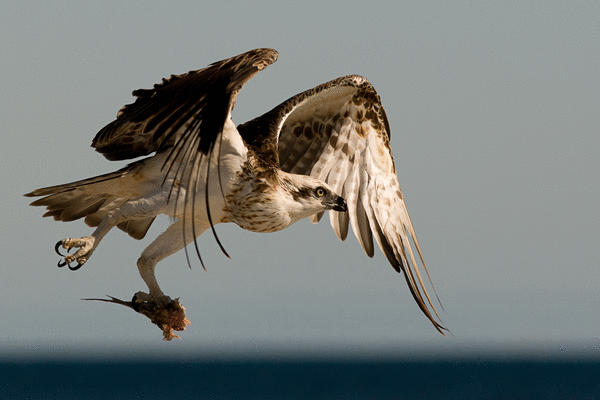
Pennsylvania may now have more ospreys than in pre-Colonial times, according to a biologist with the Pennsylvania Game Commission.
Osprey nest reports have increased 37-fold since the 1980s, according to surveys for the third Pennsylvania Bird Atlas. Unlike bald eagles, which glide as they fish, ospreys hover over the water, then dive, punching through the water’s surface.
Also known as a fish hawk, the brown and white raptors with dark wrist patches are almost 2 feet long and have a wingspan approaching 6 feet.
This spring, a local nature photographer was surprised to see an osprey defending its nest on a platform near a water tower in Sharpsburg. Steve Gosser of McCandless was looking for a fish crow when he came upon an osprey waiting for its mate to return to the nest.
After driving off three ravens, the osprey had to contend with two bald eagles that flew near the nest, and chased them as well. At long last, Gosser heard a fish crow.
“It occurred to me as I walked back to my car that seeing all of these bird species in the same place would have been unheard of in the Pittsburgh area just a few decades ago,” he said.
Roughly half a century ago, the osprey, bald eagle and peregrine all landed on the endangered species list for the same reasons — poor water quality, a beleaguered environment and the pesticide DDT, which compromised the viability of their eggshells.
All three species have recovered through the protection of the Endangered Species Act and were reintroduced in the state after the federal Clean Air and Clean Water acts were passed by Congress in 1963 and the early 1970s.
”We probably now have more ospreys in the state nesting than we did before the DDT collapse” and the early 1600s, said Patti Barber, endangered bird biologist with the Pennsylvania Game Commission.
“It’s really because of them adapting to human changes in Pennsylvania.”
Historically, ospreys nested in trees. Now they often choose to raise their families atop cell towers, utility poles and other manmade structures.
“They made that switch much more quickly than bald eagles,” she said. “A lot of the changes humans made to the landscape have benefited ospreys.”
Barber does not know of any ospreys nesting in a tree.
Counting birds
Preliminary fieldwork for the third Pennsylvania Bird Atlas is uncovering continued growth in osprey populations, especially in Allegheny County.
For the atlas, field research results are reported for 4,938 blocks in the commonwealth, each measuring about 3 by 3 miles.
In Allegheny County, there is now at least one osprey nest in 11 of 79 survey blocks. Compare that to 1983-1989, when there was at least one nest in only nine survey blocks in the county, said Amber Wiewel, the Pennsylvania Bird Atlas coordinator and an ecologist at Hawk Mountain Sanctuary in Berks County.
Atlas field research is in its third of five breeding season surveys. The hefty volume will be published in 2031 or 2032.
“Thanks to reintroduction and recovery efforts, ospreys have made a remarkable comeback since being extirpated from the commonwealth 50 years ago,” Wiewel said.
That is not the case in some parts of the country. Researchers have recently seen alarming osprey declines in the Chesapeake Bay region, likely due to the collapse in populations of menhaden, a fish that is a primary food source for osprey nestlings, Wiewel said.
“Because ospreys in Pennsylvania rely on different food sources, they are seemingly insulated from this particular issue,” she said.
The expanding population of the osprey’s main competitor, the bald eagle, could also influence osprey populations, she said.
Ospreys in Erie
About 15 years ago, James R. Hill III erected his first osprey platform at his home by a marsh in Waterford, Erie County. Soon, he spotted new neighbors on the scope he set up in his living room.
Those ospreys were among the first breeding pairs in the county. The birds were not reported in records dating back to the 1800s, Hill said.
“This is a new phenomenon, them coming here,” he said.
“I think it is cool you can build a platform with the right habitat and get the birds. If you put up a purple martin house and get martins, you are the happiest person in the world.”
A lifelong ornithologist, Hill is the founder and executive director emeritus of the Purple Martin Conservation Association at the Tom Ridge Environmental Center in Erie.
He reported the osprey nests to eBird, a crowd-sourced citizen science website. Now retired, Hill is formally counting osprey nests for the third bird breeding atlas.
“I got interested because I had ospreys in my own backyard. I saw their population explode and thought, someone has to document it.”
The work is gratifying, he said, providing purpose and an opportunity to research and document the phenomenon.
“It’s science and hobby. It’s like a scavenger hunt,” Hill said.
Pinging cell towers
He has been documenting the osprey in Erie and Crawford Counties, including Pymatuning Lake, and has made his way to Mercer County as well. In Mercer, he knows of six nests, but he thinks there might be more than 30.
Hill has noticed the ospreys’ affinity for manmade towers, some over 200 feet tall.
“They love the light poles at race tracks at Lake Erie Speedway and the Wattsburg Erie County fairgrounds,” he said.
By far, the majority nest on the tops of cell towers, Hill said.
“The owners of the towers sometimes tear out their nests over the winter, but the birds just build back when they return from migration.”
At Presque Isle State Park, ospreys sometimes build nests in dead tree snags, but high winds often destroy those nests.
“Manmade structures give them more guardrails so they don’t blow out from the storms,” Hill said.
Hill has documented a rise in the number of nests in Erie County, which now has close to 30 osprey pairs.
“I think it’s going to keep going up,” he said.
Wiewel is looking for volunteers for field surveys for the Pennsylvania Bird Atlas in Fayette and Washington counties. If interested, contact organizers at ebird.org.
_____
© 2026 the Pittsburgh Post-Gazette. Visit www.post-gazette.com. Distributed by Tribune Content Agency, LLC.






Comments