The Door Is the Whole World: How Cats Turn Thresholds Into Territory
Published in Cats & Dogs News
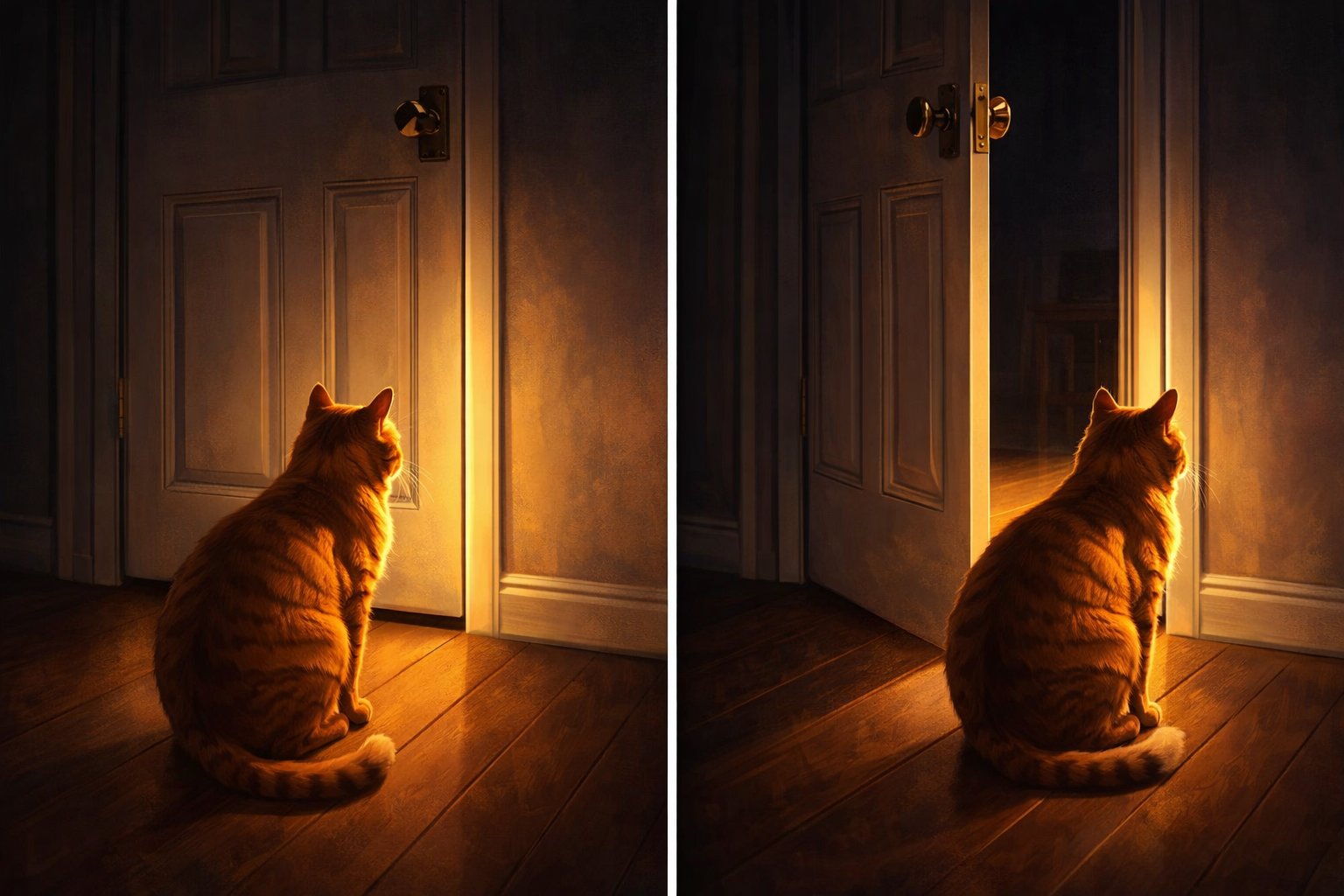
The front door is closed. Nothing moves. The house is quiet. And yet, for the cat sitting three inches from the threshold, everything is happening.
The ears are forward. The body is still but alert, weight balanced in a way that suggests either patience or imminent action. A faint sound—perhaps nothing more than a shift in air pressure—registers as meaningful. The door is not just a barrier. It is an event. It is a question waiting to be answered.
Across households, from small apartments to sprawling homes, cats gravitate to thresholds with a consistency that borders on ritual. They sit at doors, pause in hallways, hover at the edge of rooms. To human eyes, it can look like indecision or stubbornness. To the cat, it is something closer to engagement with the most important part of its world: the boundary between what is known and what is not.
The Threshold as Territory
Cats are often described as territorial animals, but that territory is not simply a fixed map of rooms and furniture. It is dynamic, layered, and constantly renegotiated. A doorway is not just a passage between spaces; it is a point of control.
From that position, a cat can monitor movement, scent, and sound. The front door carries the outside world inward—new smells on shoes, changes in weather, distant animals passing unseen. Interior doors hold subtler distinctions: the difference between quiet and activity, between access and exclusion.
Some cats claim thresholds with quiet authority. A large tuxedo cat in one household has gradually expanded his range over the years, moving from strictly indoors to a roaming presence in the neighborhood. Yet even as he comes and goes, the door remains a focal point. He pauses there, assessing, deciding, holding both worlds in balance.
Others treat the same space with caution. A smaller cat, more reserved, will approach the doorway only so far as necessary, stopping at an invisible line and observing from a distance. The door is not an invitation but a boundary to be respected, even as it is watched closely.
The Drama of the Closed Door
Few things command a cat’s attention like a closed door that was previously open. The change itself becomes the event.
A cat may sit before the door and wait, not in frustration but in expectation. The door is now an active element in the environment, and its state must be understood. Is it permanent? Temporary? Who controls it? What lies beyond it now that access has been removed?
The human response—opening the door—does not resolve the situation as much as it advances it. Often, the cat will remain in place, considering the newly opened space without immediately crossing the threshold. The act of opening was the point. What comes next requires its own evaluation.
This pattern repeats in smaller ways throughout the home. A bathroom door left ajar invites inspection. A closet door, once closed, now slightly open, demands investigation. Even a refrigerator door can trigger a similar response, less about food than about the sudden reconfiguration of space and scent.
Edges, Not Centers
Unlike humans, who tend to occupy the center of a room, cats often prefer its edges. The perimeter offers visibility, security, and control. From the edge, a cat can see without being seen, move without being obstructed, and retreat without delay.
A doorway is the most concentrated form of that edge. It compresses two spaces into a single, narrow frame. It offers information in both directions. It allows the cat to remain partially in one world while evaluating another.
In multi-cat households, thresholds can become shared or contested zones. One cat may linger just inside a room, another just outside, both aware of the other’s presence without direct engagement. The doorway becomes a line of negotiation, a place where hierarchy and tolerance are quietly established.
An older cat, long accustomed to both indoor comfort and occasional outdoor exploration, may treat thresholds with a kind of practiced indifference. She will step across them without ceremony, having long ago mapped their meaning. But even she will pause at times, not out of uncertainty but out of habit, as if acknowledging the boundary before passing through it.
The Human Misreading
To human observers, the behavior can appear contradictory. A cat sits at a door, the door is opened, and the cat does not move. Moments later, the same cat may demand access again, only to repeat the cycle.
This is often interpreted as indecision or stubbornness. In reality, it reflects a difference in how space is experienced. For the cat, the act of opening the door is itself a meaningful change. The new state must be assessed independently of the old.
Humans tend to see doors as functional—either open or closed, either permitting passage or denying it. Cats see them as states within a larger system, each with its own implications.
In that sense, the cat is not asking to go through the door. It is asking to understand it.
A World Defined by Boundaries
The idea that “the door is the whole world” is not literal, but it is instructive. For a cat, the most significant parts of its environment are not always the largest or most obvious. They are the places where change happens, where information enters, where control can be exercised.
A sunlit patch of floor may offer comfort. A favorite box may offer security. But a doorway offers something else: awareness.
In a quiet house, a cat sitting at a threshold is not idle. It is engaged in the ongoing work of mapping its world, updating its understanding, and maintaining its place within it.
The door may open. It may close. It may remain unchanged for hours. None of that diminishes its importance.
Because for the cat, the threshold is not simply a passage.
It is where the world happens.
========
Marin Ellery is a features writer specializing in everyday environments and the subtle behaviors that shape domestic life. She lives in a house quietly governed by animals who pay close attention to doors. This article was written, in part, utilizing AI tools.








Comments