Documentary in works about 'best place to hear live music in San Francisco'
Published in Entertainment News
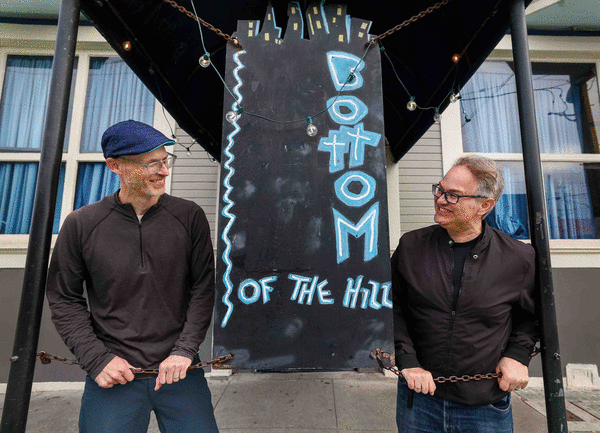
SAN JOSE, Calif. — Filmmakers Kevin Smokler and Christopher Boone were interested in making a movie about a famous music club. It just took them a while before they connected with the right one.
“We had been playing with the idea of doing a feature-length project on music venues and what makes them special,” remembers Smokler, a San Francisco-based director. “And we had been talking for a while with the 9:30 Club in Washington, D.C., about it — because we both went to college fairly close by, and I had some really good experiences at that venue, and we knew that venue was very special.”
But those talks broke down — amicably, Smokler makes sure to point out — and the filmmakers turned their attention to finding something in the Bay Area.
That led to some early conversations with the owners of the Bottom of the Hill, who were open to doing a film project about their iconic independent music venue in San Francisco.
What the filmmakers didn’t realize, however, was that they were having these conversations at a historically significant moment. And that the storyline would get a lot more dramatic, timely and newsy once the club’s three owners — Ramona Downey, Kathleen Owen and Lynn Schwarz — announced in early January that they were closing the legendary Potrero Hill club after 35 years.
Yet, they weren’t doing so immediately, but rather giving all their loyal concertgoers from over the decades a full year to come by and pay their respects before the club closes with a New Year’s Eve 2026 blow-out.
“We had to have a real heart-to-heart with Lynn, where she said, ‘Listen, this is what the next year is going to look like. And if this changes things for your movie, no hard feelings,’” Smokler says. “And we said, ‘It might change the story we want to tell, but we think it’s still just as important. And it just means we’re going to have to move faster, but that is our problem and not yours.’”
In hindsight, Smokler says the news of the impending closure “was probably the kick in the rear we needed to get this project going.”
“Yeah, so it definitely put things in high gear,” Boone says in agreement. “We were hoping that, at best, we would be starting this thing in the summer this year. And this news was, ‘Nope, nope. Can’t wait until summer to get started — we’ve got to get moving faster.’”
The filmmakers now consider the timing of the announcement — and the fact that they were in discussions with the venue owners before the announcement was made — to have been quite fortuitous. It wasn’t something that they could have planned, but rather, as Smokler puts it, “blind luck.”
And it definitely has served to add buzz to the film project.
“Honestly, it helps us, as we’ve been talking with people and getting them excited about the project,” says Boone, who is based in New Mexico. “Because as soon as (the venue owners) made their announcement, I think one of the very first comments was, ‘Somebody should make a documentary about the Bottom of the Hill.’ To which, they responded, ‘Somebody is.’”
And, no doubt, the Bottom of the Hill documentary appears to be in very capable hands with Smokler and Boone. They have previously illustrated their knowledge of — and passion for — music with 2020’s “Vinyl Nation,” the acclaimed documentary film about the staggering resurgence of interest in vinyl records.
The fact that Smokler and Boone were already in talks with the Bottom of the Hill owners about a film project before the news cycle kicked into gear leads many to believe in their ability to get the story right.
For, without a doubt, this is a venue that would deserve the full-length feature film treatment even if it wasn’t closing.
“We were also drawn to their story because they are an independent venue —-which is an incredibly difficult row to hoe in any city, but particularly in a city where running a small business is as pricey as it is in San Francisco,” Smokler says. “And it is run by three women, which is a rarity in the live music venue business.
“So, we love that story.”
Of course, there are many other chapters to the story of this club — which was once dubbed as “the best place to hear live music in San Francisco” by Rolling Stone magazine. Notably, it’s hosted no small share of rising talents over the years, including early-career sets from Oasis, Alanis Morissette, The Strokes and other acts that would go on to headline major arenas and festivals. Those kinds of historic highlights will surely be in the mix as Smokler and Boone’s film crew convenes for multiple shoots at the venue over the months to come.
Yet, despite all the well-known names that have taken the stage over the decades, the true stars of this Bottom of the Hill storyline are the three owners — Downey, Owen and Schwarz.
For this is not a tale of something gone wrong, such as rising rents, redevelopment woes, etc. Rather, it’s one about three accomplished club owners who get to ride off into the sunset — or, perhaps, onward to their next cool adventure — on their own terms.
“They own the building there — there’s no landlord beef because they are the landlords,” says Smokler, singling out one of the things that separates the Bottom of the Hill story from that of many other local music venues. “And that they’ve decided it’s time to move on and try something else means — the rarest of rarities in San Francisco — you get to tell a story about an institution closing that is a happy ending.
“The urge to lump this in with the closing of Thee Parkside because of their proximity to one another is understandable, but it’s a very different set of circumstances, and I think our movie will make that clear.”
For upcoming concerts and other information about Bottom of the Hill, visit bottomofthehill.com.
©2026 MediaNews Group, Inc. Visit at mercurynews.com. Distributed by Tribune Content Agency, LLC.











Comments