Spielberg's new alien movie asks: Who gets to decide the truth?
Published in Entertainment News

In 1977, Steven Spielberg’s "Close Encounters of the Third Kind" imagined contact with aliens as an event inspiring awe. Five years later, "E.T. the Extra-Terrestrial" envisioned another arrival as a story about connection, loneliness and friendship.
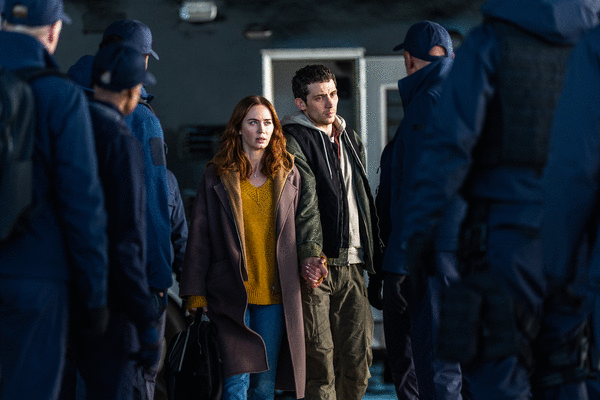
Now the mega-director is taking another look at the great unknown with "Disclosure Day." Industry watchers expect the sci-fi thriller to gross some $65 million this opening weekend and give Spielberg a blockbuster comeback after two back-to-back box office misses. It stars a career-best Emily Blunt as a Kansas City meteorologist with a hidden past and superhuman empathy, alongside Josh O’Connor as a whistleblower who wants to expose a 70-year-long cover-up about the existence of alien life. David Koepp ("Jurassic Park") wrote the script from an original story by Spielberg.
"Disclosure Day" is less interested in aliens or world-ending threats than revelation itself. Spielberg positions news cameras as truth tellers, with pivotal scenes taking place in a live TV news studio. The movie is an ideal companion piece to "Close Encounters" and "E.T.," but here a filmmaker known for optimism seems to be wrestling with some new doubts about humanity. Ultimately, he returns to the mystery that’s long obsessed him and comes to the same spiritual conclusion: Something important lies just beyond our view.
It’s incredibly well-timed. Arriving amid government file releases, congressional hearings on UFOs and renewed public fascination with the unexplained, the film explores a question more political than fantastical: Who gets to decide the truth?
Just last month, two releases of U.S. government files further moved the unexplained from the realm of science fiction into the official record and legitimacy. In a social media post, President Donald Trump said that, after studying the files, “the people can decide for themselves, ‘WHAT THE HELL IS GOING ON?’ Have Fun and Enjoy!”
The publication of the files fundamentally changed little in the real-life narrative. There was nothing shocking in them, mostly blurry photos of lights and amorphous objects that could be anything, kicking Reddit discourse into overdrive. One user, N0SF3RATU, posted, “They are doing this so they can say they release the files while keeping the real stuff hidden,” showing how the release gave more questions than answers for one group of believers.
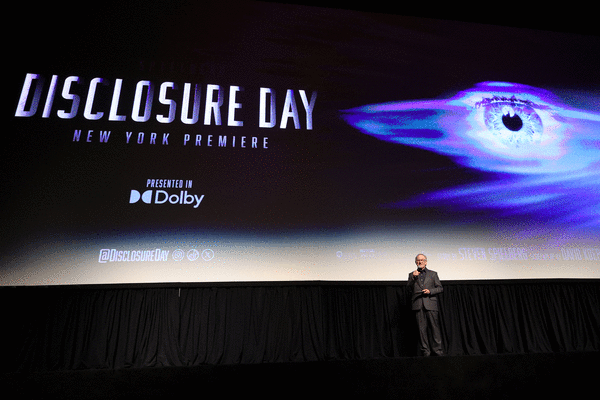
Congressional hearings held in 2022 and 2023 previously brought UFOs into the public record, with Spielberg telling "The Today Show" that listening to them helped inspire this film. The U.S. military now has an office dedicated to this phenomenon, even if the evidence remains flimsy. And Spielberg himself has been woven into a conspiracy theory that he’s working with the White House to prepare public perception: “I’m not a plant of the Pentagon,” he declared at the New York premiere June 8.
For decades, official institutions largely kept discussion of UFOs at arm’s length, starting with the 1947 incident in Roswell, New Mexico, when the U.S. military announced it had found a “flying disc” before quickly retracting and calling it a weather balloon. Pop culture has kept theories of an alien cover-up alive despite official denials ever since.
That’s changing, says Greg Eghigian, a history professor at Penn State University and author of "After the Flying Saucers Came," detailing the history of UFOs and the public’s reaction to them. “The thing that interests me is the actual legitimacy that has been granted to the subject by institutions that have historically said ‘We want to push this away from us,’” says Eghigian, referring to both military intelligence and civilian academics.
But we are in a ripe moment for this, he says. The Cold War helped fuel decades of public and government attention to unexplained sightings. More recently, the pandemic stoked fears about dark government actions, both in how COVID-19 came to be and about the vaccines created to stop the spread of it. Now couple that paranoia with increasing geopolitical tension with China and Russia and advances in surveillance technology.
Conspiracy theories have moved to the mainstream, even if the ideas fueling them aren’t new in American culture. The ’90s sci-fi show "The X-Files" feature a cynic and a believer worked together to find the truth; last year’s hostage drama "Bugonia," by Yorgos Lanthimos, imagined a basement-dwelling tinfoil-hat type who was actually onto something.
"Bugonia" and "Disclosure Day" have been created in a much broader ecosystem of suspicion. In the past 20 years, unproven conspiracy theories on everything from Sept. 11 to President Barack Obama’s birth certificate to QAnon and Pizzagate have taken on lives of their own. Elections have been called into question, with President Trump claiming widespread voter fraud without evidence in 2020 and again this summer, after the California primaries. (Spielberg is not about suggesting his own conspiracies: Remember the ending of "Raiders of the Lost Ark" when the Ark of the Covenant is boxed up and wheeled into a vast government warehouse?)
Perhaps no institution has been knocked quite as hard as the Fourth Estate, with a real crisis in trust happening over the past decade of “fake news.” According to Gallup, roughly 7 in 10 Americans trusted the mainstream media in the 1970s, when Spielberg made "Close Encounters." By 2025, fewer than 3 in 10 did, a record-low according to the polls. But Spielberg, who also made "The Post," a 2017 film positioning journalists as heroes in the Watergate era, still seems to believe in its power. TV producers play an essential role in "Disclosure Day," exposing the truth about alien life in the film.
The film resonates especially strongly today, as our fascination with UFOs unfolds alongside a broader crisis of verification. Artificial intelligence has made it easier than ever to create convincing images, videos and documents, while social media pummels audiences with competing claims and interpretations. "Close Encounters" was made in an era when photographic evidence carried authority. "Disclosure Day" arrives at a moment when anyone can ask ChatGPT to create a UFO “photo” and do their own “research” on X threads and message boards.
“We’re interested in separating the signal from the noise,” Penn State’s Eghigian says of his work, “and the noise is deafening now.”
One of the defining features of contemporary UFO culture is that debates often revolve less around extraterrestrial life than around what officials know, when and how they learned it and whether they are telling the public the truth.
The difference between the Spielberg of "Close Encounters" and the Spielberg of "Disclosure Day" is his tone. The new film strikes more skeptical notes about misinformation and institutional trust — secrecy is its central preoccupation. At one point in the film, a nun tells a character struggling with her faith amid the great alien reveal that she hasn’t lost faith in God but in people. You have to wonder if the 79-year-old filmmaker feels the same way.
©2026 Bloomberg L.P. Visit bloomberg.com. Distributed by Tribune Content Agency, LLC.










Comments