America’s 2-party system seems weird, but adding a 3rd party could make voter representation worse
Published in News & Features
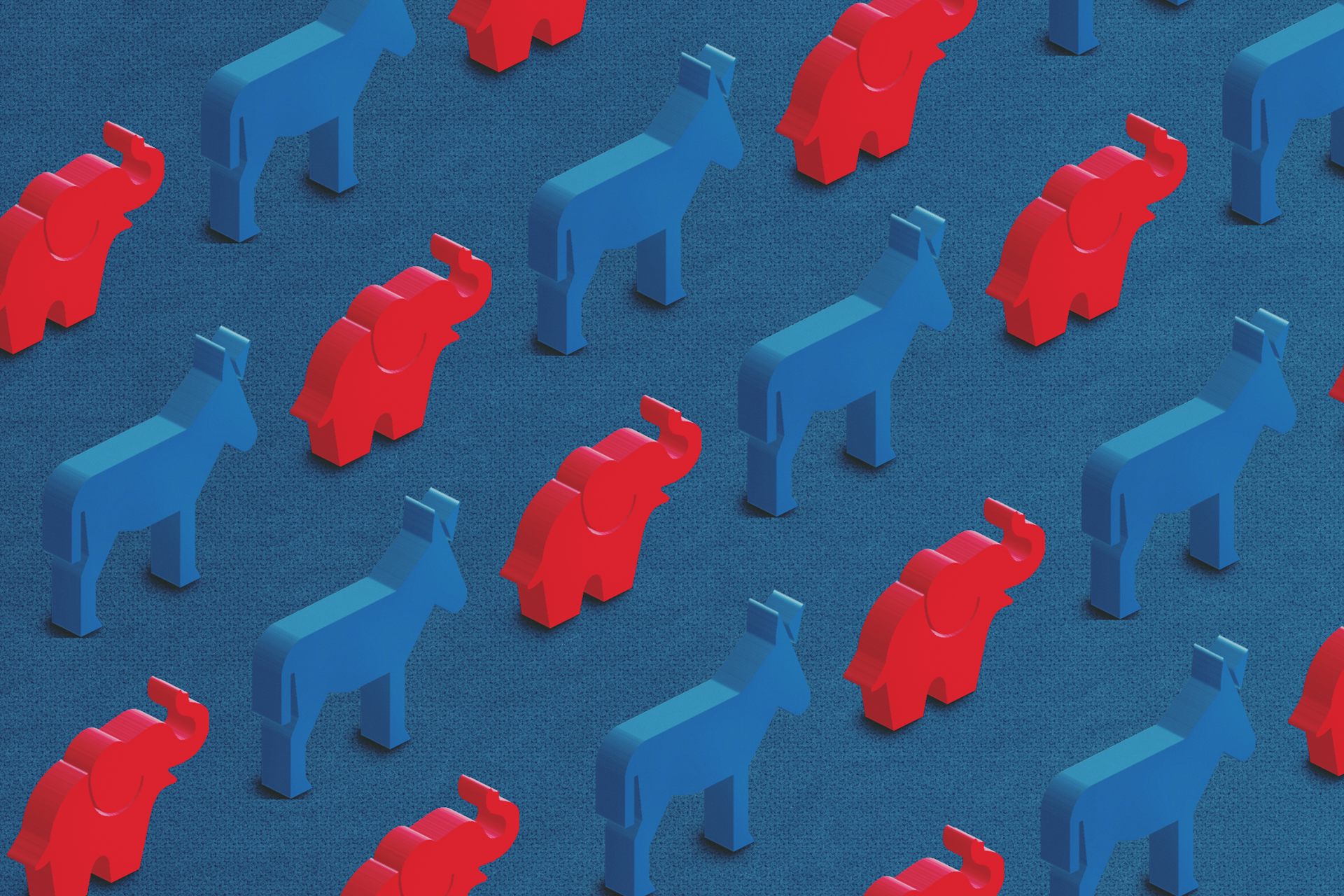
In most races in the midterm elections on Nov. 3, 2026, Americans had only two realistic choices: Democrats and Republicans.
As a scholar of parties and elections, I am often asked why the U.S. has only two major parties, while other democracies offer voters three, four or even five choices. The U.S. system looks weird compared to those, but that isn’t necessarily a bad thing.
The two “umbrella” Democratic and Republican parties mask many underlying differences in political preferences, but this large and fluid two-party system may represent voters at least as well as Canada and the United Kingdom do. Those countries elect members of their lower legislative house in the same way as the U.S., but, as my research suggests, their additional parties can distort representation.
An electoral system is the set of rules that determine how votes translate into elected representatives. The U.S. uses what’s called a single-member district plurality, or an SMD-p system, which means each district elects only one representative, and whoever gets the most votes wins.
This “winner-take-all” system is different from proportional representation, the electoral system used by most other democracies. In that system, several representatives are elected in each district, and a party’s share of seats roughly matches its share of the vote – for example, a party winning 40% of the votes would get around 40% of the seats.
SMD-p systems encourage stiff competition between two parties in each district. Because the system gives losing parties nothing, it discourages voters from supporting third parties that have no chance of winning. There is no rule against having more than two parties, but why vote for a party that is sure to lose? With only one possible winner in each district, there are typically only two real competitors.
There are many possible reasons the U.S. does not have a viable third party. The presidency pushes politicians to run under one of the major labels, and state ballot access laws make it harder for minor-party candidates to get on the ballot.
Another reason is the nature of the two parties themselves.
As “umbrella” parties, the Democrats and Republicans mask underlying differences in political preferences. For example, the Pew Research Center identifies nine ideological subtypes of American voters, including Faith First Conservatives, Pragmatic and Polite Right, Loyal Liberals and Leftward Progressives.
In a different country, with different electoral rules, these nine groups could form multiple political parties. In the U.S., they must choose between Republicans and Democrats. Democrats, for example, unite what Pew calls the Order and Opportunity Left, the Left-Out Left, the Loyal Liberals and the Leftward Progressives.
The same umbrella effect shows up in Congress.
Congressional Democrats and Republicans have typically had lower levels of party unity – the extent to which party members vote the same way on legislation – than their European counterparts. This lack of unity is often viewed negatively. In the 1950s, a group of political scientists representing the American Political Science Association, frustrated with how fluid the parties’ positions could be, called for more unified ones that would provide voters with clear and consistent options.
But low unity has an upside: It gives politicians the flexibility to represent their own voters, even when those voters disagree with the rest of the party.
So why not add another party or two to the American system?
One metric political scientists use to evaluate representation is electoral disproportionality: the gap between parties’ vote shares and their seat shares.
The U.S. electoral system is one of the most disproportional that democracies use, since only the district winner is represented. But that disproportionality rarely shows up when only two parties compete.
On the other hand, other democracies using the same kind of electoral system as the U.S., such as Canada and the U.K., have several parties competing, which sometimes poses problems for good representation.
One example of this was the U.K.’s 2024 general election, which produced some of the most disproportional results in British history. Multiparty competition allowed the Labour Party to win more than 63% of the seats in the House of Commons with less than 34% of the vote. Meanwhile, Reform UK received 14% of the vote and won less than 1% of seats.
How can this happen?
Imagine a country with 10 districts, each electing one legislator. Only two parties run: the Purple Party and the Yellow Party.
The Purple Party wins six districts and Yellow wins four. Purple gets about 56% of the vote and takes 60% of the seats. Yellow gets about 44% of the vote and takes 40% of the seats. In each case, the gap between vote share and seat share is about 4 points. That is considered the measure of disproportionality.
Now imagine a third party, the Green Party, enters the race. It wins 30% of the vote in each district, taking more votes from the Purple Party than from Yellow. That costs Purple any districts it had previously won narrowly. Now, Yellow wins six districts and Purple wins four.
Three things happen when the third party enters the race.
First, the winning party changes. Now, the Yellow Party wins a majority of seats – 60% – with just over a third of the vote.
Second, despite receiving 30% of the vote across all districts, and often coming in second place, the Green Party does not win any seats at all.
Third, disproportionality increases from 4 points to 28. Only Purple, with 40% of the seats on just under 36% of the vote, comes close to proportionality.
Adding a third party flips the winning party from one to the other and increases disproportionality, and this all happens without that third party winning a single seat.
My research suggests that in countries using the SMD-p system, growing support for third parties has increased disproportionality, sometimes dramatically. The U.S. is the exception: Its two-party system keeps disproportionality low, often even lower than in countries that use proportional representation.
The large and fluid two-party system in the U.S. may represent voters at least as well as systems with viable third parties. The only way out without further distorting representation would be to change the electoral system to some version of proportional representation. Nothing in the Constitution prevents that.
Americans have valid complaints about their parties, and there are ways to address them. But simply adding more parties to the mix is unlikely to solve anything.
This article is republished from The Conversation, a nonprofit, independent news organization bringing you facts and trustworthy analysis to help you make sense of our complex world. It was written by: Robin E. Best, Binghamton University, State University of New York
Read more:
The two‑party system is here to stay
A new third party for US politics – 3 essential reads on what that means
Third parties will affect the 2024 campaigns, but election laws written by Democrats and Republicans will prevent them from winning
Robin E. Best does not work for, consult, own shares in or receive funding from any company or organization that would benefit from this article, and has disclosed no relevant affiliations beyond their academic appointment.







Comments