Smugglers who piloted panga that capsized in Del Mar, leaving 4 dead, sentenced to prison
Published in News & Features
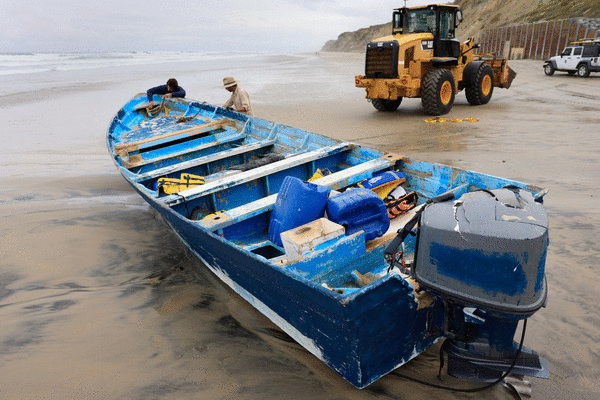
SAN DIEGO — On the day after a smuggling boat capsized last year just off the coast of Del Mar, leaving two children from India and two adults from Mexico dead, then-Homeland Security Secretary Kristi Noem called on the Department of Justice to seek the death penalty for the boat’s pilot and co-pilot.
Federal prosecutors in San Diego ultimately decided the case did not merit such a punishment, and on Monday, a federal judge in San Diego sentenced the two defendants each to five years and 10 months in federal prison. The judge agreed with defense attorneys and a prosecutor who argued that the four deaths on May 5, 2025, were the result of poor choices and a tragic mishap, rather than the type of intentional harm required for the government to seek capital punishment.
“This case is a tragedy all around, from top to bottom,” U.S. District Judge Benjamin Cheeks said, noting the poverty and cartel victimization that had driven the two defendants to agree to lead the smuggling attempt. But Cheeks added that because of their actions, “there are four people who are no longer here.”
Jesus Ivan Rodriguez Leyva, 27, and Julio Cesar Zuniga Luna, 32, pleaded guilty in April in San Diego federal court to charges of bringing in aliens resulting in death and bringing in aliens for financial gain.
Prosecutors said Rodriguez piloted the panga with 19 total people on board for about 11 hours overnight from Mexico into U.S. waters, and Zuniga acted as his co-pilot. Around sunrise on the morning of May 5, the panga’s engine failed, and a wave capsized the vessel about 200 yards off the beach in Del Mar.
The four people who died included Mexican citizens Marcos Lozada Juarez, 18, and Gorgonio Placido Diaz, 55, as well as 14-year-old Indian citizen Prince Patel, whose bodies were recovered that day on the beach. Prince’s 10-year-old sister, Mahi, also died, though her body was never recovered — only her foot was found several weeks later near Torrey Pines.
Others from the panga, including the children’s parents, ended up hospitalized, some of them with critical injuries.
Such cases involving migrant deaths at sea have become increasingly common in recent years in San Diego, but Noem’s advocacy for the death penalty — which came less than four months into President Donald Trump’s second term back in office — thrust the case into the national spotlight. Such a decision to seek the death penalty would have been unprecedented, given that defendants in similar incidents have been sentenced in San Diego federal court to fewer than five years in prison in some cases.
Assistant U.S. Attorney Sean Van Demark said Monday that the U.S. Attorney’s Office in San Diego quickly recommended to the Department of Justice that the death penalty not be sought against the two men, and the Department of Justice agreed.
But defense attorneys for both Rodriguez and Zuniga said the threat of the death penalty, however short-lived it may have been, had weighed heavily on their clients, who in statements and letters to the court expressed deep remorse for the deaths that occurred.
In sentencing documents and during arguments Monday, attorneys for both men argued their clients should be given credit for their life-saving efforts after the panga capsized. Video of the incident obtained by CBS8 showed Rodriguez dragging one woman to shore, then going back into the water and helping to pull another person out of the waves and onto the sand. The video then showed him attempting to perform CPR on at least one victim who was later seen in the footage moving and alert while a San Diego lifeguard provided her medical aid.
“He could have run away, but he didn’t,” Rodriguez defense attorney Danni Iredale told the judge Monday.
“In the moment of the tragedy, (Rodriguez) reacted by saving as many passengers from drowning as he was physically able,” Iredale and her co-counsel, Ellis Johnston III, wrote. “His tireless efforts to save people, as captured on video, give weight to Mr. Rodriguez’s statement to the Court that, even if it cost him his own life, Mr. Rodriguez would not hesitate to try saving another person from this tragic event.”
Gerardo Gonzalez, one of Zuniga’s attorneys, also argued that his client should be granted leniency for staying and trying to save lives rather than fleeing.
Van Demark, the prosecutor, acknowledged that the defendants did make efforts to help rescue people, but he told the judge they shouldn’t be given credit for helping save people that they put in danger.
The judge said he did take their life-saving efforts into account. “They did not have to do that; they could have fled,” Cheeks said. And he noted that he believed that both men were sorry for what they had done. But he said that even accidents have consequences, and he hoped that the 70-month sentences would deter other potential smugglers from trying to make the same dangerous ocean crossing.
“Today’s sentences reflect the serious consequences of placing greed above human life,” U.S. Attorney Adam Gordon said in a statement.
According to documents in the case, the group set off for the U.S. from Popotla, a small fishing village just south of Rosarito and roughly 50 miles from where the boat ultimately capsized. But a problem with the panga’s engine initially forced the group to return to Popotla.
In sentencing documents, Rodriguez’s attorneys wrote that upon returning to shore in Mexico, the smugglers who had recruited Rodriguez and Zuniga forcefully demanded that the group try again, despite the panga’s poor condition.
Rodriguez’s defense attorneys wrote that his biggest regret is that he did not stand up to those smugglers — but they said he had good reason to fear organized crime groups.
“He was (a) young man who had experienced firsthand the violence, greed and retribution of cartel power,” Iredale and Johnston wrote. “His grandfather had been killed and beheaded; his uncle disappeared, and only months prior to this trip, his stepfather had been abducted for over a month, losing his cattle and livelihood. Mr. Rodriguez was scared, he was frozen, and ultimately he followed the smugglers’ orders, striving to do the best he could with what he was given.”
Prosecutors said engine problems continued to plague the vessel throughout the night as the group traveled without lights or a radio. Van Demark noted that the panga’s engine was “literally held together by duct tape.”
As the vessel approached the beach in Del Mar, Rodriguez and Zuniga instructed their passengers to remove their life jackets so they could move more quickly once they reached shore. But a short time later, the engine failed, the panga rotated in the water and a wave crashed into its side, causing it to overturn.
At least eight survivors made it to shore and fled the scene in waiting vehicles, but they were detained later that night after a tip led investigators to a home in Chula Vista where they were located.
Three people pleaded guilty in connection with transporting the survivors away from the scene; each was previously sentenced to prison terms ranging from 10 to 21 months.
Rodriguez and Zuniga, who lived in a small fishing village on the Pacific coast of Baja California Sur, are expected to be deported once they finish their prison terms.
©2026 The San Diego Union-Tribune. Visit sandiegouniontribune.com. Distributed by Tribune Content Agency, LLC.






Comments