EU proposes Canada become the bloc's first 'associate member'
Published in News & Features
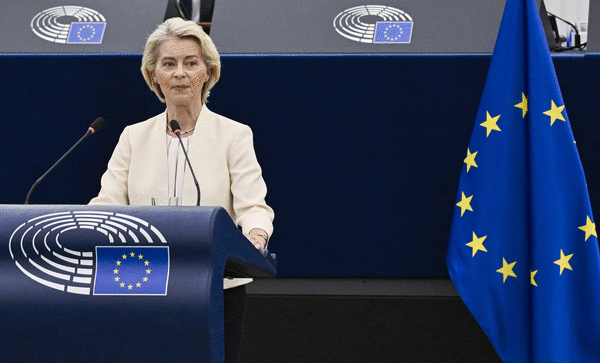
European Commission President Ursula von der Leyen proposed Canada becoming the first associate member of the European Union, forging a novel transatlantic alliance as President Donald Trump tears apart the old one.
She offered the invitation during her state of the union address in Strasbourg, France, Wednesday, with Canadian Prime Minister Mark Carney in attendance.
“In this new world, we must urgently reimagine our partnerships and build global coalitions for our resilience and democracies,” von der Leyen said. “I would like to work with you on opening the door for Canada being the first associate member of the European Union.”
By creating a tailor-made title just for Canada, the E.U. is sending a powerful signal as a trading bloc that it can expand beyond its borders and reinvent itself in the aftermath of Brexit, when it lost an economic powerhouse. What this means in practice is another matter, with negotiations likely to take years. Significantly, it also suggests a path for the U.K. to re-stitch its ties with the E.U., though with Canada ahead in terms of establishing what associate membership will entail.
Regular membership of the E.U. entails a lengthy accession process and comes with rights, like access to the single market, as well as financial, fiscal and legal obligations. There is no precedent for associate membership, and proposals earlier this year to offer a “membership light” to Ukraine faced backlash from many member states.
Certain countries like Iceland, Norway, Liechtenstein and Switzerland, however, have special arrangements with the bloc on topics such as the free movement of goods and people. Iceland two weeks ago rejected reopening talks with the E.U. over full membership.
Carney warned earlier this year that the “rules-based international order” was effectively dead and has made repeated calls for so-called middle powers to band together to oppose the pressure tactics and intimidation of the world’s dominant economies. Bloomberg reported earlier that the transatlantic allies were in talks to forge a new alliance to ensure their security.
Von der Leyen also discussed closer cooperation with Canada on manufacturing, tech, defense and energy, and cited the Arctic as a “flagship joint project.”
Carney’s government, economically shaken by a trade war with the U.S., has made a deeper E.U. partnership and other partners a top priority. After U.S.-Canada talks ended last month, Trump imposed 50% tariffs on $20 billion of goods imported from Canada, and Carney soon retaliated with tariffs on a roughly equal amount of U.S.-made products.
Canada’s focus is on concluding the ratification of CETA, the E.U.-Canada Comprehensive Economic and Trade Agreement, an accord that was negotiated a decade ago but that still hasn’t been formally approved by 10 European countries, according to people familiar with the discussions.
Outstanding issues with the bloc also include ironing out differences over E.U.’s carbon pricing tool on imported goods and its deforestation and pesticides rules.
Bloomberg reported earlier that E.U. officials see the potential to pursue a closer relationship with Canada than with the U.K. The E.U. views Canada as successfully implementing a so-called sovereignty agenda on economic and defense matters — a campaign that could inform the bloc’s own push to cut foreign dependencies. Furthermore, Canada doesn’t have the Brexit baggage London carries.
“We already are looking at how to increase the trade, what we can do in research and innovation, how we can cooperate more in defense, and also how we can support each other in all the multilateral negotiations, if it comes to WTO and other trade negotiations,” E.U. trade chief Maros Sefcovic told reporters in Strasbourg after the speech.
Sefcovic said he would meet his Canadian counterpart, Finance Minister François-Philippe Champagne later Wednesday.
Canada, unlike the U.K., has been granted access to SAFE, the bloc’s €150 billion ($173 billion) loan program for defense procurement.
Canada and the E.U. will be expected to make progress ahead of their summit in Montreal in October, at which they could sign a digital trade agreement that it’s been in the works, said the people, who spoke on the condition of anonymity.
“Europe and Canada believe in democracy,” von der Leyen said. “That power does not belong to the strongest, the richest or the loudest.”
—With assistance from Max Ramsay.
©2026 Bloomberg L.P. Visit bloomberg.com. Distributed by Tribune Content Agency, LLC.






Comments