Army Corps resumes work at Brandon Road Project as invasive carp encroach on Illinois River
Published in News & Features
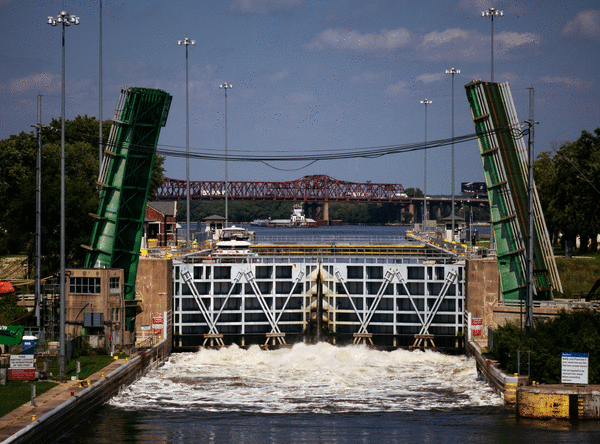
CHICAGO — More than a month after the U.S. Army Corps of Engineers halted work on the Brandon Road Lock and Dam near Joliet, part of a $1.15 billion project to keep invasive carp out of the Great Lakes, the agency announced last week it would resume construction.
The Army Corps’ Rock Island District — the main federal sponsor — issued a stop-work order on July 24 “without explanation or warning,” advocates say, except to say the project was “under administrative review.” Just three weeks later, the Illinois Department of Natural Resources said several hundred small silver carp had been discovered only 80 miles from Lake Michigan in the Illinois River, further upstream than routine monitoring had found the invasive fish since 2010.
The location indicates spawning activity may have occurred even closer to the lake, which advocates with the Alliance for the Great Lakes call a “troubling sign of an establishing population” and “shows a higher risk of invasion” than the mere presence of adult fish.
President Donald Trump had previously directed federal agencies to carry the project on the Des Plaines River forward with “maximum speed and efficiency.”
The Army Corps did not respond to a request for comment about the pause.
The Brandon Road Interbasin Project, which began construction in 2025, is the culmination of decades-long bipartisan efforts between Illinois, Michigan and the federal government to stop the invasive fish, which pose a significant threat to the native species and aquatic ecosystems of the Great Lakes, as well as its billion-dollar fishing and boating industries. Unreliable electrical barriers near Romeoville are currently the last line of defense holding the fish back in the Illinois River.
“The stop work order on the Brandon Road project resulted in costly and unnecessary delay, putting us even closer to seeing invasive carp cause irreversible harm to the Great Lakes,” said Joel Brammeier, president and CEO of the Alliance for the Great Lakes. “The overwhelming response of the entire region — including the bipartisan Congressional Great Lakes Task Force, the Great Lakes states, anglers, boaters, skilled construction workers, environmental organizations and many fellow Great Lakers — shows that we are and will continue to stand united in support of this critical project.”
Despite the bipartisan and widespread support that has characterized the project, its funding and progression have, since Trump’s second term began, become a point of contention between his administration and Illinois Gov. JB Pritzker and Michigan Gov. Gretchen Whitmer.
The stop-work order was lifted after discussions between Trump and Whitmer.
“Now that construction can resume, we will continue to make sure that it stays on track — at the construction site and in Washington, D.C.,” said Brammeier in a news release last week. “For the sake of the ecosystem and economy that our region depends on, we simply cannot afford any further disruption.”
Great Lakes environmental organizations from Illinois, Michigan, Wisconsin, Minnesota, Indiana and Ohio began in late August calling on the project to continue without additional interruptions and costs.
“Once an invasive species is introduced — the environment it breaches is never the same,” said Brian Gill, senior director of government affairs and policy at the Shedd Aquarium, in a news release Aug. 26. “We have years of evidence that non-native species forever alter the food web, outcompete native species and risk the overall safety and stability of the waterways we all rely on for our way of life. We also know from experience that it costs far more to try and clean up the repercussions of invasive species than it does to invest in proactive protections.”
Jennifer Walling, CEO of the Illinois Environmental Council, said the project “represents years of bipartisan collaboration and a critical shared investment in the future of our waterways, communities, and economy.” The vice president of government affairs at the Ohio Environmental Council, Spencer Dirrig, said the fish “don’t care about petty politics, and they won’t stop trying to enter the Great Lakes.”
Michigan and Illinois are contributing $64 million and $50 million, respectively, toward the project total. In May 2024, members of Congress from both states secured an increase in the federal cost share for operations and maintenance after construction to 90%. The federal government will also cover 90% of the project’s construction costs; Congress has already appropriated $274 million for the first of three phases, which started in May of last year.
Phase one involves site preparation and bedrock removal, as well as installing some multilayered technologies, including a bubble barrier that removes small fish trapped under barges or carried in their wake and an acoustic deterrent that creates painful sound waves for silver carp, which have a specialized connection between their inner ear and swim bladder that triggers a panic reaction when they hear loud noises. The second and third phases will include an electric barrier and more acoustic deterrents. At the end, a flushing lock will send larval fish and eggs trapped under commercial barges back downstream.
Invasive across the United States, these carp include silver, bighead, grass and black carp. The fish were introduced in the 1960s to get rid of seaweed without using chemicals in aquaculture facilities and sewage ponds in Arkansas.
But after extreme flooding events in the 1980s and 1990s, the carp escaped into the Mississippi River basin — the third largest in the world — spreading to 31 states. Some were also released after breeding experiments failed.
Silver and bighead carp are particular threats to native species as they have no natural predators in American waterways and likely never will, meaning their populations can grow uncontrollably.
Additionally, they can’t be easily caught as they don’t care for bait; they are filter feeders and eat plankton from the base of the aquatic food chain. Because of their large numbers and reproductive capacity, silver and bighead carp can eat faster than and starve native fish and mussels.
After monitoring crews, made up of biologists and experts from state and federal agencies, discovered juvenile silver carp in the Marseilles Pool of the Illinois River in August, they have ramped up additional monitoring in the upper river, its tributaries and the Dresden Island Pool some 50 miles from Lake Michigan.
They are also implementing electrofishing — a monitoring tool that sends electric currents from a boat to stun fish for collection and removal — in backwater habitats that juvenile carp like. Back in May, Army Corps crews conducted electrofishing surveys in Lake Calumet, which is 6 miles downstream of Lake Michigan via the Calumet River, and found no bighead or silver carp.
Experts are also studying the microchemistry — the study of chemical elements in ear bones and scales — of the fish captured in August to understand their origins.
Contract commercial fishing for adult invasive carp resumes this month in the Starved Rock and Marseilles pools in LaSalle County and in the Dresden Island Pool near the confluence of the Des Plaines and Kankakee rivers. These locations are known to have adult invasive carp, but not multiple life stages of young, so fish biologists do not consider these populations established there.
Multi-agency monitoring over the past 16 years has indicated established invasive carp populations in the lower 240 miles of the Illinois River, from the Peoria Pool all the way toward its confluence with the Mississippi, along which they have wreaked havoc on local economies and ecosystems.
____
©2026 Chicago Tribune. Visit at chicagotribune.com. Distributed by Tribune Content Agency, LLC.






Comments