Why NC homeless camp ban forces 'punitive' fix on 'very urgent' problem
Published in News & Features
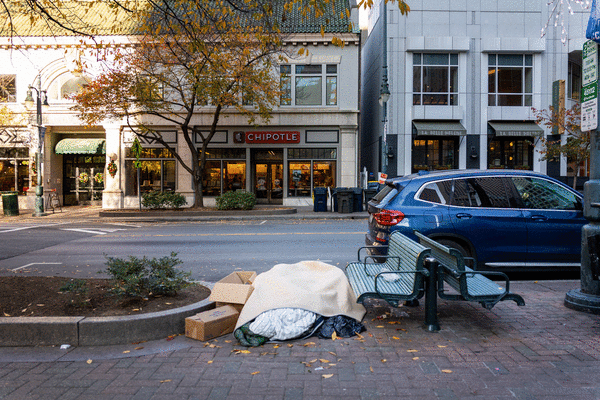
CHARLOTTE, N.C. — Clearing encampments won’t end homelessness. Instead, it could create a cycle of clearing and re-establishing sites, said Liz Clasen-Kelly, CEO of the nonprofit, Roof Above.
It’s one of several effects Clasen-Kelly anticipates if the North Carolina legislature overrides Gov. Josh Stein’s veto on House Bill 437. The bill, which would ban homeless encampments statewide, could add more punitive measures to enforcement against unsheltered homelessness in Charlotte.
Stein, a Democrat, vetoed the bill on July 8, saying it is “poorly constructed” and “creates another significant unfunded mandate for local governments.”
The bill has three main stipulations. It bans homeless encampments in public spaces, makes homeless service zones drug-free, where violations are punishable by a felony, and provides an exception to the homelessness ban by permitting local governments to designate property for public camping. The Department of Labor must certify these sanctioned encampments, which require access to bathrooms, running water and behavioral health services in addition to prohibiting substance and alcohol use. It doesn’t apply to recreational campgrounds.
But this exception comes with no money from the state, Mecklenburg County Commissioner Laura Meier said. If the county chooses to enact sanctioned encampments, it will pull from a budget that is already “strapped,” Meier said.
The state House plans to override Stein’s veto when it returns in November, the Raleigh News & Observer reported. If it does, the bill’s homelessness ban wouldn’t be totally new for Charlotte. But other provisions more punitive to local government and homeless service providers could enforce solutions that do not solve the problem, officials say.
Homelessness in Charlotte
Homelessness affects, at minimum, 2,018 people in Mecklenburg County, according to the county’s 2026 Point-In-Time Count, which identifies the number of people experiencing homelessness on a single night. Of those, 499 people experience unsheltered homelessness, which refers to people living in places like cars, on streets and in tents.
While the total number of people experiencing homelessness is down from last year — with 2,101 people identified in 2025 — unsheltered homelessness is up, rising from 444 to 499.
Homeless encampments have become a public health issue, Meier said, but banning them does not solve the problem.
The Charlotte-Mecklenburg Police Department did not answer questions but provided information about how it addresses homelessness and quality-of-life concerns. In 2019, it launched its Community Policing Crisis Response Team, a group of trained officers and mental health clinicians who de-escalate and provide assistance during behavioral-health and substance-use crises. A group of social workers, known as the Community Assistance: Response, Engage, Support (CARES) Team, also respond to homelessness needs. Just last year, CMPD began its CROWN Culture Initiative which increases police presence and promotes collaboration with community partners.
Yet, some efforts to combat homelessness in the center city pushed people to Charlotte’s periphery, including the east side, said Greg Asciutto, executive director of CharlotteEAST.
Homelessness is a “real” and “very urgent” problem, Asciutto said. Violence from it affects residents, businesses and other people experiencing homelessness. Asciutto’s words are not to demonize the homeless population, he said, but to show the reality of the situation.
The number of people sleeping outside has real quality of life costs; however, this bill falls short of the solutions needed, Clasen-Kelly said.
What are the bill’s implications?
Charlotte already has the authority to clear encampments; the city banned camping on public property in 2012. In 2021, Mecklenburg County exercised this authority when it removed an encampment near uptown known as “Tent City.” Today, violation of this ordinance is punishable as a Class 3 misdemeanor and a fine up to $500, according to municipal code.
“I think it is the smaller pieces of (the bill) that actually could have larger impacts,” Clasen-Kelly said, “and that’s not necessarily where people are looking.”
Homeless service operators, those running facilities for people to live or receive help, who “intentionally allow” drug dealing would be guilty of a newly created felony crime. This provision includes “gray language” Clasen-Kelly said and insinuates some providers are ill-intentioned. It feels “off” from the reality of people who commit their lives to the well-being of others, she added.
The bill also says people and business owners can sue if local governments fail to take action to clear an encampment within 15 business days of being notified about it.
“You’re saying we’re going to have to do additional things across the board without having the necessary resources to do it, and then add a punitive nature to local governments if they can’t do it?” Asciutto asked. “It just is not fully fleshed out.”
The bill “puts a sense of urgency” on Charlotte’s lack of affordable housing, said Loán Lake, University City Partners spokesperson. The onus will fall not only on people experiencing homelessness, but also taxpayers whose money will go to finding solutions that get people off the streets.
Where will Charlotte’s homeless population go?
The county has previously invested in permanent housing, mental health and substance abuse support for Charlotte’s homeless population, said Mark Jerrell, chair of Mecklenburg’s Board of County Commissioners.
He suspects the bill could have a “significant impact” on Charlotte, but it is difficult to say how because the city’s homeless shelters cannot support everyone. Emergency shelter beds decreased from 1,352 to 1,225 between 2024 and 2025 while emergency shelters continue to operate near full capacity, according to county data.
One possibility is nothing new, Asciutto said: Without the funds to support them locally, officials might shift homeless populations around.
“Local municipalities and local counties across the state, if they don’t have the resources, which this bill does not provide the resources, what happens is they put homeless individuals with one-way bus tickets to other cities,” he said. “I believe this will ultimately contribute to more of that.”
Clearing encampments could also lead to more criminal charges as homeless populations interact with law enforcement, said Jessica Lefkowitz, executive director of Hearts for the Invisible Charlotte Coalition. This creates a cycle with far-reaching effects.
The crimes homeless people will get charged for are not the ones that will keep them in the county’s already overcrowded jails, Lefkowitz said. Their release creates the possibility of repeat offenses, and having a criminal history makes it more difficult to eventually get housing.
If local governments choose to set up a sanctioned encampment, people could go there. But sometimes people experiencing homelessness, especially those with mental and behavioral health problems, are resistant to crowded, traditional emergency shelters, Clasen-Kelly said. They may be more receptive to non-congregate shelters, which are those with private living spaces, like the ones set up during the COVID-19 pandemic in hotel rooms, she added.
Still, stakeholders are unsure what effects a veto override will have.
“I don’t have the answer of what this is going to ultimately look like in the end,” Lefkowitz said. “We’re going to stay connected to the folks that we serve to best serve them through this process.”
©2026 The Charlotte Observer. Visit at charlotteobserver.com. Distributed by Tribune Content Agency, LLC.






Comments