US-Iran peace prospects dim as violence flares in Lebanon
Published in News & Features
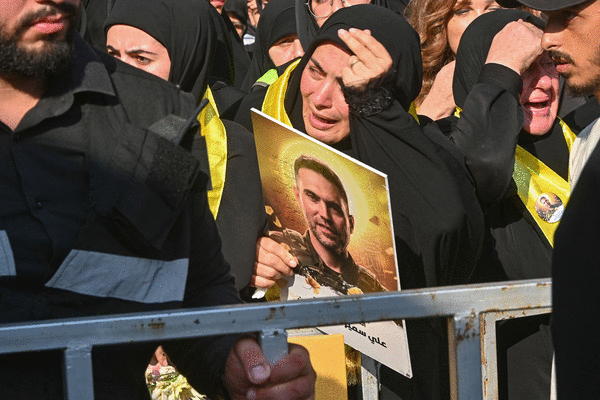
Fighting between Israel and Iran-backed Hezbollah flared in Lebanon over the weekend, the latest setback in efforts to end parallel wars in the Middle East that have dragged on for almost six months and disrupted global markets.
Israel’s military said Sunday that it killed senior Hezbollah commander Abu Hassan Alaa in southern Lebanon a day earlier. Eleven people died in the Israeli strikes, which Prime Minister Benjamin Netanyahu said were in retaliation for an attack by the militant group that seriously injured three soldiers.
In recent days, Israel has also struck Iran-backed Hamas in Gaza, the Yemen-based Houthis have attacked ships in the Red Sea, and several vessels have been hit by projectiles in the Strait of Hormuz. Tensions in the West Bank have meanwhile been on the rise, with Israeli settlers laying siege to Palestinian homes, drawing international condemnation. Netanyahu has downplayed that violence and blamed a small number of radicals.
The renewed fighting in Lebanon risks derailing a U.S.-brokered ceasefire that calls for Hezbollah’s disarmament, an eventual Israeli withdrawal from occupied territory and the Lebanese army taking responsibility for security.
It will also complicate efforts to revive deadlocked negotiations to end the war between the U.S. and Iran. A 60-day truce — already repeatedly violated — will expire on Monday without a deal on how Hormuz should be managed and Washington readying new economic measures to pressure Iran.
The price of Brent crude has gained more than 7% since the start of last week as the prospects further dimmed for a swift reopening of Hormuz, through which a fifth of the world’s oil and gas transited before the war. The global benchmark rose at much as 1.3% on Monday to $89.68 a barrel.
Washington and Tehran signed a 14-point memorandum of understanding in June. Among its provisions were a pause in hostilities “on all fronts, including Lebanon” and free passage through Hormuz, opening up a 60-day window for the parties to negotiate a comprehensive agreement.
The deal never stuck and intermittent clashes continued albeit on a limited scale. Last month U.S. President Donald Trump declared the ceasefire effectively over.
“The number one Goal is, and always will be, that Iran cannot have, in any way, shape, or form, a Nuclear Weapon,” he said in a post on his Truth Social platform on Monday.
Iran’s Foreign Ministry spokesman Esmail Baghaei told reporters on Monday that U.S. violations of the truce had made the 60-day deadline irrelevant.
Trump has struggled to find an off-ramp to a war that’s increasingly unpopular in the U.S., and last week announced plans to ramp up economic pressure on Tehran. While much of Iran’s industrial capacity has been damaged and crude exports severely curtailed by a U.S. naval blockade, decades of sanctions have failed to force it to bend on its nuclear program or relinquish control over Hormuz.
Iran and Oman say they have finalized a “shipping map” as part of a broader agreement on how to govern traffic in the strait, but that won’t necessarily translate into its reopening. Intensive talks are continuing, but reaching a deal has been time consuming because of security complexities and the “obstructionist behavior of destructive elements,” Baghaei said.
The U.S. isn’t directly involved in those negotiations and may resist terms that don’t restore free passage through the waterway.
Iran has used the relative lull in fighting to prepare for a potentially broader confrontation, the Wall Street Journal reported, citing Iranian and Arab officials. Tehran has installed hard-line veterans in key security posts and accelerated missile and drone production, it said.
Meanwhile, Trump’s son-in-law and peace envoy Jared Kushner is visiting the Middle East this week to try and accelerate a U.S.-brokered ceasefire in Gaza. He, along with former U.K. Prime Ministry Tony Blair and Nickolay Mladenov, the Board of Peace’s top envoy, are holding talks with Netanyahu in Jerusalem on Monday.
Kushner met with Hamas chief Khalil al-Hayya in Egypt on Sunday, the Associated Press said, citing a regional official and a Hamas official.
In a statement, Hamas called on mediators and the U.S.-created Board of Peace overseeing the ceasefire to “compel” Israel to approve a road map setting out the next steps in the truce, the news agency said.
—With assistance from Arsalan Shahla, Magdalena Del Valle, Alisa Odenheimer and Carla Canivete.
©2026 Bloomberg L.P. Visit bloomberg.com. Distributed by Tribune Content Agency, LLC.






Comments