Vandalism hits Flock license plate cameras in many Minnesota cities, 8 in Winona and 6 in Duluth
Published in News & Features
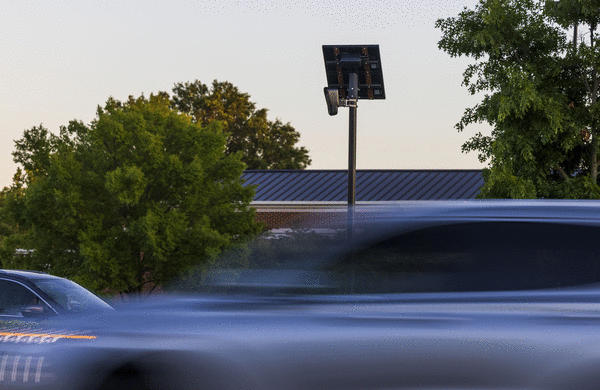
MINNEAPOLIS — Vandals have been damaging — or outright stealing — license plate-reading cameras in numerous Minnesota cities of late, including one that was swiped from atop a 10-foot-tall pole in Faribault, officials said.
Flock cameras have ignited a privacy debate and faced pushback from officials and vigilantes in the Twin Cities and around the country, in part over their use in immigration enforcement.
Justin Lee Campbell, 42, was charged in Rice County District Court with interference with emergency communications, a felony, and gross misdemeanor theft in connection with allegedly stealing a Flock camera from its mount last week just off Interstate 35 in Faribault.
Campbell, of Faribault, was arrested July 28. He appeared in court the next day and was released on his own recognizance ahead of an Oct. 7 court hearing. The Minnesota Star Tribune reached out to Campbell for a response to the allegations. His attorney, Racheal Flock, declined to comment.
Police in Winona disclosed on Monday that all eight of their cameras were swiped after their mounting poles were cut down with a saw. Police Sgt. Nicholas Quimby said an officer on patrol noticed Saturday night that one of the poles was down, thrown into the weeds and its camera gone.
That led the officer to check on the other cameras positioned along the city’s major highways, and he saw there had been no activity from any of them for the previous 24 hours, Quimby said. Police discovered they were all stolen in a similar manner, the sergeant said. Quimby confirmed there have been similar incidents recently over the border in Wisconsin.
Quimby said that either opposition to the cameras philosophically or a desire to turn the components into cash “are definitely possibilities as far as motive, but we haven’t been able to talk to any suspects yet.”
Also on Monday, the Duluth Police Department told the Minnesota Star Tribune that it has recorded six times when its cameras were either stolen or vandalized.
Edina police said its cameras “have been vandalized a few times,” and Eden Prairie said one of its cameras in the Eden Prairie Drive area had its wires cut in May.
Plymouth lost use of two cameras to vandalism, said Police Chief Erik Fadden. One was “found in pieces at the base of the pole it was mounted to” on July 20, the chief said. The second damaged camera “was found to have its power cord cut,” he said.
Also, the Anoka County Sheriff’s Office said one of its cameras was similarly targeted at Viking Boulevard and Baugh Street in Nowthen.
Other than in Faribault, no agency has reported any arrests.
Shortly before the Faribault camera was removed from its mount, Campbell told a work acquaintance that Flock cameras “track him coming and leaving the city,” according to the criminal complaint.
“‘I think I might take one,’” he is alleged to have said to the acquaintance.
Automatic license plate readers take photos of passing vehicles and store them with a time stamp, allowing police to track a driver’s movements. The devices, while effective in combating crime, have raised privacy concerns across the country over their use as a federal immigration enforcement tool.
The Star Tribune has found law enforcement agencies in Minnesota and elsewhere searched several Twin Cities suburbs’ camera data and labeled their queries as civil immigration enforcement — a mechanism used to detain people in the country illegally who have not committed other crimes.
Most of the searches were run on Fridley’s Flock Safety cameras, as Fridley had looser restrictions on its data than other agencies. Fridley now is among a growing number of Twin Cities suburbs restricting access to its license plate readers, following the Star Tribune’s investigation.
Several suburbs had already restricted data sharing in recent months by requiring individual sharing agreements with other law enforcement agencies and banning searches for immigration or other civil matters.
Reports from around the United States have bubbled up over the past several months of drivers and others stealing or vandalizing the cameras.
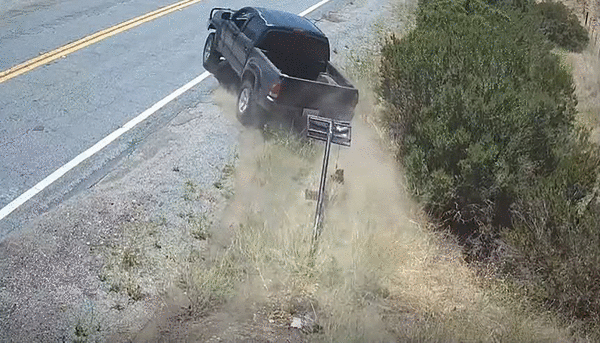
Last week in Monterey County, Calif., a 40-year-old man was jailed on allegations that he vandalized three cameras. The Sheriff’s Office in the coastal county posted photos that included one they say showed him using his pickup truck to topple a camera mounted on a pole.
In St. Petersburg, Fla., Carl Gunn has been obscuring a camera’s view with a sign atop a 14-foot-tall pole that reads, “Down with Flock cameras.”
Gunn told central Florida’s Spectrum News 13, “I don’t like it because we’re being tracked, and if we’re gonna track us, that’s against our constitutional rights. And I have a right to move about this country free without somebody looking over my shoulder.”
Atlanta-based Flock Safety is the dominant provider of the cameras. The company says it has clients using roughly 120,000 of its cameras in more than 6,000 communities across 49 states.
“People have every right to make their voices heard,” Flock spokeswoman Courtney Terlecki told the Minnesota Star Tribune. “But criminal acts should never be part of that process. Damaging public safety equipment ultimately hurts the very communities this technology is there to help protect.”
When a camera is taken offline, Terlecki continued, “an investigative lead can disappear, and a time-sensitive alert tied to an AMBER Alert, a missing-person case, or a violent crime suspect on the move may never reach the officers who need it.”
On Friday, the American Civil Liberties Union issued a statement contending that “companies like Flock Safety are quietly trying to build a nationwide mass surveillance system. If there are Flock cameras in your city, they are tracking, logging and sharing your movements without a warrant.”
The ACLU statement included a link to its “Get the Flock Out” toolkit with instructions on how “you can join the movement and organize your community against mass surveillance.”
Faribault Deputy Police Chief Matthew Long said the camera that was stolen has yet to be replaced. The city will be charged roughly $800 for a new camera and another $50 for the cables that were cut, police said.
“The camera was roughly 10 feet high,” Long said. “We do not know for sure exactly how it was accessed.”
Long said his department has 10 cameras positioned at “main access points to the city [and] have been very valuable in a whole litany of cases.”
According to the charges out of Faribault, a caller to emergency dispatch reported that Campbell stole the camera. Officers went to the intersection of Lyndale Avenue S. and Highland Place and confirmed the camera was missing and had been offline since 1:43 a.m. July 27.
The caller later told an investigator that Campbell brought the camera into his shop on 7th Street and was “bragging about how he’d taken the camera” and intended to take it apart, the criminal complaint read.
One of Campbell’s co-workers told police he saw Campbell take the camera out of a backpack.
Police spoke with Campbell at his home. He told police he found the camera in the road and said he didn’t know what it was and had no intention of keeping it. Campbell led officers to his garage, where the camera was on the floor. Its lens was covered with black tape.
—Allison Kite and Sarah Ritter of the Minnesota Star Tribune contributed to this story.
©2026 The Minnesota Star Tribune. Visit at startribune.com. Distributed by Tribune Content Agency, LLC.






Comments