Federal government implements 10-year Colorado River plan after states fail to find deal
Published in News & Features
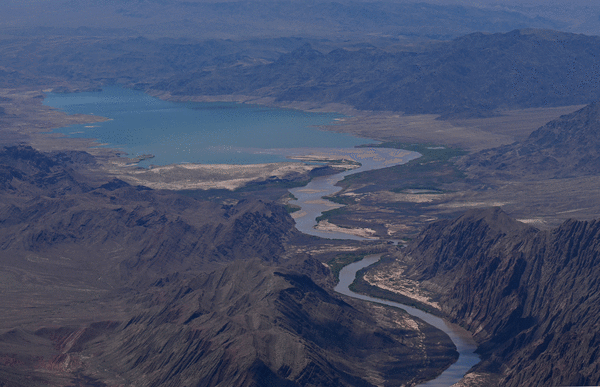
Federal water managers on Friday announced a 10-year plan to manage the critical Colorado River that opens the door to unprecedented water supply cuts to three states and will require near-constant negotiation between water users in the river basin.
The report made public Friday is the culmination of years of intense and divisive negotiations to replace the 2007 operating guidelines, which governed the river for the last two decades and expire this year.
But unlike previous long-term operating guidelines, the report does not prescribe specific management rules. Instead, it sets parameters for specific operation plans that will be re-negotiated every two years. Those two-year plans will determine how much water will be released from the system’s two major reservoirs — Lake Powell and Lake Mead — and how large water cuts will be to users downstream of those reservoirs.
The decision marks the first time federal authorities have implemented such a broad management plan on the waterway depended upon by 40 million people, 30 tribes and 5.5 million acres of farmland across the Southwest.
For a century, the seven basin states — Colorado, Utah, New Mexico, Wyoming, California, Nevada and Arizona — have successfully worked together to negotiate long-term plans for the river. But this time, the states failed to reach an agreement after three years of negotiation, forcing the federal government to step in.
Federal leaders repeatedly urged the states to find agreement on how to divvy up the shrinking river, but said they would implement their own plan as a last resort. State negotiators for years said they did not want to cede decision-making to the federal government, which could heighten the risk of litigation and mire the basin in legal proceedings and uncertainty.
Federal officials in their announcement said the framework balances water managers’ need for certainty so they can plan their operations with the flexibility needed to manage the river as drought and climate complicate predicting its flows. If the states can find consensus, those agreements can also be worked into the two-year planning process.
“The Department has a responsibility to ensure the Colorado River system remains reliable and resilient for the millions of Americans, communities and industries that depend on it,” Secretary of the Interior Doug Burgum said Friday in a news release. “This framework provides the flexibility to respond to changing hydrologic conditions while preserving the opportunity for the Basin States to continue working toward durable, consensus-based solutions.”
The U.S. Bureau of Reclamation’s plan has already raised hackles in at least one basin state.
The plan opens the door for major cuts to water supplies for the three Lower Basin states downstream of the reservoirs: Arizona, California and Nevada. Reclamation officials described the potential reductions as “large and unprecedented,” but said even the most drastic cuts might not be enough in critically dry years to stabilize the basin’s two declining reservoirs.
In dry years or when reservoir levels fall critically low, those two-year operational plans can include cuts to water supplies in the Lower Basin states of up to 3 million acre-feet, the framework states.
Cuts of that size are “unacceptable,” according to leaders from Arizona, which would likely take the deepest cuts.
“Such reductions would devastate Arizona’s water users and its economy,” officials from the Arizona Department of Water Resources said Friday in a statement.
The document does not outline mandatory cuts to the Upper Basin states — Colorado, Wyoming, Utah and New Mexico — but does contemplate voluntary water conservation goals.
Whether the Upper Basin states should agree to mandatory water cuts became a key sticking point in state negotiations. Upper Basin negotiators said they should not have to take cuts because they’ve never used their full legal allotment and their water supplies depend on mountain snowpack, not massive reservoirs like Powell and Mead.
Colorado’s lead negotiator, Becky Mitchell, said in a statement Friday that her office is reviewing the document, which is hundreds of pages long, but did not offer substantive analysis. Other Upper Basin leaders said they would provide more thorough analysis after the plan for the next two years is made public.
“Colorado remains committed to protecting our state’s significant rights and interests in the Colorado River and working collaboratively with the other Basin States, federal government, and Tribal Nations to adapt to supply-based operations,” she said.
The management framework comes amid a crisis on the river decades in the making. Lake Powell and Lake Mead are at a record low due to drought and overuse. Nearly every year since 2000, water users below the reservoirs have consumed more water than flowed into the river system’s primary water storage banks.
Scientific studies have shown that the warmer temperatures and drier soils caused by climate change are shrinking the river’s flow. Winters with significantly less mountain snow will become more common, sapping the source of the vast majority of the river’s water.
Neither the Bureau of Reclamation’s news release nor the 80-page executive summary of the report mention climate change. But federal authorities noted that more than two decades of drought and the expectation of continued aridification and lower river flows have complicated planning in the river basin.
“Developing new guidelines is difficult in this complex Basin, where critically low storage in Lake Powell and Lake Mead, significant hydrologic variability, and the anticipation of drier future conditions amplify the central tradeoff: balancing the potentially profound impacts of water-delivery reductions with the need to maintain reservoir storage,” the report’s executive summary states.
When the basin states signed the 1922 Colorado River Compact — the bedrock agreement allocating the river’s water — they apportioned 7.5 million acre-feet for the three Lower Basin states and another 7.5 million acre-feet for the four Upper Basin states.
But since 2000, the river has produced far less than the 14 million acre-feet expected by the creators of the 1922 contract.
In 2025, the average flow calculated over the prior 20 years equaled 12.7 million acre-feet, Reclamation data shows. But even that number hides the reality of recent dry years. The five-year average amounts to only 10.9 million acre-feet. Last year’s flow measured at 8.5 million acre-feet and this year’s is expected to be even lower.
Sen. Michael Bennet, a Democrat from Colorado, said in a statement that the two-year operating plans are the “bare minimum” needed to administer the river. He called for continued negotiations for a long-term consensus plan for the states.
Bennet wasn’t the only Coloradan disappointed by the plan.
“The Colorado River needs consequential and systemic change that confronts the ecological, political, and legal chaos caused by climate change and Glen Canyon Dam, but Reclamation’s plan is just ‘lather, rinse, repeat’ of past failed policies,” said Gary Wockner, executive director of Save the Colorado, which advocates for the environmental needs of the river and the removal of Glen Canyon Dam, which impounds Lake Powell.
The two-cycle negotiating cycle — while labor intensive — is preferable to litigation, said Celene Hawkins, director of The Nature Conservancy’s Colorado River program.
“My initial read of it is that the Reclamation team worked really hard to leave the door open to long-term consensus in the basin,” she said. “It is my hope that the basin states can walk through the door together and figure out the long-term plan.”
The report published Friday is the first in a series of documents expected in the near future. Before Oct. 1, reclamation officials will issue a final long-term management framework based on the report as well as a more specific operational plan for the next two years.
The reports and frameworks are just the beginning of the next era of Colorado River management, which will require significant investment into proactive solutions to keep the system afloat, Hawkins said.
“Investment now is going to be much cheaper than emergency response later,” she said.
_____
©2026 MediaNews Group, Inc. Visit at denverpost.com. Distributed by Tribune Content Agency, LLC.






Comments