'Haiti is hell': Ohio governor says kicking Haitians out of US hurts economy
Published in News & Features
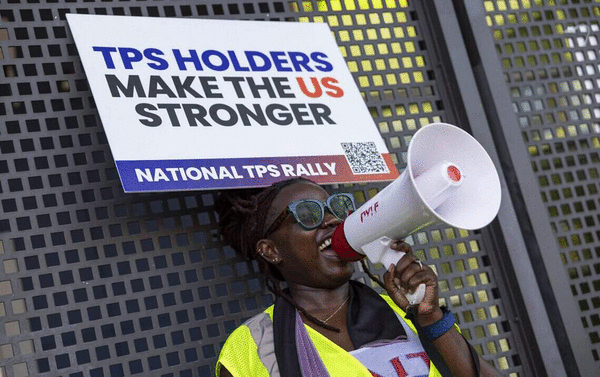
The Republican governor of Ohio is speaking out against the Trump administration’s end of deportation protections for more than 300,000 Haitians, saying that terminating the humanitarian program and targeting the group for mass deportations “is a mistake” and does not serve either the interest of the United States or his state.
“Haiti is hell today, so you’d be sending people back, literally back to hell,” Gov. Mike DeWine said in an interview Monday with CBS News. “The situation is really horrible. This is a dysfunctional government. This is a dysfunctional police. This is a country that’s in virtual chaos, and you see horrible tragedies that occur there every single day.”
According to the United Nations, over half of Haiti’s 12 million people require urgent humanitarian assistance, while nearly 1.5 million people remain displaced from their homes by gangs. Meanwhile, more than 2,000 people have been killed by gang violence this year; three foreigners, including a 6-year-old U.S. citizen, and three Haitian government officials are among those being held captive by gangs.
A former member of both the U.S. Senate and House of Representatives, DeWine is a longtime supporter of Haiti’s causes even before becoming governor of his midwestern state in 2018. There is a network of tuition-free schools inside Haiti’s largest slum, Cité Soleil, in the capital named after his daughter, Becky, who died in a car accident.
During the interview, DeWine noted that Haitians have helped to transform the city of Springfield, opening restaurants and other businesses, rehabbing houses and creating and filling jobs.
Kicking them out of the country, he said, “is frankly a blow” to both the city and state’s economy.
“We’re creating more jobs than we have people filling at this point,” DeWine said. “We need people... We don’t want to lose any of our own people. But we also, frankly, need immigrants who want to come here and who want to be part of the success story and help build the state of Ohio. So it’s hurtful.“
DeWine’s comments on the impact of President Donald Trump’s immigration policy comes as Haitian and immigration advocates urge taxpayers to continue to reach out to Republican members of the U.S. Senate for support on a bill that would reinstate TPS for Haitians in the U.S. An effort to have the legislation fast-tracked for a vote was blocked by a Republican senator.
While Trump “has done a phenomenal job” sealing the U.S.-Mexico border, DeWine said, he believes the president should use the opportunity to bring a discussion to Congress and the American people about legal migration, and what’s in the best economic interest of the U.S.
“The issue is frankly even bigger than Haitians, and I think the issue is bigger than Ohio. If you look at our long-term care facilities, over a third of the people who work in our long-term care facilities are from some other country. It’s the same way for so many essential things that we have. So, people who are staying in their home, who don’t want to go to a nursing home, one-third of those individuals who are helping them stay in their own home come from some other country,” DeWine said.
“When you start mass deporting all of these people, it’s going to impact your mother, your father, your brother, your sister who’s trying to stay at home and who has a Haitian or somebody from some other country who is caring for them, and then that person is gone,” the governor added. “You’re not going to be able to find people to replace them, frankly.”
Springfield is among several cities around the country that have benefited from an influx of Haitian immigrants, many of whom moved there after receiving humanitarian parole under the Biden administration.
Drawn by available jobs and relatively affordable housing, many settled in the city and established new lives. During the 2024 presidential campaign, however, the city became a political flash point after Trump and his running mate, JD Vance, falsely claimed that Haitian immigrants in the city were eating their neighbors’ pets.
At the time, DeWine joined others in pushing back on the president’s claims. “The Haitians who are living there and employed there, they came there to work, and they came there because there were jobs that were not being filled by other people,” DeWine said of Springfield’s Haitian population, which had been estimated at roughly 15,000.
Immigrants in general have contributed to the state’s economy and 23% of physicians statewide are foreign-born, he added. “We need to develop a form of immigration policy that is in the interest of the United States. Letting people, for example, who come here and go to college, letting them stay. If there’s a security risk, we’ll take care of that. But if they’re here, we educate them,” he said.
Last month the U.S. Supreme Court allowed the Trump administration to move forward with its effort to end Temporary Protected Status, a federal humanitarian program that allows nationals of countries facing armed conflict, natural disasters or other extraordinary conditions to live and work legally in the United States.
While advocates await an order from U.S. District Judge Ana C. Reyes in Washington, D.C., formally lifting a stay she imposed after blocking the administration’s effort in February to terminate the program, hundreds of thousands of Haitians on Monday lost their authorization to work as their employment permits expired.
Reyes was concerned about a surge in detention and deportations, asking the Department of Homeland Security of their plans to target Haitian communities in Ohio and Florida, home to one of the nation’s largest Haitian populations. Over the weekend, CBS New reported that Immigration and Customs Enforcement planned to increase raids as early as this week.
The prospect of increased immigration raids has spread fear through Haitian communities. On Tuesday, the streets of North Miami, home to one of the largest Haitian-American communities, were largely empty.
Earlier in the day, U.S. officials had notified Haitian authorities that a planned deportation flight with more than 150 people on board including 11 children had to be rescheduled due to technical problems with the aircraft.
DeWine said while he hasn’t been notified about a surge in ICE raids, he has been in touch with Haitians in his state, as well as Haiti’s ambassador to the U.S., Lionel Delatour.
“Very few of these Haitians will voluntarily go back to Haiti. If they have to leave, they’ll go someplace else,” he said. “They want to work. They want to support their family. They don’t want to go back to Haiti.”
DeWine noted that because of gang violence, planes cannot land in Port-au-Prince and must land in Cap-Haïtien, which means that deportees need to travel by road and pass through areas controlled by gangs.
“Then, when they get home, they see the chaos that is Haiti,” he said. “Haiti has been a tough place for a long, long time, but it’s much tougher. It’s much more dangerous today than it’s ever been.”
Despite his disagreement with the administration’s immigration policy, DeWine said his state will follow the law. Once TPS officially end people will not be able to work.
“There’s nothing that we can do,” he said. “All I can do is, as governor of the state of Ohio, explain to anyone who wants to listen what impact this will have on Ohio, and it will not be good for Ohio.”
_____
©2026 Miami Herald. Visit miamiherald.com. Distributed by Tribune Content Agency, LLC.






Comments