Are spotted lanternflies on the decline in Maryland? Scientists can't agree.
Published in News & Features
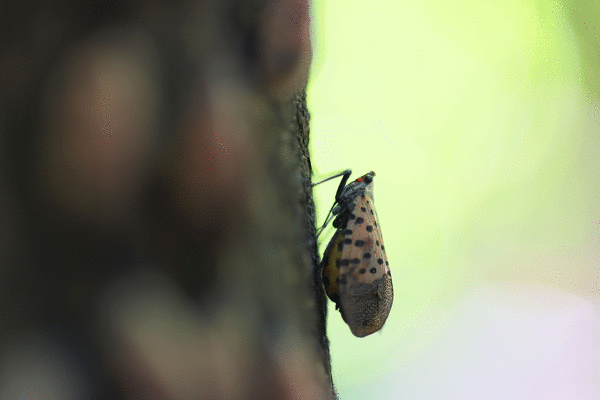
Spotted lanternflies, the pest that has infested Maryland for 8 years, are shifting their populations across the state as increased predators, effective management techniques and community reporting play a role in the bug’s presence.
Although scientists disagree on whether the bugs are on the decline within the state, they agree that the lanternfly is mostly harmless to humans, pets and plants, some trees excepted.
The spotted lanternfly was first catalogued in Maryland in late 2018 after it crept across the Pennsylvania border into Harford and Cecil counties, said Michael Raupp, an emeritus professor of entomology at the University of Maryland who studies invasive species. Raupp said in an interview with The Baltimore Sun that the pests are on the decline in those areas, mimicking a pattern seen in eastern Pennsylvania, where the spotted lanternfly was first recorded in the U.S. in 2014, he said.
“As with many invasive species, what we see is once they reach these high levels in the invaded realm — in this case Pennsylvania and several other states here in the U.S. — the indigenous natural enemies’ populations increase and begin to cause declines,” Raupp said.
Pathogens, predatory insects and birds have all begun to feast on spotted lanternflies over the past few years, debunking the previous idea that the species had no native predators.
“Mother nature’s hit squad” is taking its toll on the pest, Raupp said.
While they largely remained solely in Northern Maryland for many years, the invasive species crawled like a “slow-moving tsunami” into every country across the state, Raupp said. It will take some time for heavily infested counties to see population declines, but Raupp is optimistic, he said.
Not everyone is so sanguine.
While some researchers like Raupp say there has been a decline in population in northern Maryland, the Maryland Department of Agriculture’s spotted lanternfly coordinator Jessica Boyles told The Sun it could be an artefact from a lack of reporting over several years.
During the pandemic, the department stopped asking people to report spotted lanternfly sightings in Harford and Cecil counties because of the overwhelming number of submissions they were receiving from the area, Boyles said, but recently resumed the effort to take reports from the areas around Harford and Cecil counties.
However, Boyles said she suspects the data might be artificially low due to residents becoming accustomed to the lanternflies.
“I’m hoping that once I get some more data I can back up a decline, but at this point, I cannot,” she said.
The lanternfly continues to flourish in central Maryland, with its population increasing from last year.
“Populations in the future kind of ebb and flow depending on different environmental conditions and predator pressure,” said Madeline Potter, a faculty specialist with the University of Maryland Extension’s Home and Garden Information Center.
Additionally, a surprising amount of the invasive species are popping up in southern Maryland, Boyles said. While she predicted the state would see higher numbers of lanternflies in the region this season, she said she herself was surprised by how much the population grew.
Pesky, but not dangerous
In late July, spotted lanternflies transition to their adult phase. Raupp described the time of the year as “a season of evil” as the bugs grow larger and more apparent.
But the bugs are largely benign, annoying residents through their “honeydew,” the sticky, sugary substance the bugs secrete as they feed. Honeydew facilitates the growth of a fungus that can kill the plants it sits on by blocking photosynthesis.
So far, few Maryland trees have died from the spotted lanternfly, however — the tree of heaven, an invasive species that the spotted lanternfly counts as its primary source of food, and small walnut seedlings, Raupp said.
The bugs do pose somewhat of a threat to agricultural sectors as they feast in vineyards and on other plants, but the damage seems to be less than in previous years, Raupp said.
Boyles said while spotted lanternflies do not pose threats to humans or pets, she still encouraged people to report sightings to the department so they can monitor the species.
Eco-friendly mitigation strategies
Some methods and home remedies Marylanders have used in an effort to remove spotted lanternflies from their property render ineffective and ultimately end up harming the environment, said the University of Maryland Extension’s Home and Garden Information Center’s Potter. In most cases, pesticides, sticky bands and homemade solutions do more harm than good, often impacting species other than the spotted lanternfly, she said.
“Just because a chemical product is available or offered doesn’t mean it’s necessary,” Potter said.
Potter recommended stomping on the bugs rather than using a pesticide or something similar, though she noted that there is not evidence that “stomping season” significantly reduces populations. She also recommended gardeners put nets around plants they want to protect and remove any tree of heaven plants on the property, as that is a lanternfly’s primary source of food.
________
©2026 The Baltimore Sun. Visit at baltimoresun.com. Distributed by Tribune Content Agency, LLC.






Comments