Rebuild of Baltimore's Key Bridge advances amid questions over costs and timeline
Published in News & Features
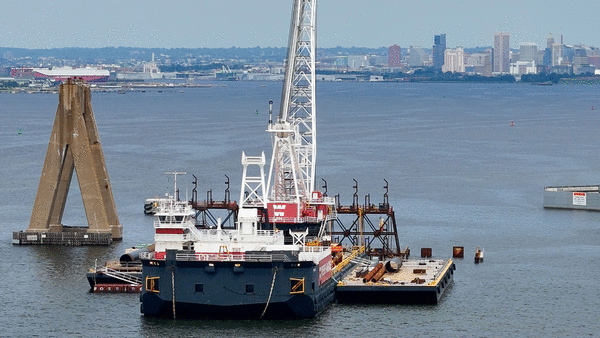
BALTIMORE — Maryland’s lone Republican in Congress told The Baltimore Sun on Tuesday that he is skeptical the Francis Scott Key Bridge can be rebuilt by late 2030 and wants clearer answers about the project’s cost as the federal government is being asked to provide additional funding.
Rep. Andy Harris declined Gov. Wes Moore’s invitation to tour the construction site Monday with members of Maryland’s congressional delegation and two influential Republican transportation leaders. Harris said the visit offered little value after the delegation received a briefing from Moore last month.
“I don’t need to go on a boat tour. We just need answers,” he said. “As far as I know, there’s nothing new to learn.”
Harris’ criticism exposes a partisan divide within Maryland’s delegation as state officials work to preserve congressional support for a project now expected to cost as much as $5.2 billion and ro open two years later than expected. The federal government has committed to covering the full replacement cost, but Harris said state officials have not adequately explained the higher price or whether it could affect that commitment.
“I’m skeptical that this project can even be completed” by the revised deadline, Harris said. The Maryland Transportation Authority (MDTA) told The Sun the current estimate has not changed since November 2025 and that it remains confident in its cost and schedule projections. Moore’s office called Harris’ criticism “unfounded speculation” and rejected the characterization that Monday’s tour was merely symbolic.
The administration instead emphasized the participation of two Republicans positioned to influence federal transportation policy and spending: Sen. Shelley Moore Capito of West Virginia, chair of the Senate Environment and Public Works Committee, and Rep. Steve Womack of Arkansas, chairman of the House Appropriations subcommittee overseeing transportation funding.
“The Francis Scott Key Bridge is more than a Baltimore or Maryland asset — it’s a vital piece of our national economy,” Moore’s office said. “Their partnership is critical to rebuilding the bridge as quickly, safely and cost-effectively as possible.”
Moore’s office said every member of Maryland’s congressional delegation was invited. Harris declined, but most Democratic members accepted. Rep. April McClain Delaney did not attend and did not respond to requests for comment. Reps. Sarah Elfreth and Jamie Raskin’s respective offices said the lawmakers were unable to attend due to prior commitments.
State advances next phase of rebuilding
Questions about the bridge’s rising cost come months after MDTA ended its contract with Kiewit Infrastructure over disagreements about projected costs for future phases of construction. Kiewit will complete its current work through the end of the year while the agency seeks new contractors for the remaining phases.
On Tuesday, MDTA issued a request for qualifications for the project’s largest construction contract — the bridge’s main span and marine approaches. The competitive procurement begins the search for a design-build team to complete the bridge’s signature cable-stayed span, with work expected to begin in summer 2027.
MDTA Secretary Katie Thomson called the solicitation “the first major milestone in assembling our construction team.”
After Monday’s tour, Capito said seeing the work firsthand reinforced the project’s national importance and pledged to continue working with Maryland and the U.S. Department of Transportation to ensure federal dollars are spent effectively.
Womack also praised the pace of construction despite the project’s complexity. “Their track record is pretty good right now when you consider the speed at which a lot of these things are happening,” he said. “This is going to be open in record time, and everybody will benefit, particularly the nation.”
Liability fight moves forward
Still, the bridge project continues to face challenges beyond construction and congressional oversight. In federal court Monday, the companies that owned and operated the Dali renewed their effort to limit their financial responsibility for economic losses caused by the collapse.
Grace Ocean Private Ltd. and Synergy Marine Pte. Ltd. argue that a 1927 Supreme Court decision bars many of those claims because the plaintiffs did not suffer direct physical property damage. If the judge agrees, the companies could avoid paying the city, county and many businesses millions.
The companies said Baltimore’s claim involving damage to a city-owned water main should remain under consideration but argued claims related to road damage from diverted truck traffic should be dismissed. They also contend Baltimore County lacks a sufficient property interest to recover damages and that businesses have not shown they qualify for an exception to the Supreme Court precedent.
The outcome of the legal dispute could determine whether local businesses, Baltimore City and County recover millions of dollars in economic losses tied to the bridge collapse. The city, county and business coalition have urged the court to reject Grace Ocean and Synergy’s argument to dismiss the claims.
------------
©2026 The Baltimore Sun. Visit at baltimoresun.com. Distributed by Tribune Content Agency, LLC.






Comments