Federal officials withhold $199 million in Medicaid funds to Minnesota pending fraud review
Published in News & Features
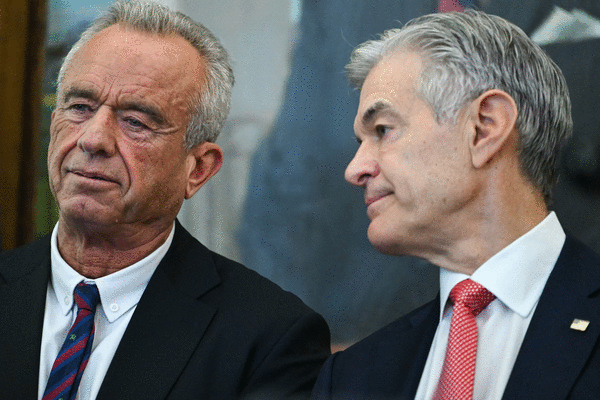
The Trump administration on Tuesday said it is withholding more federal Medicaid payments to Minnesota and California, citing suspected fraud and compliance concerns involving more than a dozen high-risk Medicaid programs.
The pause includes $199 million in payments to Minnesota and $867.5 million to California. Officials said a review of claims in 14 Medicaid services in Minnesota prompted the pause.
Health and Human Services Secretary Robert F. Kennedy Jr. and Dr. Mehmet Oz, the head of Centers for Medicare and Medicaid Services, told reporters during a news conference that Minnesota and California would need to provide further documentation to prove that the high-risk claims they uncovered are not fraudulent before they release the funding.
“If Gov. Gavin Newsom or Tim Walz wants this funding released, all they have to do is find basic documentation showing that these services are legitimate and not fraudulent,” Kennedy told reporters. “That’s common sense.”
This is the third time the federal government has deferred Medicaid funds over alleged fraud in Minnesota’s social services programs. The administration has expanded similar enforcement efforts to other states across the country.
The 14 programs identified as high risk for fraud include a range of services that help people who have developmental, intellectual and physical disabilities, mental illness, substance use disorder and other needs.
Minnesota’s Department of Human Services (DHS) — hoping to prevent the Trump administration from withholding Medicaid funds — had raced to check the validity of more than 5,500 social service providers doing that high-risk work. State officials said they had less than five months to do a review that the rest of the country does in two years.
At the end of May, DHS disenrolled 3,411 businesses and nonprofits from the high-risk programs — a move that sparked a massive outcry from providers. Many organizations said they were cut off because of a minor paperwork error or due to no fault of their own, but because state staff never got around to visiting them.
Amid concerns that thousands of vulnerable Minnesotans could lose care, DHS has allowed providers to appeal their disenrollment and keep billing as the state reviews their appeal. That process is still playing out.
This quarter, Oz said about $413 million worth of claims had been under review by the federal government, and of that more $3 million were claims from Minnesota linked to “documentation gaps.” These gaps included “charging us for care you’ve provided to a deceased person,” Oz said.
“Minnesota removed the providers, we looked back to see how much they billed us last quarter, and unfortunately, it was a lot,” Oz said. “It’s a majority of the $199 million that we’re deferring from Minnesota today.”
A DHS official pushed back on the Trump administration’s latest funding deferral, arguing the agency has already been cooperating with the federal government in good faith.
“CMS touts their new fraud-detection capabilities, yet has not provided data or explanation on how the deferral amount was calculated or what it was based on,” DHS temporary commissioner John Connolly said in a statement. “I respectfully ask the federal government to partner with us and share any information about their methods to identify potentially fraudulent providers in Minnesota.“
He said the federal government continues to act in “unprecedented and punitive ways as part of their war on Medicaid and its recipients.”
Walz also stressed that lost funding will hurt vulnerable people who rely on Medicaid services.
“They’re not punishing fraudsters, they’re punishing children, seniors, working families, and people with disabilities,” Walz said. “This is about cutting healthcare for people they don’t care about in their campaign of retribution against Minnesota.”
Oz said federal officials had been working with both states throughout the review. Minnesota has already submitted documents requested by federal officials, he said, and those materials are now being evaluated.
Earlier this year, Vance announced the federal government would halt $259 million in Medicaid payments to Minnesota over concerns about fraud in the state’s social services programs. The Trump administration also said it would defer an additional $91 million in Medicaid funding to the state.
The Centers for Medicare and Medicaid Services had also threatened to suspend $2 billion annually to Minnesota unless officials completed and implemented a fraud corrective action plan that federal officials deemed sufficient. The provider revalidation effort is a major part of that plan. In March, CMS approved a revised plan from the state, but the funding threat is still hanging over Minnesota as federal officials monitor state progress on the plan.
Minnesota had attempted to challenge that funding loss in court, but a judge denied state officials’ request for the court to immediately block the withholding.
In response to the federal government’s persistent crackdown on the state, Minnesota has bolstered its fraud-fighting efforts over the past year, including adding a pre-payment review process to detect suspicious activity. The state has also added guardrails on some programs deemed at high risk for fraud and ended one program entirely.
_____
©2026 The Minnesota Star Tribune. Visit startribune.com. Distributed by Tribune Content Agency, LLC






Comments