Starmer exits world stage unsure his foreign policy will endure
Published in News & Features
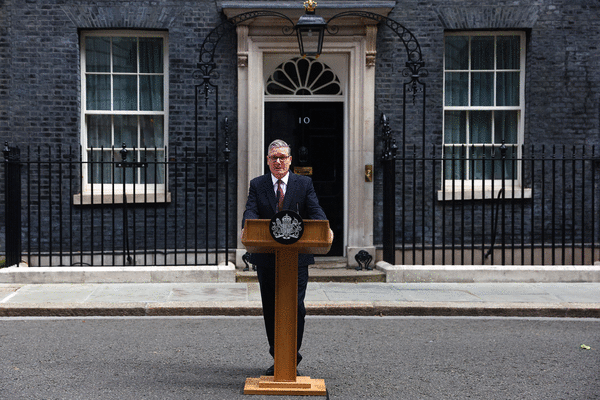
Keir Starmer’s swan-song trip as Britain’s prime minister to the NATO summit this week sought to cement a shaky diplomatic legacy for a successor who’s untested in the international arena.
British diplomats spent the weeks leading up to the gathering in Ankara, Turkey, fretting that no leader would want to meet the outgoing premier, and dealing with a diplomatic slight when Egypt canceled a visit by Starmer planned for afterward. And despite foreign policy being a bright area of a tenure marked by unpopularity, the premier struggled to contain a bruising row over defense spending in his final weeks.
As he prepares to fade into the background of British politics, Starmer is likely to hand over the baton to former Greater Manchester Mayor Andy Burnham, whose pitch for leadership centered on domestic issues rather than foreign policy, even as the U.S.-Iran war heats up again, the bloody Ukraine-Russia conflict grinds on and President Donald Trump continues to disrupt the global order.
Burnham on Thursday made his first big intervention on foreign policy, writing a piece for the Times newspaper in which he vowed to rebuild Britain’s “hard power” and reduce dependency on other countries for defense equipment, while at the same time strengthening ties with allies.
“We will do this by boosting our sovereign capabilities in areas where we already have incredible strengths and in the tech of the future — from shipbuilding and energetics to AI and quantum,” Burnham wrote. “Re-industrialization through defense — and other sectors — is critical for both our economic and national security, building resilience in all our places. It will be a core priority for me.”
Burnham also promised to stay firm on Britain’s commitment to NATO, the U.K.’s nuclear deterrent, and its “critical” defense and security relationship with the U.S. The country’s support for Ukraine “will not waver,” he added.
Starmer in recent weeks has highlighted foreign policy successes for Britain including a drive to increase diplomatic cooperation with France and Germany, the lead taken by the U.K. in planning for both a coalition force in postwar Ukraine and a potential de-mining operation in the Strait of Hormuz, and increased presence in the high north of Europe.
In Ankara, he held just a handful of bilateral meetings with leaders from the Netherlands, Norway, Turkey and Denmark, as well as forging new defense deals and initiatives on long-range weapons and shipbuilding. But he also faced stinging criticism both in public and private for the U.K.’s lagging defense investment and wider political turmoil. Britain persuaded only three nations to sign up to its new defense funding mechanism.
Defense Secretary Dan Jarvis came under intense pressure from allies at a presummit meeting in Brussels over his government’s military-spending plans, just under a month after his predecessor, John Healey, quit, accusing Starmer of failing to adequately protect the country.
Trump has repeatedly berated Britain alongside other European allies for not doing more on defense, though Starmer said he and Trump plan to stay in touch, insisting the pair got on well throughout his premiership.
Even fellow Europeans waded in. In an appearance on BBC TV, Finland’s president, Alexander Stubb, urged Britons to “sort yourselves out.” Senior European diplomats, even from nations lagging further on defense spending than Britain, privately pointed out the U.K. had fallen in NATO rankings comparing national contributions to the alliance.
In Ankara, Starmer repeatedly said he didn’t want to advise Burnham on how to govern, but urged the would-be premier to treat international affairs as intrinsically linked to domestic policy. That seemed to reflect a concern that the former mayor won’t make diplomacy a priority.
“You can’t divorce the international from the domestic, that’s not a sensible way of looking at it,” Starmer told reporters on the sidelines of the summit. He pointed to the impact of the Iran and Ukraine wars on the cost of living. “I’m afraid the two go together, they’re two sides of the same coin.”
In his piece on Thursday, Burnham appeared to have taken that message on board. He vowed to use a “sustained increase in defense investment” to resupply Britain’s armed forces with appropriate kit, as well as to “generate economic growth and create apprenticeships and jobs in communities that have seen opportunities drain away.”
“I see our strength at home and our strength in the world as indivisible,” the prospective premier wrote. “There’s no doubt that we face a growing and evolving threat, which we must prepare for using the ingenuity and talents of the British people. As prime minister, I will surround myself with the best and most experienced advisers,” he said, adding that he intended to keep the Starmer appointee, Jonathan Powell, as the U.K.’s national security adviser.
With rumors swirling that Starmer has his eye on the NATO secretary general’s job, the only longer-form interviews he gave in Turkey were to a pair of social media influencers, one of whom specializes in careers advice. But Starmer insisted he’s not thinking about what comes next.
_____
©2026 Bloomberg L.P. Visit bloomberg.com. Distributed by Tribune Content Agency, LLC.




Comments