US, Iran trade airstrikes as fears grow of a return to war
Published in News & Features
The U.S. military attacked Iran for a second day and Tehran retaliated against American allies in the Persian Gulf, raising fears of a return to war after little progress in efforts to secure a diplomatic outcome.
U.S. Central Command said on X about 90 targets were hit overnight — after 80 the previous day — “to further degrade” Iran’s ability to attack commercial shipping in the Strait of Hormuz.
Iran reported strikes on the perimeter of a nuclear power plant and two railway bridges connecting the capital to the city of Mashhad, where former Supreme Leader Ali Khamenei is being buried on Thursday.
The Islamic Republic responded by targeting U.S. bases in Bahrain, Kuwait and Qatar, according to the semi-official Iranian Students’ News Agency. Jordan intercepted eight Iran-launched missiles, according to that country’s state-owned TV.
“Every time they hit us, we’ll hit them 20,” U.S. President Donald Trump told reporters on Air Force One.
“I don’t know,” he added, when asked whether the U.S. and Iran were returning to an all-out war. “We’d win it very quickly. We have many ways we could win.”
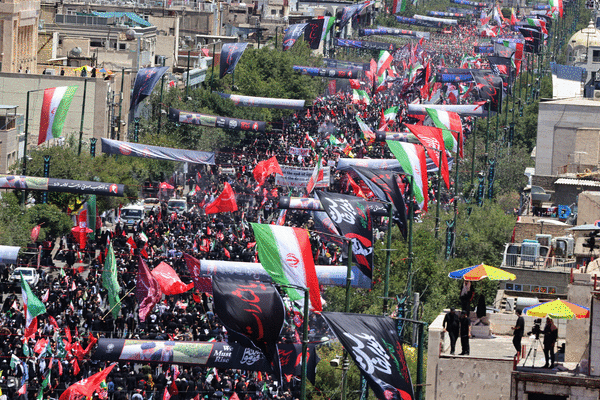
The hostilities came about three weeks after the U.S. and Iran signed an interim peace agreement that triggered a 60-day negotiation period to resolve outstanding issues in the conflict. The talks, which are on hold while Iran conducts a week-long mass funeral for Khamenei, have yet to achieve a breakthrough.
The U.S. has revoked a waiver allowing new sales of Iranian oil — a condition of the interim deal — in response to attacks on ships in the Strait of Hormuz that the administration blamed on the Islamic Republic.
Traffic through the waterway came to a near standstill on Thursday, and Iran’s insistence that it retains control of the passage is one of many issues on which the two sides remain far apart.
Iran’s Islamic Revolutionary Guard Corps Navy said Thursday that any U.S. interference in determining shipping routes through the strait would “seriously disrupt the gradual reopening process and jeopardize the interests of countries” that rely on the waterway, according to the state-run Islamic Republic of Iran Broadcasting.
The latest attacks will “keep a firm ceiling on the number of vessels willing to transit” the strait, Helima Croft, chief commodities strategist at RBC Capital Markets, said in a note. “The key question is whether these attacks will trigger a more serious resumption of fighting or if they will be followed by another tenuous truce.”
Qatar is pausing efforts to rapidly revive production at the world’s largest liquefied natural gas facility after an attack on one of its tankers in the strait, Bloomberg News reported.
Oil prices fluctuated on Thursday after surging following the outbreak of fighting the previous day. Brent crude, the global benchmark, dropped 1.2% to $77 a barrel by mid-afternoon in London, after gaining more than 5% on Wednesday.
The IRGC threatened to expand its attacks, according to Press TV. Earlier, parliamentary speaker Mohammad Bagher Ghalibaf issued a warning that “the U.S. still hasn’t learned that bullying and breaking its commitments no longer come without a cost.”
“Let me be clear: If you strike, you will be struck back,” he said in a post on X.
Qatari Prime Minister Sheikh Mohammed Bin Abdulrahman Al Thani discussed the military escalation in a phone call with Iran Foreign Minister Abbas Araghchi, according to a statement from Qatar’s foreign ministry. Attacks on commercial ships in Strait of Hormuz erode trust and harm efforts for regional security, Al Thani said.
Iran said Araghchi also held separate calls with his counterparts in Oman and Turkey, during which Hormuz and the importance of diplomatic efforts were discussed.
Kuwait’s army said it intercepted three ballistic missiles, one cruise missile, and 10 drones that entered the country’s airspace in the early hours of Thursday. Bahrain’s Ministry of the Interior said sirens had sounded and urged residents to head to the nearest safe place.
Traffic through the Strait of Hormuz dropped off as traders assessed the outlook for Middle Eastern crude supplies. Observable movements in the world’s most vital energy conduit largely occurred along an Iran-approved route nearer to the waterway’s north, while the U.S.-supported Omani corridor was quiet, ship-tracking data show.
Trump threatened to resume a blockade of Iranian ports and escalate the military campaign by targeting infrastructure such as desalination and power plants. On Wednesday, he declared the ceasefire “over,” sending oil higher and stocks and bonds lower, before saying he would let negotiators continue talks and that he didn’t think the war would resume.
Still, the latest violence casts doubt on the prospect of negotiations continuing.
Issues to be resolved in discussions include management of the strait and the release of billions of dollars of frozen funds to the Islamic Republic, with talks on Iran’s nuclear program to follow.
_____
(With assistance from Eltaf Najafizada, Patrick Sykes and Salma El Wardany.)
_____
©2026 Bloomberg L.P. Visit bloomberg.com. Distributed by Tribune Content Agency, LLC.





Comments