Ukraine's missiles now have almost half of Russia in reach
Published in News & Features
Ukraine has expanded the range and intensity of its missile strikes inside Russia, triggering alerts across nearly half of the regions in the world’s largest country so far this year.
Missile threats were declared in at least five regions of the Volga Federal District southeast of Moscow in the past week alone, as well as in the southern Astrakhan region and at least four regions in the North Caucasus. Similar warnings were also issued in the Moscow, Vladimir, Tambov, Orel and Lipetsk regions of central Russia.
Ukraine struck the Ufa oil refinery more than 1,300 kilometers (807 miles) from the front line for a second time, as well as a military-industrial facility in the Penza region that produces missile components, Ukrainian President Volodymyr Zelenskyy said Wednesday in a statement on the X platform. Bloomberg News can’t independently verify the claims.
The scale and geographic reach of the attacks highlight how Ukraine’s tactics and long range strike capabilities have evolved as it attempts to bring the war closer to home for Russians. Kyiv is stepping up pressure on President Vladimir Putin to enter peace talks after more than four years of fighting.
Earlier in the war, missile alerts were largely confined to Russian regions bordering Ukraine as well as Ukrainian territories occupied by Moscow’s forces. This year, however, the areas that are home to more than 70% of the country’s population have sounded the alarm at least once, according to a Bloomberg analysis of statements by regional authorities.
Omsk region in western Siberia, nearly 3,000 kilometers east of the Ukrainian border recorded its first missile alert in June, as did the entire Ural region.
Samara, a city of about 1.2 million people on the Volga River, temporarily suspended overground public transport during one alert this week, while the metro remained open as a public shelter.
A missile strike killed five people last week in the Voronezh region that borders Ukraine, with local authorities issuing air alerts almost daily since then. A weekend attack in the Volgograd region in which Ukraine said it used its new Flamingo missiles also left two people dead.
Novgorod and Pskov regions in northwest Russia triggered missile alerts this week for the first time since Russia began its full-scale invasion of Ukraine in 2022.
Kremlin spokesman Dmitry Peskov declined to comment.
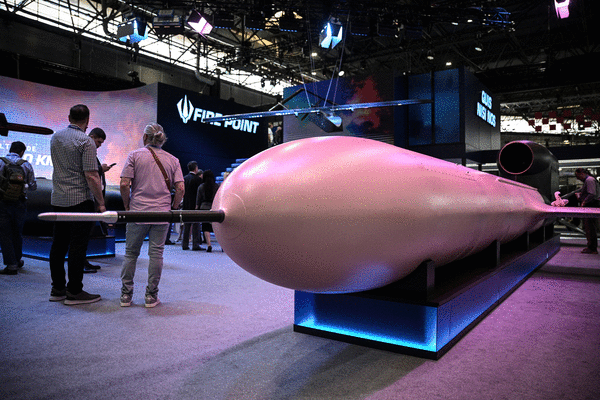
Ukraine is increasingly relying on domestically developed long range cruise missiles to complement its expanding fleet of attack drones, giving Kyiv the ability to strike military and industrial targets over greater distances inside Russia.
Zelenskyy said in May that Flamingo cruise missiles had flown more than 1,500 kilometers for the first time to strike a defense plant that manufactures navigation components in Cheboksary, the capital of Russia’s Chuvash Republic in the Volga region.
“This marks a significant evolution in Ukraine’s long range strike campaign,” said Douglas Barrie, a senior fellow for military aerospace at the International Institute for Strategic Studies. “Flamingo offers the ability to strike deep into Russia with a large warhead.”
The ability to strike Russian critical national infrastructure with long-range attack drones and cruise missiles “is having the effect of damaging elements of the Russian industrial war effort, hitting the economy, and underscoring to the Russian public that the war on Ukraine has a cost,” Barrie said.
This should translate into greater pressure on the Kremlin, but whether Putin will become more willing to negotiate is another question, he added.
Almost every Russian region reported either fuel rationing or disruptions to gasoline supplies by the end of June following Ukrainian drone strikes in recent weeks that targeted key oil refineries, temporarily halting operations at some of them.
A fire at an oil refinery in Slavyansk-on-Kuban in Russia’s Krasnodar region was burning for a second day after a large-scale Ukrainian drone and missile attack on Sunday, local authorities said. The strike involving 110 drones and five Flamingo cruise missiles on the district that hosts the refinery was the largest since the start of the war, killing one person and injuring six.
“Ukraine often tries to saturate Russia’s air defense with drones so that cruise missiles can get through,” said Sam Cranny-Evans, a military analyst at the Royal United Services Institute in London.
Ukraine’s Defense Ministry declined to comment on its missile production program.
Ukraine began producing the Flamingo last year and claims the missile has a range of up to 3,000 kilometers, potentially allowing it to hit targets across most of European Russia and, in theory, beyond the Ural Mountains.
Neptune, Ukraine’s first home-grown long range cruise missile, was originally developed as an anti-ship weapon and used to sink the Moskva cruiser that was the flagship of Russia’s Black Sea Fleet in 2022. The repurposed missile is capable of hitting land targets over a distance of as much as 1,000 kilometers.
Ukraine has fired Neptunes against targets in Crimea and Sevastopol since 2022, as well as in regions of Russia. The Russian Defense Ministry first reported intercepting a Neptune missile in August 2023.
Moscow doesn’t disclose how many missiles it intercepts on a daily basis, while publishing statistics primarily on Ukrainian drone attacks, even as Putin insists Moscow retains the upper hand in the long range strike campaign.
Putin said this week that he was prepared to continue talks with U.S. envoys on ending the war in Ukraine while rejecting proposals to halt long range strikes.
“Our retaliatory strikes deep into Ukrainian territory are much more powerful, more sensitive and, frankly, more destructive, leading to truly serious consequences” for Kyiv, Putin said, without identifying who’d made the proposals.
—With assistance from Thomas Hall, Kollen Post, Alex Newman and Alex Kokcharov (Analyst).
©2026 Bloomberg L.P. Visit bloomberg.com. Distributed by Tribune Content Agency, LLC.






Comments