Maryland GOP oblivious as Democrats eye July special session for redistricting
Published in News & Features
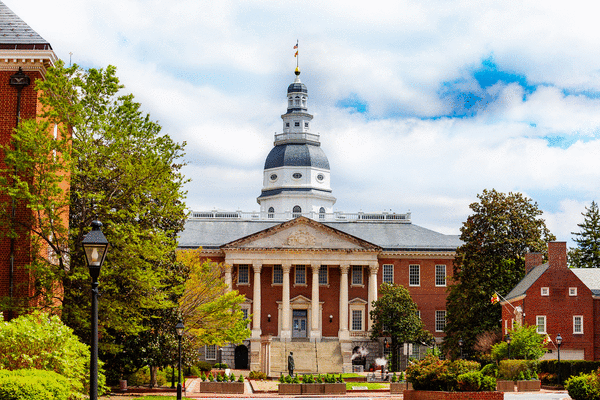
Maryland Republicans say they were largely left in the dark as Maryland’s top Democrats prepare plans for a mid-July special session that could create a pathway for redrawing the state’s congressional map, potentially reshaping the balance of political power in Maryland’s congressional delegation.
Senate President Bill Ferguson’s office confirmed to The Baltimore Sun on Monday that legislative leaders plan to call for a special session immediately after Maryland’s June 23 primary election. The formal announcement will likely come jointly from Ferguson, Gov. Wes Moore, and House Speaker Joseline Peña-Melnyk, whose offices have been coordinating on the effort, Ferguson’s office added. Lawmakers would consider a November referendum on a constitutional amendment removing a barrier preventing congressional districts from crossing the Chesapeake Bay. Maryland’s highest court rejected a similar approach during the 2022 redistricting cycle. No revised map has been proposed. However, Republicans have noted that removing the Chesapeake Bay restriction could give lawmakers greater flexibility to redraw Maryland’s lone Republican-held congressional district, represented by U.S. Rep. Andy Harris.
If approved by lawmakers and ratified by voters, the change could allow Democrats to pursue new congressional maps ahead of future elections. According to Ferguson’s office, lawmakers must act by July 31 to place the measure on the November ballot. The amendment language is still being drafted and is expected to differ from proposals debated earlier this year.
Moore and other Maryland Democrats have argued the state should explore redistricting options as part of a broader national fight over congressional control. Supporters have framed the effort as a response to redistricting efforts in Republican states like Texas and Florida, maintaining that Democrats should not unilaterally disarm while other states redraw maps for partisan advantage. But critics maintain that the practical effect would be to create new opportunities for Democrats to expand their advantage in Maryland’s congressional delegation.
Maryland Republicans also argue that Marylanders are struggling with affordability concerns, accusing Democratic leaders of engaging in partisan map-drawing. Senate Minority Leader Steve Hershey added that Senate Republicans would introduce legislation intended to lower costs if lawmakers return to Annapolis.
House Minority Leader Jason Buckel said Republican lawmakers have not been formally consulted about the proposal and only received informal indications that Democratic leaders were preparing a July special session focused on redistricting.
Hershey called the proposal “the wrong priority” while Maryland faces budget and affordability concerns. “If we’re going to bring lawmakers back to Annapolis, it should be to deliver real relief for Maryland families — lower energy costs, meaningful tax relief, and solutions to the rising cost of living — not to abuse the State Constitution for political purposes,” he told The Sun in a text message.
House Minority Whip Jesse Pippy said the effort is less about election reform than expanding Democratic political power. “It’s beyond disappointing that Maryland Democrats would rather spend their time eliminating the voices of the minority party, rather than addressing the important issues our citizens face,” he said.
Looming hurdles
The proposal faces political and logistical hurdles. Under Maryland law, constitutional amendments require support from three-fifths of lawmakers in each chamber — 29 votes in the Senate and 85 in the House.
Ferguson’s office said Senate leaders are continuing discussions with Democratic senators to gauge support and identify a date when enough lawmakers will be available to attend a summer special session. Similar concerns exist in the House, despite the chamber’s prior approval of redistricting legislation.
The move marks a significant reversal for Ferguson, who earlier this year declined to advance House-passed redistricting legislation despite pressure from fellow Democrats. At the time, Ferguson warned that reopening Maryland’s congressional map could trigger litigation and potentially cost Democrats one of the state’s seven congressional seats. Last month, however, Ferguson said a recent U.S. Supreme Court decision involving Louisiana’s congressional map altered the legal and political landscape enough to warrant reconsidering a special session.
The issue has divided Maryland Democrats for more than a year.
The debate has also surfaced in Ferguson’s reelection campaign. Last month, LaPin joined Sen. Arthur Ellis in calling for a special session after the Supreme Court’s decision.
“Once again, Senator Ferguson is reacting instead of leading. The damage is already done—you don’t get credit for fixing a problem you caused,” LaPin said in a Monday text message to The Sun.
Maryland’s congressional delegation currently consists of seven Democrats and one Republican.
________
©2026 The Baltimore Sun. Visit at baltimoresun.com. Distributed by Tribune Content Agency, LLC.






Comments