In major decision, Pa. Supreme Court rules 'skill games' are slot machines
Published in News & Features
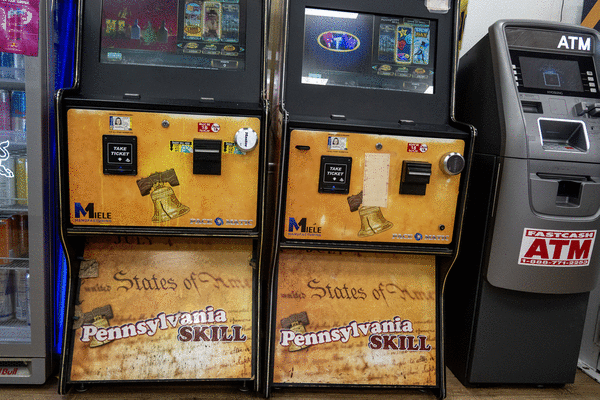
HARRISBURG — So-called skill games, the slot-machine lookalikes that have proliferated by the tens of thousands around Pennsylvania bars and corner stores, are slot machines devices and should be regulated as such, the state’s highest court ruled Monday.
The Pennsylvania Supreme Court ruling clears the way for widespread taxation and regulation by the state, as well as limits on where the machines are available, as a majority of justices ruled that both gambling law and the criminal code apply to the machines.
“The device is a ‘slot machine,’” wrote the newly-independent Justice David Wecht in the majority opinion.
The majority recognized that the ruling could cause a “potential disturbance” for “business owners and other good-faith participants in the industry,” so the ruling will take effect after a 120-day “safe harbor” period. And if lawmakers in Harrisburg disagree with the opinion, the General Assembly “remains free at any time to take whatever legislative action it may deem appropriate.”
Pennsylvania’s gambling industry is highly regulated and taxed. If state law is unchanged after the 120-day waiting period, the estimated 70,000 skill game machines available across the state would need to be regulated and confined to specific locations like casinos that have the proper licenses.
Chief Justice Debra Todd and Justice Daniel McCaffery, both Democrats, joined the opinion in full, while Republican Justices Sallie Updyke Mundy and Kevin Brobson concurred with most of the majority’s reasoning but wrote a short dissent.
Justice Christine Donohue, a Democrat, wrote a concurring decision.
“Because chance predominates both the player’s eligibility for winnings and the magnitude of those winnings, the [skill games] device is a gambling device,” Donohue wrote.
Justice Kevin Dougherty, a Philadelphia Democrat, sat out the long-awaited decision.
Skill game operators have evaded taxation and regulation for more than a decade, operating in a legal gray area after lower courts ruled that the machines require a level of skill not necessary to play games of chance like slot machines.
The most influential player in the skill games industry, Georgia-based operator Pace-O-Matic, has asked the state on multiple occasions to regulate and tax the machines — at a rate much lower than slot machines, arguing that their technology helps small businesses with small margins stay afloat as prices rise.
In a statement, Pace-O-Matic said it was disappointed by Monday’s ruling with “far-reaching consequences” on Pennsylvania’s small businesses and fraternal organizations.
“[Small businesses] are now potentially left facing an impossible choice: cease operating these games and lose an important source of revenue, or endure a legislative solution that could bring excessive regulation and crippling taxation, which will force them to cease operating these games and lose an important source of revenue,” a spokesperson for Pace-O-Matic added.
Gov. Josh Shapiro, a first-term Democrat, has proposed regulating and taxing skill games at 52% — the same rate currently levied on slot machines and most other games of chance. He estimated taxing and regulating the machines could bring in $765.9 million for the state in new revenue in its first year, as part of its $53.2 billion February budget pitch.
State lawmakers have been waiting for the state Supreme Court to rule whether the machines are legally slot machines or not, as the split legislature considers whether to and how much to tax them as a way to create a much-needed new revenue stream.
Top legislators and Shapiro have convened over the last few weeks in closed-door meetings to finalize a state budget deal ahead of its June 30 deadline. Now with the decision in hand, Senate President Pro Tempore Kim Ward (R., Westmoreland) and Majority Leader Joe Pittman (R., Indiana) said in a statement they believe gaming reform is a “critical piece of resolving this year’s budget.”
In Philadelphia, City Council banned skill games in 2023 over concerns that they attract crime, but a lower court previously blocked its enforcement while several cases reached the state Supreme Court.
A Philadelphia jury ordered Pace-O-Matic to pay $15.3 million last year to the estate of Ashokkumar Patel, a Hazelton store clerk killed during a 2020 robbery. And a Philadelphia store clerk shot last year during an armed robbery of a Philly Market in Frankford, Ahmedine Maham, sued Banilla Gaming, a North Carolina-based skills game manufacturer, for enticing his assailants.
At the end of the 120-day waiting period, the machines will be subject to regulation like slot machines and restricted to specific locations licensed to house slot machines — unless lawmakers decide to change the law.
Pace-O-Matic, in its statement Monday, urged lawmakers to approve bipartisan legislative proposals backed by rural GOP members and Philadelphia Democrats that would charge a $500 fee per skill game machine and would not restrict the machines to licensed slot machine locations, such as casinos.
In a statement, Pennsylvania Attorney General Dave Sunday, a Republican, praised the Supreme Court’s decision as a “significant victory for consumers, taxpayers, and the rule of law.”
“The Supreme Court recognized what our office has argued from the beginning – these machines operate as gambling devices and cannot legally exist without the same oversight, regulation and accountability as other forms of legalized gaming in the commonwealth,“ Sunday added. ”Pennsylvanians deserve protections that ensure games are fair, transparent and operated within the bounds of the law.”
©2026 The Philadelphia Inquirer, LLC. Visit at inquirer.com. Distributed by Tribune Content Agency, LLC.





Comments