US vows interim Iran deal will reopen Hormuz, end nuclear threat
Published in News & Features
WASHINGTON — The U.S. said an interim peace deal that reopens the Strait of Hormuz and ends Iran’s nuclear weapons ambitions looks increasingly likely and could be signed within days, though conflicting messages between Washington and Tehran continued to cast doubt on that timeline.
A senior Trump administration official briefing reporters Friday said there was an 80% or 85% chance that an agreement gets signed soon, then added that some Iranian hardliners still want to kill any breakthrough. Those internal disagreements are being worked out, the official said.
The deal would ensure Iran doesn’t have a nuclear weapons program but would let it maintain a civilian nuclear energy program, the senior official said. It would also ensure enriched nuclear material is removed from the country and end both sides’ blockade of the Strait of Hormuz. If all terms are met, the U.S. would ease sanctions on Iran and allow it to reintegrate into the global economy, according to the official.
It wasn’t immediately clear whether Tehran has agreed to the same terms outlined by the U.S. official, though comments from mediators suggested some progress was being made in a bid to end a conflict that has largely blocked a crucial energy artery and damaged the global economy.
“The Islamabad Memorandum of Understanding has never been closer,” Iranian Foreign Minister Abbas Araghchi posted Friday on X. He vowed that “all details will be shared with the public in due course.” President Donald Trump reposted Araghchi’s statement.
Iran’s foreign ministry said Tehran was still reviewing the draft. The terms of the deal still need to be approved by Iran’s Supreme Leader Mojtaba Khamenei, according to a European official familiar with the matter.
Bringing a conclusive end to the conflict, now in its fourth month, has thrust Trump into a complicated political bind: He wants to present the deal as a win to national security hawks in his own party as well as to an American public that has increasingly turned against the war he started in late February with a joint U.S.-Israeli bombardment of the Islamic Republic.
It’s not clear that the deal outlined by the senior official will thread that needle. Some of the terms, including the continuation of a civilian nuclear program and talk of allowing the current Iranian regime to return to the global economic mainstream, will be anathema to more hawkish supporters of the president, as well as to allies in Israel.
A person familiar with the deliberations, who asked not to be named while discussing sensitive matters, said the memorandum will be open to interpretation in certain areas, including what the reopening of Hormuz would mean in practice. While Trump said ships will have free passage in the waterway, Iranian media suggested Tehran will still have a degree of control.
Another diplomat familiar with the talks said the U.S. and its allies would aim to ensure normal levels of shipments through the strait within about a month of a deal being signed. That may be complicated by the high likelihood of Iran having placed mines in the strait, which the U.K. and France are preparing to help clear.
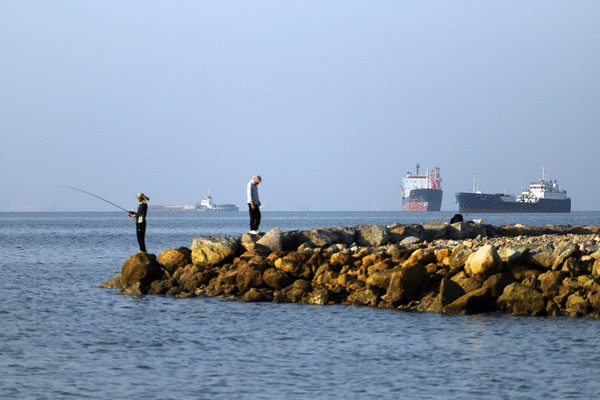
Roughly 140 ships passed through the narrow chokepoint each day before the conflict erupted. The number of vessels has crept up in recent weeks, but is still far below pre-conflict levels.
The senior U.S. official said the Trump administration believes Iran’s control over Hormuz has weakened and that its ability to threaten its neighbors has also diminished. That statement, however, comes just a few days after Iran downed an American military helicopter and launched more ballistic missiles and drones at Israel.
The war has killed thousands of people across the region, mainly in Iran and Lebanon.
Despite continuing uncertainty, energy prices continued to fall on Friday following Trump’s announcement a day earlier that he had canceled plans for new strikes on Iran.
Brent futures fell as much as 5.1% to trade at the lowest level since the early days of the war, while European gas slumped as much as 8.4%, before paring gains. While the global benchmark is still up almost 50% this year, it’s fallen from a high of $125 in late April.
Beyond questions about control of the strait, the senior administration official offered no details about how a nuclear weapons inspections regime, which Iran previously agreed to under the international deal Trump pulled out of in his first term, would work. The Trump administration has repeatedly criticized any comparison to that earlier deal, the Joint Comprehensive Plan of Action, signed during the Obama administration.
As divergent descriptions of the agreement leaked out, Vice President JD Vance pushed back against some GOP hawks with a post earlier on Friday in which he assailed “people who (rightly) said Donald Trump was a historic president a month ago now criticizing a deal based on unconfirmed media reports.”
“The president is going to get us a good outcome, one way or the other,” Vance said, vowing that Iran won’t get access to billions of dollars in blocked accounts just for signing an agreement.
That contradicted an earlier report from Mehr, an Iranian news agency, that the deal would include the release of $24 billion of Iranian funds held in foreign banks. Mehr also said the agreement states the U.S. will withdraw forces from areas near Iran, lift oil sanctions and “present reconstruction plans” for the Islamic Republic worth around $300 billion.
The senior U.S. official told reporters that such reports out of Iran can’t be trusted, calling them domestic propaganda meant to sell any agreement to the Iranian people.
Trump earlier denied and vented his frustration about Iranian media reports.
The Iranians are “very dishonorable people to deal with,” Trump said in a social media post. “They better get their act together, and FAST!”
Nevertheless, the growing talk of a breakthrough is putting more focus on a potential signing around the G7 summit in Evian, in the French Alps, from June 15-17. Yet the senior U.S. official said Friday that no decisions about timing or location have been settled.
Another potential sticking point is Israel, which is not part of the negotiations for the interim deal. Prime Minister Benjamin Netanyahu has signaled he’d prefer more strikes to further degrade Iran’s military.
Israel’s minimum expectation is now that an end-of-war deal ensures highly enriched uranium is removed from Iran, according to a person familiar with the matter.
Until Iran responds again, it will be hard to determine whether the latest maneuvering is a fresh step toward a longer-term peace or just another short-lived promise. Trump has vowed dozens of times that an agreement is near, only for none to materialize.
The senior administration official suggested that this time was different. U.S. diplomatic efforts have been an all-hands-on-deck process over the past 24 hours involving officials including Secretary of State Marco Rubio, Defense Secretary Pete Hegseth, Trump’s son-in-law Jared Kushner and White House Chief of Staff Susie Wiles, the senior US official said.
(Salma El Wardany, Jennifer A. Dlouhy, Dan Williams and Courtney Subramanian contributed to this report.)
©2026 Bloomberg L.P. Visit bloomberg.com. Distributed by Tribune Content Agency, LLC.






Comments