Washington National Opera sues Kennedy Center for $17 million
Published in News & Features
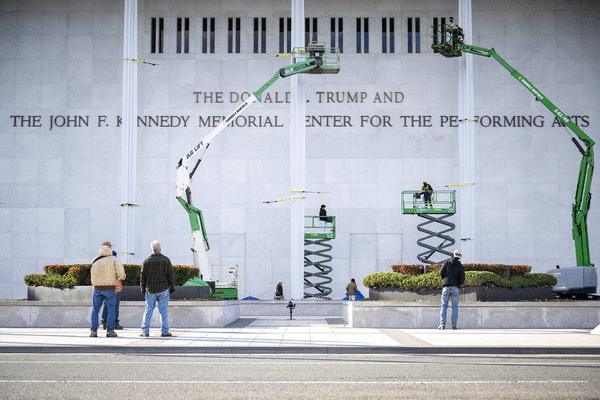
The Washington National Opera has filed a federal breach-of-contract lawsuit in Washington claiming that the opera company is owed $17 millions in donations and endowment funds by the John F. Kennedy Center for the Performing Arts.
The complaint, which was filed Thursday, says the opera’s leaders are filing the suit “reluctantly” against the venue where they performed for 50 years following months of fruitless negotiations with Kennedy Center officials.
It also is the most public document to date to describe in detail the worsening relationship between the Opera and the nation’s premiere cultural performing arts institution during President Donald Trump’s second administration.
Discussions to terminate the relationship were initiated by the Kennedy Center’s immediate past president, Richard Grenell, and began last November; by Jan. 9, both parties had agreed to the split.
The opera company wrote in a statement provided to The Sun on Friday that it has “no other option” than to file the lawsuit because it bears a fiscal responsibility to its donors to ensure their contributions are used as they intended.
“WNO has repeatedly and in good faith asked the Center to return the donor funds it holds on WNO’s behalf and to provide a basic accounting,” the Opera wrote. “Five months later, the Center has not returned the funds and has refused to say whether it intends to return the money at all. According to the Kennedy Center, it has put a significant portion of these funds at risk by using them to collateralize the Center’s line of credit.”
The Opera performed “West Side Story” in May at concert halls in Baltimore and North Bethesda, and will perform “La traviata” in Montgomery County next spring.
Kennedy Center spokeswoman Roma Daravi said that the institution intends to file a countersuit against the Opera, and that the money expended by the Kennedy Center on the Opera’s behalf greatly exceeds the total that the cultural group says it is owed.
A contract providing the WNO with the exclusive right to perform operas at the Kennedy Center “financially burdened the Kennedy Center for more than a decade,” Daravi wrote in an email.
“Taking into account the WNO’s endowment … the WNO accumulated a $72 million deficit to the Center from 2011 through 2026.
“The Center,” she concluded, “has acted transparently and in the best interests of the public throughout this process.”
The Opera’s complaint is just the most recent legal salvo fired against the beleaguered cultural center.
On May 29, U.S. District Judge Christopher Cooper overruled plans by the Center board of trustees to close the facility for two years for repairs starting in July. He also found that Trump’s name had been illegally added to the institution’s facade and ordered the Center’s board to remove it. The Center’s board asked the judge to delay that part of this order and allow the president’s name to remain on the facility temporarily; on Friday, Cooper refused.
And last week, District of Columbia Superior Court Judge Tanya Jones Bosier threw out a lawsuit the Center had filed against Maryland jazz musician Chuck Redd, who canceled his planned Christmas Eve, 2025 concert at the Center to protest Trump’s takeover of the venue. In February 2025, the president removed all the board members and appointed his own appointees. The new members dismissed Baltimore Orioles owner David Rubenstein as board chairman, elected Trump in his place and fired organization president Deborah Rutter.
According to the Opera’s lawsuit, the Kennedy Center provided several administrative services for the Opera during their 15-year affiliation agreement between 2011 and 2026, including managing donations made to the opera company. But beginning last summer, the Center stopped performing many of its legal obligations to the Opera, including marketing, fundraising and issuing reports on the Opera’s endowment and other funds, according to the lawsuit.
“The result was chaos,” the complaint says.
“Gifts went unprocessed or unacknowledged, donor benefits went unfulfilled and donor communications went unanswered. … WNO lost all visibility into its own financial activities by fall 2025.”
Beneath the dry legal verbiage, the timeline described in the 28-page complaint reads almost like the libretto of a five-act opera. The suit recounts the rapid deterioration — and futile attempts to salvage — what for a long time had been a mutually beneficial professional and artistic partnership.
On Jan. 8, Donna Arduin, the Kennedy Center’s chief financial officer, sent a letter to the Opera “asserting for the first time” that the money in the opera board’s budget reserve fund of unrestricted bequests “belonged to the Kennedy Center,” according to the complaint.
The next day, the opera’s board of trustees voted to terminate its affiliation agreement.
Later that day, according to the complaint, the Kennedy Center cut off the Opera’s access to its electronic data, “including WNO’s emails, donor information, meeting minutes and Board of Trustees records dating back to 2011.”
The Opera was locked out of its Kennedy Center offices and scrubbed from the organization’s website. Opera employees were sent termination notices.
The complaint says the Opera attempted to engage in mediation to resolve its concerns. Instead, the complaint alleges, the Kennedy Center stalled. Officials initially agreed to resume discussions about the funds in question, but instead postponed and “abruptly canceled” planned meetings, including one just 20 minutes before the agreed-upon time “while WNO’s representatives were waiting in the Kennedy Center’s lobby.”
_____
©2026 Baltimore Sun. Visit baltimoresun.com. Distributed by Tribune Content Agency, LLC.






Comments