DeSantis' property tax measure would strip power from local governments
Published in News & Features
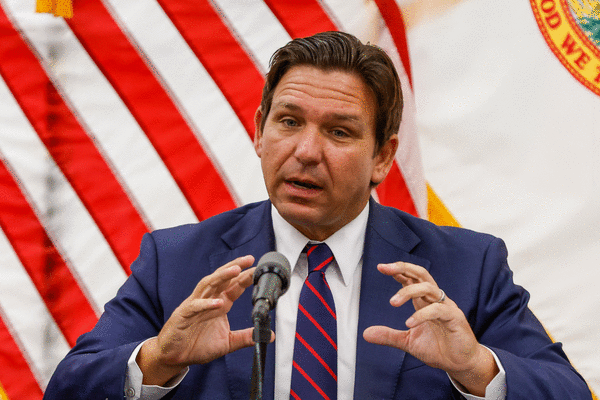
TALLAHASSEE — City and county governments across Florida are sounding the alarm on the proposal by Gov. Ron DeSantis to drastically cut homeowners’ property taxes, force them to follow a state-approved formula for future tax assessments and dictate how those dollars are spent.
“It is a complete takeover by the state government,” House Democratic Leader Fentrice Driskell, D-Tampa said Friday as policy analysts around the state rushed to quantify what would be a historic sea change in how Floridians pay for and receive government services.
The Florida Legislature will decide during a special session beginning Monday whether to put the Save Our Homes from Excessive Property Taxes resolution on the November ballot for voters to decide. Getting it on the ballot requires at least 60% approval from both chambers, and 60% of voters must back it for it to become law Jan. 1.
In its current form, the resolution calls for applying up to a $250,000 homestead exemption and limiting how much local governments can raise tax rates on non-homesteaded properties – including business, commercial, and residential rental properties – for a total estimated loss of $10 billion in tax revenue in the first two years, according to the Florida Association of Counties.
Of course, that’s also a savings of $10 billion mostly for tax-paying homeowners — but the question is what they’ll give up in the bargain.
Not only does the proposal take away the local governments’ time-honored constitutional right to decide how much to levy to pay for services for their constituents, it also restricts what they can spend their money on to six vaguely-defined “core services,” which would be etched into the state constitution if voters approve the measure.
It also contains language requiring the Legislature to create a uniform procedure for adjusting assessed values and increasing the exemptions until all the remaining assessed valuation is zeroed out, “permanently eroding the tax base and widening the gap created by each year’s adjustment,” the Florida Association of Counties concluded in a report released Friday.
That could result in cities and counties trekking to Tallahassee each year to plead for money, Driskell said.
“They want our local governments to come hat in hand and beg for the resources that they need in order to function,” she said.
If the Legislature is dictating what services get funded, setting spending limits for local governments and telling them how much they can charge in taxes, then it becomes “government by permission slip,” said former state Sen. Jeff Brandes, a Republican from St. Petersburg who started his own nonprofit think tank the Florida Policy Project.
“The lack of local autonomy is my biggest concern,” Brandes said. If Florida’s 67 counties must ask the state to help fund roads, bridges, police protection, emergency services and other so-called core services, he said, then they aren’t really independent anymore.
Left off the allowed expenditure list are things like parks and recreation, libraries, senior centers, Medicaid payments, arts funding, legal aid and mosquito control.
If the measure is approved, Florida school districts — which had been protected in some previous property tax-cutting proposals, but not in the governor’s — could also lose billions in tax revenue from homestead properties. The cuts would compound on the existing financial crisis in Florida districts caused by declining public school enrollment, which is being driven by lower birth rates, an exodus of immigrants, and the surge of state-funded vouchers for private schools.
The $250,000 homestead exemption would cost school districts $5 billion annually, according to a report released Friday by the nonpartisan Florida Policy Institute. The nonprofit institute also said that in many rural fiscally constrained counties “the cost of a $250,000 homestead exemption is close to the cost of full elimination.”
Orange County Public Schools would lose an estimated 7.3% of its overall budget should the state eliminate property taxes on homesteads, according to a Sentinel analysis. Seminole County Public Schools could see a 10.5% decrease, Lake County Schools would face an 11.5% shortfall, and the School District of Osceola County would lose 12.3%.
Angie Gallo, a school board member in Orange County and president of the Florida School Boards Association, said the proposal would “decimate” her district. Orange County Public Schools would face “massive” cuts across the board, including about a quarter of their workforce, extra curricular programs, athletics and closing more schools.
“It would be a complete and utter mess and chaos to our school district, and so so extremely unfair to our teachers, our classified staff and to our students,” Gallo said.
The $250,000 homestead exemption would cost school districts $5 billion annually, according to a report released Friday by the nonpartisan Florida Policy Institute.
FPI also said in many fiscally constrained rural counties, due to the lower assessed value of properties, a $250,000 homestead exemption is close to full elimination of taxes on primary residences.
DeSantis downplayed the concerns expressed by critics at a news conference Friday in Davie, saying many cities and counties are rich in tax revenue and can absorb the cuts.
“They’re going to say, ‘If you do this we can’t have services,’” DeSantis said. “We’re guaranteeing that the money has to go to local services. Not all of your property taxes go to essential services … and they could do the same services at a lower cost.”
He also said the Legislature would create a state trust fund to give grants to financially strapped counties and cities that come up short on revenues if the new exemptions become law. He called such money for rural counties “chump change.”
“That is so insulting to the taxpayers who live in rural counties,” Driskell said.
Most likely, the money for smaller counties, many of which are Republican-led, would come from the wealthier, more populous and more likely Democratic-led counties, she said.
“You’re creating a red county welfare state, and this has never been how we ‘ve operated as a state government,” Driskell said.
Driskell also said she is concerned about what DeSantis means by “core services.” The resolution specifically identifies them as police and fire protection, emergency medical services, education, infrastructure like roads and bridge construction, storm water and flood control, debt services on existing local bonds, and retirement benefits for local government employees.
“It doesn’t say that they will fund those services at the current level,” Driskell said, noting that her local government officials are worried about how this will affect paying off debt service on bonds used for municipal construction.
For example, the city of Orlando just took out the largest municipal bond debt in its history in the past year to pay for stormwater upgrades, road projects, and a few parks. Those bonds are backed by property taxes.
And major developers like Tavistock and The Villages have used huge municipal bond issues to build giant developments, also backed by property taxes.
“Any time there is legislation this big and this impactful and this broad and sweeping and rushed through this process, there are always unintended consequences that no one would have anticipated,” Driskell said.
And what happens when the money runs out, Brandes asked, especially when state economists are projecting a $1.5 billion revenue shortfall next year and a $6.8 billion shortfall the following year?
“There are lots of unanswered questions and issues,” Brandes said. “Once you go into that level of negotiations in the Legislature, the bill dies. Once you have to start explaining things, the bill dies.”
If approved in November, even places such as tony Boca Raton would have to make tough choices. Despite a “relatively strong tax base” said Michelle Grau, the city’s deputy mayor, “maybe we’d have to scale back the library hours … It’s going to have to come from something.”
“Somebody’s going to have to suffer,” she said.
_____
(Orlando Sentinel writers Martin E. Comas, Steven Walker and Ryan Gillespie and Sun-Sentinel reporter Abigail Hasebroock contributed to this report.)
_____
©2026 Orlando Sentinel. Visit orlandosentinel.com. Distributed by Tribune Content Agency, LLC.






Comments