Nevada agencies clash in court over water rights tied to rural fish hatchery
Published in News & Features
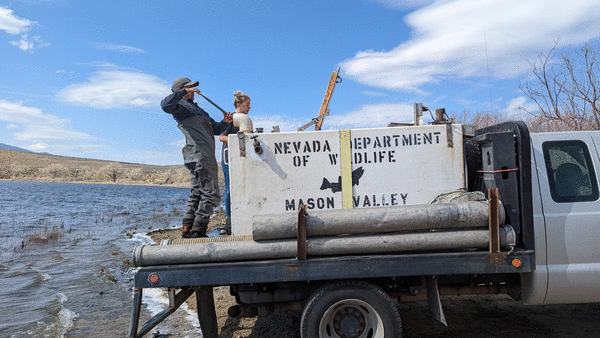
LAS VEGAS — Two Nevada agencies are in court over a water rights decision that could have major implications for a state-run fish hatchery in rural Lyon County during times of drought.
The Nevada Department of Wildlife has maintained a permit to pump 861.5 acre-feet of groundwater for its Mason Valley Fish Hatchery for decades, representing one of 13 permits that contributes about 15% of the facility’s water supply. The hatchery is north of Yerington, about 60 miles southeast of Carson City.
Now, after its water rights permit was canceled and later reinstated by the state engineer’s office due to a lapse in paperwork, the wildlife department worries for its ability to produce tens of thousands of trout each year to stock bodies of water in western Nevada. That’s because the reinstatement came with a new priority date.
Senior Deputy Attorney General Richard Yien wrote that the unusual dispute between two taxpayer-funded, state agencies cannot be resolved without the district court per a 2019 decision from the Nevada Supreme Court.
“Wildlife filed this Petition for Judicial Review not out of an inability to resolve differences between state agencies, but because only the District Court has authority to grant the requested equitable relief,” Yien wrote in a May 4 complaint on behalf of the Wildlife Department.
A spokesperson for the attorney general’s office declined to comment. Spokespeople for the Wildlife Department and state engineer’s office did not return requests for comment Monday.
Wildlife officials contended in the complaint that they did not file the necessary paperwork for a permit extension because of personnel changes and the impact of a ransomware attack on the state that affected IT systems.
In Nevada and much of the American West, water rights follow a “first in time, first in right” principle, or the prior appropriation doctrine.
The original 1967 date for the permit is much more desirable than the new 2025 date; if the state engineer ordered curtailment for the Lyon County basin, more junior water rights holders would be the first to experience cuts.
And losing any significant amount of water could be a death knell for the facility and its fish, Yien wrote in a legal complaint.
“The hatchery would have to operate with lower water volumes and at a less efficient capacity thereby directly impacting fish health,” Yien wrote. “Reduced flow would lead to overcrowding, increased stress, and contribute to the spread of disease within the fish population.”
The complaint adds: “In turn, Wildlife would be unable to stock our waterways with fish that also impacts its ability to support youth fishing events, fulfill commitments tied to biological research, and maintain recreational opportunities that bring millions of dollars into Nevada’s economy, with much of that flowing into rural counties.”
Overall, the fear of curtailment is not unfounded.
Even though the state engineer predicts it could deliver 25,000 acre-feet of water from the Mason Valley basin per year, the groundwater is committed on paper to the tune of 159,593 acre-feet, according to a legal complaint.
_____
©2026 Las Vegas Review-Journal. Visit reviewjournal.com.. Distributed by Tribune Content Agency, LLC.






Comments