Former cops describe Venezuela torture system at human rights court hearing
Published in News & Features
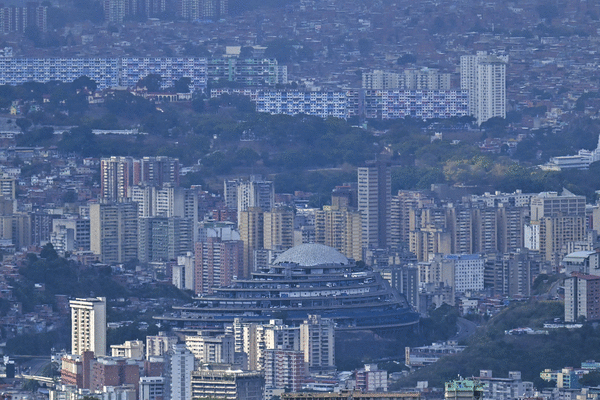
For more than 40 days, the former Venezuelan police officers said, two of their colleagues simply vanished inside El Helicoide.
No lawyer could find them. No relatives knew where they were. The guards refused to answer questions.
Then one afternoon, after weeks without sunlight, some of the detainees were marched through a corridor inside the sprawling headquarters of Venezuela’s intelligence police.
What they saw waiting there, they testified last week before the Inter-American Court of Human Rights, still haunts them years later.
Curled into a fetal position beside a railing was one of the missing officers, César Mijares. His head and arms were wrapped in newspaper and adhesive tape. He was handcuffed, barely conscious and pleading for help.
“They’re killing me,” former Chacao police Officer Ángel Alfonso Sánchez Blanco recalled hearing Mijares scream. Chacao is one of the main subdivisions of Caracas.
Systematic torture
The testimony, delivered during a landmark hearing before the hemisphere’s top human rights tribunal, offered one of the most detailed public accounts yet of what former detainees describe as systematic torture, forced disappearances and political persecution inside El Helicoide — the notorious Caracas detention center operated by Venezuela’s Bolivarian National Intelligence Service, known as SEBIN.
Together, the testimonies paint a broader portrait of how Venezuela’s judicial system, according to former detainees and their lawyers, evolved into a central instrument of political repression under Caracas’ socialist regime — one used to criminalize dissent, intimidate opponents and tighten the government’s control over society.
Former officers described courts issuing release orders that intelligence officials ignored with impunity, prosecutors pursuing cases without evidence and security agencies using prolonged detention, torture and public accusations to impose political obedience.
The hearings also underscored how many of the officials accused of overseeing those abuses remain in positions of power today, even after strongman Nicolás Maduro was captured in Caracas by U.S. forces during a January operation that triggered a dramatic political transition in Venezuela.
Following Maduro’s capture, Vice President Delcy Rodríguez assumed the presidency as head of an interim government that Washington has backed as part of what U.S. officials describe as a phased transition process aimed at stabilizing the country, reopening institutions and steering Venezuela toward elections.
But for many of the former detainees, the new political reality has done little to ease fears, because the security apparatus responsible for years of repression remains largely intact.
When asked during the hearings who he considered most responsible for what had happened to him, Sánchez Blanco identified Gustavo Enrique González López — the powerful military intelligence figure who simultaneously served as interior minister and SEBIN chief during the officers’ detention.
According to Sánchez Blanco, González López oversaw the machinery that allowed arbitrary arrests, torture and the defiance of judicial release orders to occur.
The issue has gained renewed attention because González López was recently appointed defense minister by Rodríguez, a move critics say illustrates how deeply entrenched figures linked to past human rights abuses remain within Venezuela’s power structure.
Rodríguez has publicly sought to distance her interim government from some of the most notorious symbols of repression associated with the Maduro era.
Earlier this year, she announced that El Helicoide would be shut down permanently and converted into a memorial site dedicated to victims of political persecution. But witnesses appearing before the court said the closure has done little to halt abuses, arguing that torture operations and arbitrary detentions have simply been transferred to other military and intelligence facilities across the country.
Prolonged torture
Several former officers testified that widespread human rights violations continue in Venezuela despite the political transition, with detainees still being held incommunicado, tortured and denied due process in centers such as Fuerte Guaicaipuro and Rodeo I.
Over several days, former officers of the Chacao municipal police force described beatings with baseball bats, suffocation with plastic bags, electric shocks, prolonged isolation, starvation and months of imprisonment despite judicial release orders that they say intelligence officials openly refused to obey.
In interviews with the Miami Herald, lawyers representing the victims said the proceedings marked an unprecedented moment in the regional court’s history because it was the first time the tribunal directly heard allegations involving political prisoners tortured inside El Helicoide.
“This is the first time the Inter-American Court of Human Rights has heard a case involving political prisoners and torture at El Helicoide in Venezuela,” said Génesis Dávila, president of Defiende Venezuela.
The court an autonomous judicial institution based in San José, Costa Rica, established in 1979 to promote and protect human rights across Latin America.
The case, known as PoliChacao vs. Venezuela, centers on the detention of 14 officers arrested after the 2016 killing of pro-government journalist Ricardo Durán.
According to testimony presented before the court, the officers voluntarily surrendered after senior Venezuelan officials publicly accused members of the opposition-controlled Chacao police force of participating in the homicide.
But several witnesses testified that authorities never produced credible evidence linking them to the crime.
Instead, the former officers say they became targets in a broader political campaign aimed at dismantling one of Caracas’ most opposition-aligned police departments during a period of intensifying anti-government protests.
No legal protections
Former Officer Fred Armando Mavares Zambrano testified that between 18 and 21 officers presented themselves at the headquarters of Venezuela’s criminal investigations police after the interior minister at the time, Gustavo González López, nnounced at a televised press conference that 14 Chacao officers would be charged.
According to Mavares, investigators then arbitrarily selected which officers would remain detained.
“We didn’t even know who the 14 officers were supposed to be,” he testified.
The detainees said they spent their first days sleeping on the floor of a narrow hallway without access to bathrooms or water before being transferred to El Helicoide.
What followed, they testified, was a descent into a system where legal protections effectively ceased to exist.
Sánchez Blanco described being taken into an interrogation room containing buckets of water, baseball bats, electric devices, adhesive tape and roach spray. Officials allegedly demanded that he record a video implicating fellow officers and then-Chacao Mayor Ramón Muchacho, an opposition leader who later fled Venezuela.
When he refused, Sánchez Blanco said, officers immobilized him with tape and newspaper before beating him and suffocating him with plastic bags while spraying insecticide inside and hitting him with electric jolts.
“They told me I was going to pay for that dead man (the pro-government journalist) if I didn’t record the video,” Sánchez Blanco testified.
Several witnesses said the abuse extended beyond physical torture.
Inside El Helicoide, detainees described living under constant white fluorescent lights that never turned off, isolated from sunlight and uncertain whether they would disappear next.
Venus Soleil Medina Ferrer, one of the female officers detained in the case, testified that women were held in extreme overcrowding with spoiled food, scarce water and almost no medical attention.
At one point, she said, 32 women shared cells with only two bathrooms.
The screams coming from interrogation rooms upstairs became part of daily life.
“We lost our dignity inside that place,” Medina Ferrer testified.
The hearings repeatedly pointed to senior Venezuelan officials as politically responsible for the persecution campaign, including Maduro, National Assembly President Jorge Rodríguez — Delcy Rodriguez’s brother — and González López.
Witnesses also described how Venezuelan courts became powerless once intelligence officials decided detainees would remain imprisoned.
According to testimony, prosecutors eventually requested the officers’ release after finding insufficient evidence.
Center of political repression
Even though judges issued release orders, SEBIN ignored them anyway, witnesses said.
Some detainees remained jailed for more than a year after courts ordered their freedom.
The former officers responded with hunger strikes. Some sewed their lips shut.
Others, like Mavares, eventually escaped.
Now scattered across Spain, Germany and other countries, the former officers told the court they lost careers, homes, marriages and years with their children.
One officer who later returned to Venezuela was detained again and is currently being held under deteriorating conditions, according to Dávila.
Human rights organizations have for years accused El Helicoide of functioning as one of Venezuela’s principal centers of political repression.
But the hearings also marked something different: survivors publicly reconstructing, in extraordinary detail, what they say happened inside one of Latin America’s most feared detention centers.
The case has already been reviewed by the Inter-American Commission on Human Rights, part of the Organization of American States, which concluded that the Venezuelan government bears international responsibility for the violations.
The victims are asking the court to order comprehensive reparations, medical and psychological treatment, guarantees against future abuses and the permanent closure of El Helicoide.
_____
©2026 Miami Herald. Visit miamiherald.com. Distributed by Tribune Content Agency, LLC.






Comments