American Airlines, Iberostar settle suits over Cuba properties seized from Cuban Americans
Published in News & Features
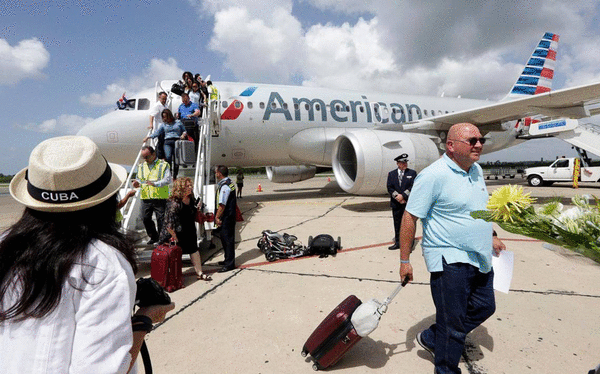
American Airlines and Spanish hotel chain Iberostar have settled lawsuits brought by Cuban Americans who inherited property confiscated by the Cuban government six decades ago, in another blow to foreign companies investing or doing business on the island.
American was the first air carrier to be sued, accused of trafficking in confiscated property in 2019, when President Donald Trump, in his first term, enacted a previously suspended provision of the 1996 Helms-Burton law.
The company was sued by José Ramón López Regueiro, the son of José López Vilaboy, a businessman who was close to Cuban dictator Fulgencio Batista in the 1950s and who owned what is now Havana’s José Martí International Airport.
According to the lawsuit filed by the Miami-based Rivero Mestre law firm, López Vilaboy bought the airport land from its previous owner, Pan American Airways, in 1952 for $1.5 million. The Cuban businessman then modernized the runway and built the airport terminal that he renamed José Martí. The airport was confiscated shortly after Fidel Castro took power in January 1959.
Iberostar, a Spanish company that has partnered with Cuba’s military-owned tourism company Gaviota and other government companies to manage several hotels on the island, was sued by the heir of Dolores Martí Mercade and Fernando Canto Bory, the owners of a hotel named “El Imperial” in Santiago de Cuba, which was later rebranded as Iberostar Heritage Imperial. A law firm in Coral Gables, Florida, Zampano Patricios, represented the heirs in court.
Iberostar settled last year and American Airlines early this year, but the agreements had not been made public. They were first reported by the New York-based U.S.-Cuba Trade and Economic Council over the weekend.
The news of the agreements adds to the increasing uncertainty for foreign businesses in Cuba, after the Trump administration ramped up the pressure on the Cuban government and threatened foreign companies and banks partnering with the Cuban government with sanctions. Canada’s mining company Sherritt International has already announced it is suspending its operations on the island.
Two similar lawsuits — one against four cruise companies that docked at the port of Havana, the other one against Cimex, the largest umbrella company in the Cuban military conglomerate known as GAESA — are before the U.S. Supreme Court, and a ruling is expected soon. Experts believe a favorable ruling for the Americans who sued over confiscated properties could further deter foreign investors from doing business in Cuba until the claims are settled in negotiations between the two governments. Until that moment, companies landing at the international airport in Havana, for example, could face similar lawsuits.
Delta Air Lines is also a defendant in a separate lawsuit filed by López Vilaboy in November last year.
The claims issue was discussed in a meeting between senior State Department officials and Cuban government representatives last month in Havana.
The settlements come after years of fierce and expensive court battles, which highlighted the difficulties in interpreting a legal provision that was first enacted several years after it was written into law. President Bill Clinton signed the Helms-Burton Act, also known as the Cuba Liberty Act, into law in 1996, but then suspended a part of it, Title III, which grants U.S. nationals the right to sue companies benefiting from confiscated property in Cuba. Every president had suspended that part of the law it until Trump enacted it in 2019.
The lawsuit against American Airlines had been dismissed by a federal court in Miami in 2022 because López Vilaboy was not a U.S. citizen when he inherited the claim, and his father was not a U.S. citizen when the airport was confiscated. But the Helms-Burton law does not state those citizenship requirements, and the trial court’s decision was overturned in an appeals court.
_____
©2026 Miami Herald. Visit miamiherald.com. Distributed by Tribune Content Agency, LLC.






Comments